Somerset tax ditch easement violations and drainage fixes
Roughly 183,000 acres of Eastern Shore farmland, forest, roadway, and residential property drain through about 821 miles of publicly maintained tax ditches across Maryland’s Eastern Shore counties.
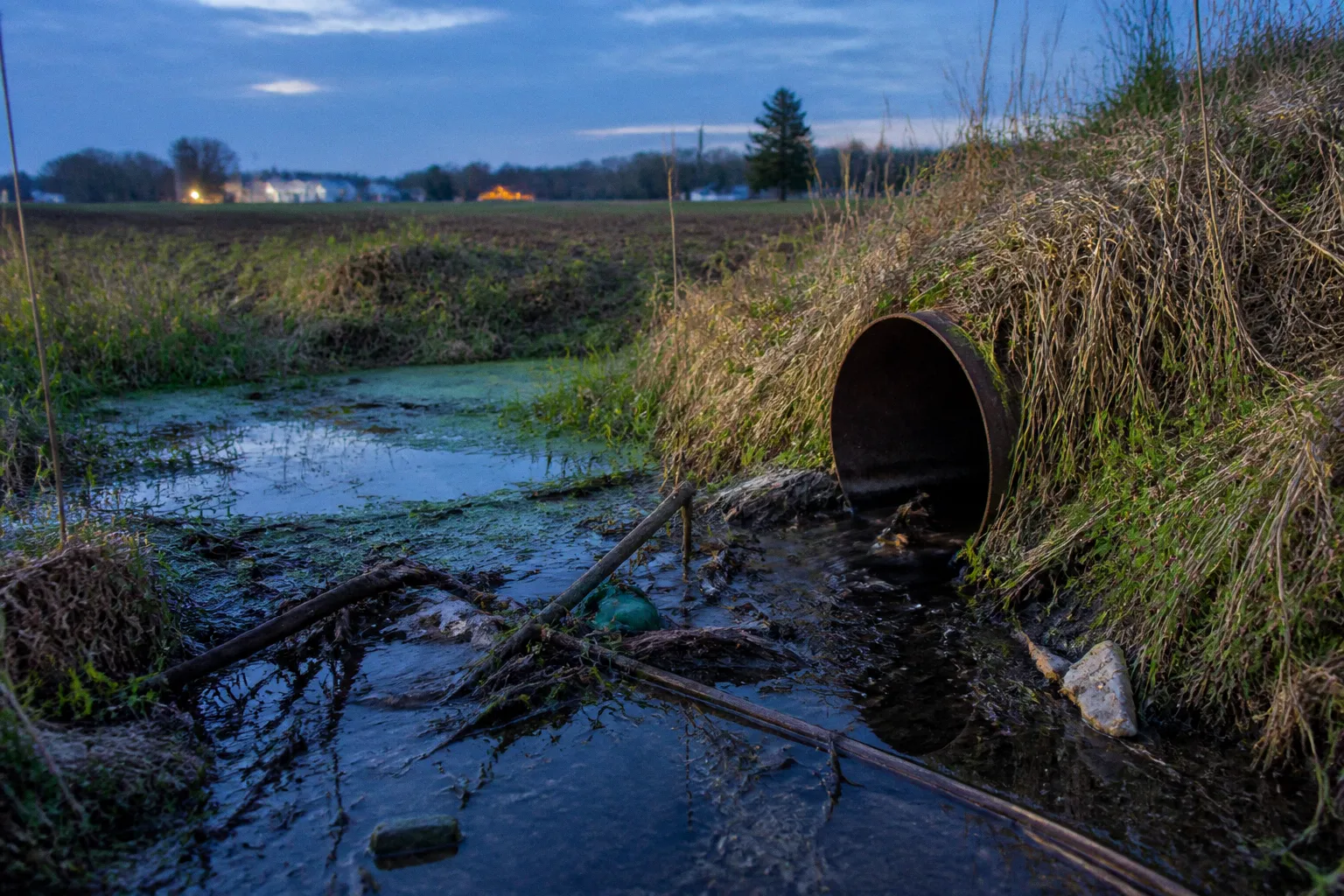
In Somerset County, that network can be the difference between a passable harvest and a flooded field, between a livable rural road and a closure after a nor’easter.
When an easement is violated—a fence driven into the channel, a shed built across the access corridor, or a row of trees planted where an excavator needs to swing—the ditch does not necessarily fail all at once. It backs up. It silts in. Water moves onto someone else’s land, and the cost of correcting the problem eventually reaches the drainage association, the affected landowners, or both.
The rules covering these ditches are not suggestions. They are codified in Maryland’s Local Government Title 26, administered through independent Public Drainage Associations and Public Watershed Associations, and supported by the authority of boards of managers to impose assessments on the parcels that benefit from the system.
A parcel subject to a recorded PDA or PWA easement is bound by the terms of that easement whether the current owner has read the deed or not. The recorded document, not a general assumption about how drainage works in the county, determines the rights of access and the restrictions on the property.
That is the point many property owners miss: a tax ditch easement is not simply an unused strip of land behind a field or along a property line. It is working infrastructure. The corridor must remain available for mowing, excavation, spoil placement, culvert repairs, and other maintenance. When it is narrowed or blocked, the impact can travel well beyond the parcel where the obstruction began.
The Legal Framework of Public Drainage Associations in Maryland
Public Drainage Associations, or PDAs, and Public Watershed Associations, or PWAs, are not ordinary county departments. They are independent governmental entities created under Maryland statute and governed by boards of managers elected by the landowners in their drainage district. The legal history of organized public drainage in Maryland reaches back centuries. The modern statutory structure dates to 1957, with substantial revisions in 2013 that moved the PDA statutes into Title 26 of the Maryland Code’s Local Government Article.
Tax ditches are not private ditches. They are public infrastructure with easements, budgets, and enforcement authority.
Somerset County is part of a larger Eastern Shore drainage system overseen by the Maryland Department of Agriculture in cooperation with local associations. Across the five Eastern Shore counties carrying the bulk of the network—Somerset, Caroline, Queen Anne’s, Wicomico, and Worcester—there are 101 active PDAs and four PWAs maintaining 821 miles of channel.
The distinction between the two types of association matters. PWAs address larger watershed-scale systems. PDAs generally operate the smaller lateral and field-tile networks that move water toward those larger channels. The structures differ from one district to another, so a property owner cannot assume that a rule or procedure used by one association automatically applies to another.
The Somerset share of the total mileage, along with a precise county-only count of associations, is not published in a single document. A current county-wide total of outstanding easement-violation fines is not available as a general public figure either. Anyone who needs that level of detail has to work from the circuit court land records, the relevant association’s charter, its Operation and Maintenance Plan, and records held by the association or the Maryland Department of Agriculture.
The statutory framework gives a drainage association several essential powers:
- It may hold an easement or right-of-way across private land for the ditch and related maintenance work.
- It may enter the easement with equipment needed to maintain the channel and banks.
- It may assess the landowners who benefit from the drainage system.
- It may enforce the recorded access corridor when an obstruction prevents proper maintenance.
- It may recover certain costs associated with clearing an obstruction or correcting work that was performed without approval.
Boards are also required to maintain a current Operation and Maintenance Plan approved by the Maryland Secretary of Agriculture. They must file an easement record with the clerk of the circuit court identifying the maintenance easements and rights-of-way within the system. Under Maryland Code, Local Government § 26-601, the easement record must show a corridor not less than 20 feet wide, or wider when the original design called for a wider corridor.
That minimum is a legal reference point, not a universal description of every ditch in Somerset. The recorded easement controls. A particular reach may have a wider corridor, additional access language, a designated spoil area, or special provisions for crossings and vegetation. The statute establishes the framework; the association’s records determine how that framework applies to the parcel.
A property owner should also separate three questions that are often collapsed into one:
1. Who owns the land? An easement usually does not transfer the underlying ownership of the parcel.
2. Who holds the maintenance right? The recorded document identifies the association’s right to enter, operate, repair, or maintain the drainage system.
3. What use is allowed? The owner may retain ordinary use of the property, but that use cannot defeat the purpose of the easement.
That distinction is why a landowner can remain responsible for a fence or structure on privately owned ground. Ownership and unrestricted use are not the same thing.
Understanding Easement Rights and Maintenance Access Requirements
The easement is the load-bearing element of the drainage system. Without a recorded corridor of usable width, an excavator cannot reach the ditch, a mower cannot keep the banks clear, and accumulated sediment cannot be removed efficiently. Every later maintenance decision depends on access remaining available.
The 20-foot figure is a floor, not a ceiling. Some original Somerset drainage easements were drawn at 30, 40, or more feet to accommodate the equipment used when the channels were constructed. The easement recorded in the circuit court is what governs, not the minimum width alone.
That distinction is important when a property owner measures only the visible ditch. The legal corridor may extend beyond the water itself and include the top of the bank, equipment travel area, spoil placement, and the turning space needed to perform maintenance. A fence can be outside the channel and still be inside the easement. A tree can be rooted on the edge of a bank and still interfere with the equipment needed to clear the reach.
The practical access questions usually concern three related issues:
- Equipment access. A tracked excavator needs clear, reasonably stable ground to sit, travel, and swing its boom. The exact space depends on the machine and the terrain, but a narrow corridor can become unusable long before the ditch itself disappears.
- Spoil placement. Excavated sediment has to go somewhere. Historic easements were often designed with room for spoil on one or both sides of the channel. If that area is occupied by landscaping, a fence, a driveway, or a structure, the association may need to haul the material away or find another approved placement area.
- Vegetation management. Trees and large shrubs can obstruct a mowing path, interfere with an excavator’s reach, and contribute leaves, roots, and woody debris to the channel. Whether vegetation may be removed depends on the recorded easement and the applicable Operation and Maintenance Plan, but planting inside the working corridor is not a harmless landscaping decision.
The right to enter does not mean the association can ignore the recorded boundaries. It means the association has an enforceable maintenance interest in the corridor that the landowner must not defeat. A board, contractor, or landowner who is uncertain about the boundary should work from the recorded map and legal description rather than relying on a fence line, an old aerial image, or what a previous owner believed the easement covered.
A drainage easement also does not transfer general ownership of the parcel to the association. The landowner may continue to use the property, but that use is limited by the easement’s purpose. Ordinary activities outside the working corridor may have no effect on maintenance. A permanent obstruction inside the corridor is different because it prevents the public drainage system from performing the function for which the easement exists.
Why a narrow corridor becomes a hydraulic problem
A blocked access route first creates a maintenance problem, but the maintenance problem becomes a hydraulic one. If equipment cannot reach the banks, vegetation and sediment remain in place. The channel gradually loses effective cross-sectional area. Water moves more slowly, backs up sooner, and can spill into fields, yards, or road approaches that were not designed to carry it.
The effect is not necessarily proportional to the size of the obstruction. A single crossing with an undersized or crushed pipe can act as a dam during a heavy storm. A fence that prevents regular mowing can leave a reach unmanaged for long enough that woody growth and sediment make later work more difficult. A patch of fill placed in the channel reduces the available flow area immediately, even if the fill appears small from the road.
That is why a board may treat an obstruction as a system issue rather than a private disagreement between two neighbors. The ditch is a connected network. Water does not stop at the property line, and neither does a blocked reach.
An access dispute can also become harder to resolve when it is left until the next maintenance cycle. A board may have scheduled equipment, contractor availability, spoil-handling arrangements, and a plan for reaching several connected segments. If one parcel cannot be entered because a structure or fence blocks the corridor, the association may have to postpone work, use more expensive equipment, or return to the area after another obstruction has been addressed.
The cost is not limited to the item that caused the problem. It can include additional mobilization, hand clearing, material removal, repairs to a crossing, or work needed to restore the bank after unauthorized grading. Whether a particular cost can be charged to an owner depends on the governing statute, the recorded documents, the association’s procedures, and the facts of the violation.
Common Obstructions and Their Impact on Regional Drainage
The most common violations are familiar across the Eastern Shore. They usually begin as ordinary property decisions: securing livestock, adding a driveway, planting trees, storing equipment, or making a yard appear more finished. The conflict arises when the decision occupies ground reserved for public drainage maintenance.
| Obstruction type | Typical encroachment | Drainage or maintenance consequence | What must be verified |
|---|---|---|---|
| Fences | Post-and-wire or privacy fencing placed across or along the corridor | Blocks mowing and equipment movement; may divide the working area into unusable sections | The recorded easement line and any approved crossing or gate provision |
| Structures | Sheds, decks, HVAC pads, docks, or other permanent improvements | Eliminates access for heavy equipment and may require removal before maintenance | Whether the structure lies within the easement and whether written approval exists |
| Vegetation | Trees, hedges, large shrubs, or volunteer growth within the working width | Restricts the boom and mower path, anchors sediment, and adds debris to the channel | The association’s vegetation rules and the reach-specific Operation and Maintenance Plan |
| Fill | Dirt, gravel, yard waste, or construction material pushed toward or into the channel | Reduces the channel cross-section and can redirect or raise water | Whether the material is inside the channel, bank, spoil area, or easement |
| Unauthorized crossings | Driveways, culverts, bridges, or ATV ramps installed without association approval | An undersized, crushed, or poorly placed crossing can restrict flow and trap debris | The plan’s crossing requirements and the board’s written authorization |
The timelines shown in informal property discussions should not be treated as engineering rules. A fence does not become a drainage failure after a fixed number of years, vegetation does not follow a universal deterioration schedule, and fill does not require a particular number of storms before it causes damage. Soil, slope, rainfall, channel geometry, maintenance frequency, and the type of obstruction all change the result.
The safer way to assess risk is to look at function:
- Can the association’s equipment reach the ditch and both banks?
- Can water pass through the channel and any crossing without backing up?
- Is sediment being deposited because the flow path has narrowed?
- Does the obstruction force water toward a neighboring parcel?
- Can the board perform scheduled maintenance without moving private property first?
- Does the work comply with the specific Operation and Maintenance Plan for that reach?
A blocked easement does not necessarily affect only one property. It can back up parcels upstream of the obstruction and overload low points downstream. In Somerset’s low-lying fields, that can mean delayed planting, standing water in cropland, damage to rural road approaches, and additional pressure on ditches already affected by tidal conditions.
An unauthorized crossing deserves particular caution. A culvert may look adequate during ordinary weather and still restrict flow when a storm brings debris or when water levels rise across the network. The relevant question is not simply whether a vehicle can pass over it. The crossing must preserve the drainage function and leave enough access for the association to inspect, clear, repair, or replace it.
The question is not whether an obstruction looks small from the road. The question is whether the drainage association can still reach the ditch and move water through it.
A landowner should also avoid assuming that a neighbor’s existing obstruction establishes a precedent. Older encroachments may predate the current plan, may be subject to a separate agreement, or may simply have gone unaddressed. The presence of one fence or culvert is not written permission for another.
Fences and gates
Fences create a recurring problem because they appear easy to work around. In practice, a fence can prevent a mower from reaching the bank, leave no safe route for an excavator, or require workers to dismantle and rebuild part of the line. A gate may improve access, but its usefulness depends on location, width, condition, and whether equipment can approach it without crossing another obstruction.
A landowner planning a fence near a ditch should identify the full recorded corridor first. Keeping posts out of the channel is not enough if the fence still divides the maintenance route. If a crossing is necessary for livestock or vehicles, the owner should address it with the association before construction and keep the approval in writing.
Landscaping and trees
Landscaping is often treated as reversible, but mature trees and dense hedges are not simple to move when a maintenance crew arrives. Roots can destabilize or bind the bank, while fallen limbs and leaf accumulation can collect at culverts and crossings. A line of trees may also prevent the association from placing excavated material where the original design anticipated it would go.
The issue is not that every plant near a ditch is prohibited. The issue is whether the planting occupies or compromises the working corridor. The answer comes from the recorded easement and the applicable maintenance plan, not from the owner’s view of where the ditch appears to end.
Fill, grading, and construction
Adding soil or gravel near a ditch can change the way water reaches the channel even when no material is deliberately placed in the water. Grading may eliminate a shallow overland route, push runoff toward a neighboring property, or reduce the space available for equipment. A shed, deck, pad, or other improvement can create a permanent conflict that becomes visible only when maintenance is needed.
Before grading or construction, an owner should provide the association with enough information to locate the proposed work against the easement. A sketch, survey, or site plan may be necessary where the corridor is not obvious. The goal is not to create paperwork for its own sake. It is to prevent a private improvement from becoming a public drainage problem.
Landowner Responsibilities and the Role of the Board of Managers
The board of managers operates the PDA much like a small public-works utility. It sets the maintenance budget, arranges contractors, keeps the association’s records, and collects assessments from the parcels that benefit from the drainage system. Landowners in the district elect the board from among themselves, and the assessments fund the work.
The board’s responsibilities include:
- Maintaining a current Operation and Maintenance Plan approved by the Maryland Secretary of Agriculture.
- Filing and maintaining the easement record with the Somerset County circuit court clerk.
- Holding at least one annual meeting of the benefited landowners.
- Levying assessments against parcels according to the association’s classifications and the proportional benefit received from the system.
- Authorizing entry onto easement lands for maintenance.
- Addressing obstructions that prevent the association from carrying out that maintenance.
- Coordinating, where appropriate, the correction of a violation with scheduled work on the same reach.
The board does not have to accept an encroachment as permanent simply because it has existed for years. A fence, structure, planting, or crossing can remain a violation if it occupies the recorded corridor without authorization. The fact that several owners have tolerated it, or that a previous board did not act, does not automatically change the easement.
At the same time, enforcement should begin with the records and the actual location of the obstruction. A board needs to know which easement applies, what the plan requires, and whether the alleged violation is inside the corridor. A landowner receiving a notice should ask for that information rather than relying on an argument about how the property has traditionally been used.
For the typical Somerset landowner, the practical duties are limited but non-negotiable:
1. Determine whether the parcel lies within a PDA or PWA district. The Somerset County planning office, the circuit court land records, and the relevant association can help identify the district.
2. Read the easement record before changing the property. Fencing, planting, grading, construction, and driveway work can all affect maintenance access.
3. Contact the board before installing work inside or across the corridor. Written approval is the safest way to establish what was proposed, what conditions apply, and who is responsible for future repairs.
4. Keep crossings clear and functional. A crossing must accommodate water and maintenance access, not merely vehicle traffic.
5. Pay the annual assessment. These charges support the maintenance program. Unpaid assessments can accumulate and may lead to a lien on the parcel.
6. Do not place fill, yard waste, equipment, or building materials in the working corridor. Temporary storage can become an obstruction if maintenance crews cannot use the space when they arrive.
7. Preserve access after a property transfer. A buyer should receive the easement information, and a seller should not describe the corridor as unrestricted yard, pasture, or surplus land.
The board’s role is not simply to issue violation notices. It also has to maintain a workable system. That means identifying priority reaches, coordinating access, communicating with affected owners, and distinguishing between a minor maintenance inconvenience and an obstruction that threatens the function of the channel.
A constructive notice should identify the claimed obstruction, the relevant easement or maintenance requirement, and the correction the board is seeking. Where the facts are disputed, the owner should have a reasonable opportunity to provide a survey, approval, or other record showing why the work is permitted. A clear paper trail protects the association and the landowner alike.
If voluntary correction fails, the association may have statutory or legal remedies. The precise route depends on the association’s governing documents, the nature of the obstruction, and the applicable law. The existence of enforcement authority does not make every dispute simple. Boundary questions, historical agreements, environmental constraints, and questions about responsibility for a crossing can all require professional review.
Navigating Compliance and Operation Plans for Somerset Properties
The most reliable way to prevent a tax ditch dispute is to treat the easement as part of the property’s operating documents. It belongs in the same due-diligence folder as the survey, septic information, flood-related records, and restrictions affecting construction.
A property owner considering work near a ditch should proceed in an order that answers the location question before the construction question.
Start with the recorded documents
Begin with the land records for the parcel and the association’s easement record. Look for the legal description, map, stated width, access language, maintenance rights, and provisions concerning crossings or spoil. If the document refers to a plat or earlier instrument, that referenced material may be necessary to understand the corridor.
Aerial imagery can help locate the visible ditch, but it is not a substitute for the recorded easement. Banks shift, channels are reshaped, and property features move. A line that looks correct on a recent image may not match the legal description.
Where the corridor cannot be located confidently, a surveyor may be needed. That is especially true before placing a permanent structure or installing a fence that would be expensive to relocate.
Read the Operation and Maintenance Plan
The Operation and Maintenance Plan turns a broad easement right into operating instructions for the association’s system. It may address mowing, excavation, access, vegetation, crossings, spoil, and other recurring maintenance issues. The plan for one association or reach should not be treated as a universal rule for every Somerset property.
A landowner seeking approval should ask practical questions in writing:
- Where may equipment enter and turn?
- Is a gate required, and what dimensions or access conditions apply?
- Can a driveway cross the ditch, and what culvert or bridge design is acceptable?
- Where may excavated material be placed?
- Are trees or shrubs allowed within any portion of the corridor?
- Who repairs a crossing damaged during maintenance or ordinary use?
- What must be removed before scheduled work begins?
The answers may depend on the association’s records and the physical reach. Written communication is valuable because informal permission can be misunderstood by a later owner, board, contractor, or neighbor.
Coordinate before a violation becomes a project delay
Owners frequently contact the association only after a contractor has arrived or a permit application has been filed. By then, the proposed work may already conflict with the access route. Early coordination gives the board a chance to review the location, identify alternatives, and determine whether conditions can make the work compatible with maintenance.
This matters for more than large construction. A small driveway extension, a new livestock fence, a row of ornamental trees, or a grading project can occupy the same ground needed for a maintenance machine. The earlier the conflict is identified, the more options remain.
A compliant design may involve moving the improvement outside the corridor, using a removable gate, preserving a specified access lane, replacing an existing crossing, or agreeing on conditions for future maintenance. None of those solutions should be assumed without the association’s review.
Responding to an alleged obstruction
A landowner who receives a notice should not ignore it, but neither should the owner remove or alter a structure without understanding the claim. The first response should be documentary and specific:
1. Ask for the recorded easement, map, or plan provision being relied upon.
2. Compare the claimed corridor with a current survey or reliable site information.
3. Identify the feature at issue and whether it was approved by a prior board or association.
4. Ask what correction is required and by what process.
5. Keep copies of notices, photographs, approvals, contractor estimates, and communications.
6. Obtain legal or surveying advice when the location, title, or enforcement authority is disputed.
If a blockage is causing active flooding, the owner should communicate the urgency rather than waiting for the next regular meeting. Emergency conditions may require a different response from routine maintenance, but urgency does not erase the need to document what was done and who authorized it.
The same discipline applies to a landowner reporting a neighbor’s obstruction. Photographs can show the condition, but they do not establish the easement boundary or prove that a particular owner caused the drainage problem. The association should be given the location, the observed effect on water or access, and any available information about the parcel. The board can then compare the complaint with its records and maintenance responsibilities.
Assessments and the cost of correction
A PDA is funded through assessments on parcels that benefit from the system. Those assessments are not a fee for optional landscaping or a private service ordered by one owner. They support a shared drainage network whose maintenance benefits the district in different ways.
An assessment does not automatically authorize a landowner to use the easement as a private driveway, storage strip, or building site. Payment supports the system; it does not cancel the restrictions needed to operate it.
Conversely, an owner should not assume that paying the assessment transfers every maintenance responsibility to the association. The recorded easement, the association’s plan, and the circumstances of the work determine who must keep a crossing clear, remove an unauthorized obstruction, repair damage, or bear additional costs caused by noncompliant work.
The safest approach is to ask the board before work begins and to obtain a written explanation of any cost allocation. If a violation has already been identified, delaying corrective work can increase the expense and complicate the association’s next maintenance cycle.
Keeping a Somerset Drainage Easement Usable
The central rule behind Somerset County tax ditch easement rules is straightforward: a property owner may own the ground, but cannot use it in a way that defeats the recorded public drainage easement.
That does not mean every property near a ditch must remain empty. It means improvements have to be located, designed, and maintained with the drainage system in mind. A fence may be possible with a properly planned gate. A crossing may be possible if it preserves flow and equipment access. Vegetation may be manageable outside the working corridor. The answer comes from the particular easement and Operation and Maintenance Plan, not from a universal distance measured from the water’s edge.
For boards, the same principle works in the other direction. Enforcement is strongest when it is tied to the recorded documents, the physical maintenance need, and a clearly stated correction. Treating every disagreement as a neighbor dispute obscures the public function of the ditch; treating every uncertainty as proof of a violation creates a different kind of problem.
A tax ditch is easy to ignore when the weather is ordinary and the channel is carrying water quietly. Its value becomes visible when the system needs access, sediment removal, a repaired crossing, or a clear route through a storm. Keeping that access open is not a technical detail. It is the condition that allows the drainage association to protect the fields, roads, yards, and connected parcels that depend on the network.