Tax ditch maintenance in Somerset: five request steps
A Somerset County tax ditch maintenance request cannot be routed correctly until the drainage system is classified. The county’s jurisdiction generally extends to roadside ditches located within 15 feet of the centerline of a county road.
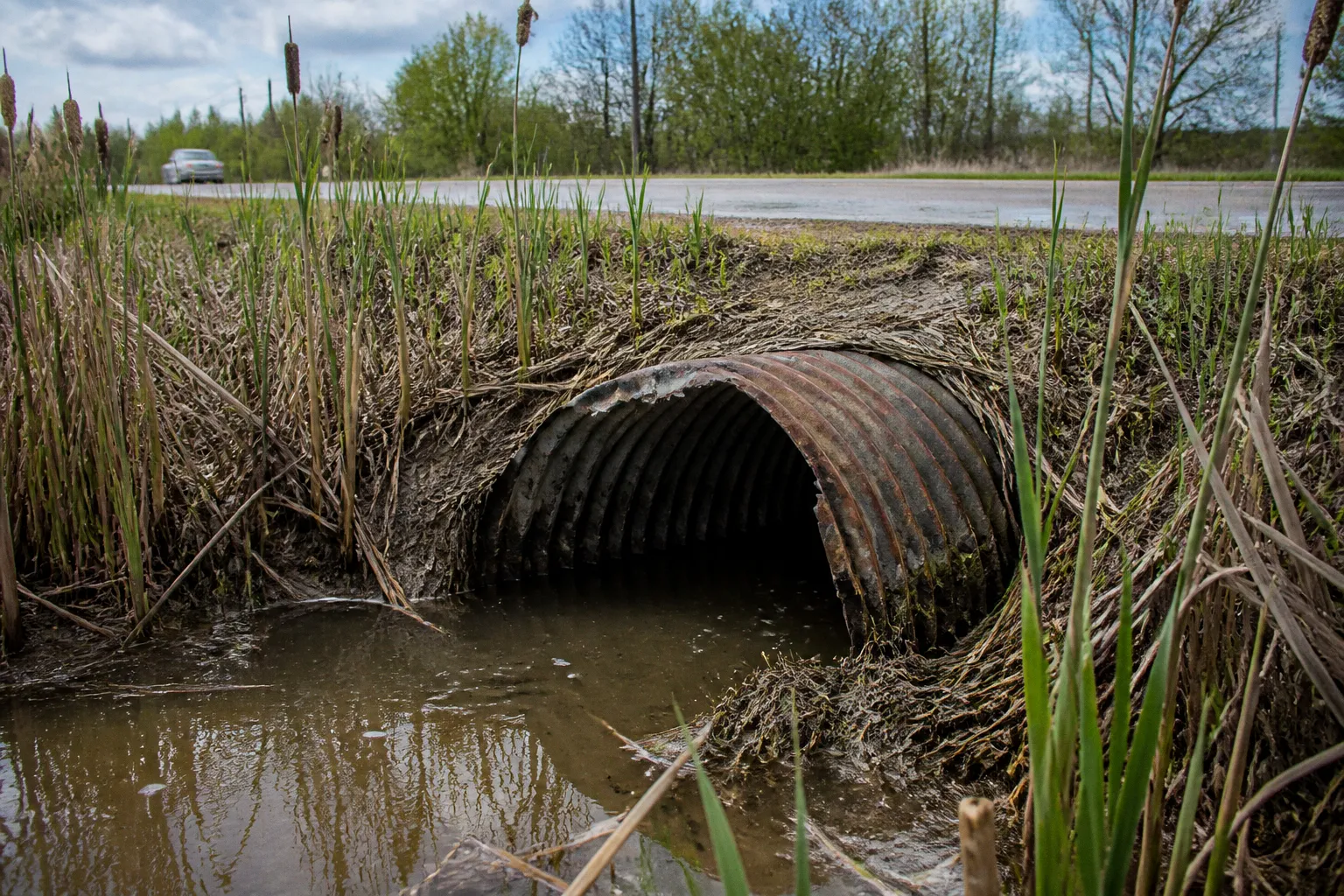
Drainage features beyond that boundary are generally assigned to the property owner or resident, unless the system is administered by an independent public drainage or watershed association.
The term “tax ditch” does not, by itself, establish county responsibility. Under Maryland’s public drainage framework, a tax ditch may belong to a public drainage association whose assessments are imposed on benefited land. These associations are independent governmental entities with drainage rights-of-way and easements. A resident must therefore identify the responsible entity before requesting maintenance, clearing, excavation, culvert replacement, or structural repair.
The following five-step sequence is a practical request procedure based on Somerset County drainage guidance and Maryland public drainage law. It is not presented as an official county form or a guaranteed county work order process.
1. Establish whether the ditch is roadside or off-road
The first classification is spatial. Measure the drainage feature from the centerline of the road, not from the edge of pavement, shoulder, property line, or driveway.
Somerset County identifies a ditch within 15 feet of the road centerline as a roadside ditch. The county’s Roadside Drainage Program administers drainage systems within the county road right-of-way. This may include:
- Open roadside ditches.
- Pipes and driveway culverts.
- Inlets and manholes.
- Tide gates.
- Other drainage structures located within the county road drainage system.
A ditch farther than 15 feet from the road centerline is generally treated as an off-road drainage feature. Routine maintenance in that area ordinarily remains the responsibility of the property owner or resident. The 15-foot boundary is a jurisdictional reference used by the county. It is not proof of ownership, an easement boundary, or a final legal determination of title.
This distinction matters because the same flooding symptom can arise from different systems. Water standing beside a driveway may be caused by a blocked roadside inlet, a collapsed driveway culvert, an off-road ditch with insufficient capacity, a tide gate problem, or a downstream restriction. Each condition produces a different responsible party and a different request path.
Preliminary site record
Before contacting an agency, document the physical location and the failure mode. The record should contain:
- The property address and nearest county road.
- The approximate distance between the ditch and the road centerline.
- Photographs taken from the road, driveway, upstream area, and downstream area.
- The date and duration of standing water.
- Whether the condition occurs after ordinary rainfall, high tide, or a major storm.
- The location of any culvert, inlet, manhole, tide gate, or crossing.
- The number of parcels that appear to rely on the same drainage channel.
- Any visible blockage, bank collapse, sediment accumulation, invasive vegetation, or debris.
- Whether the obstruction is located on private land, within the road right-of-way, or across multiple parcels.
A photograph of water in a yard is not sufficient to establish responsibility. The relevant evidence is the relationship between the feature, the road right-of-way, the drainage network, and the affected properties.
The controlling question is not who sees the water first. It is which entity controls the drainage feature at the point of failure.
2. Determine whether a public drainage association controls the system
A drainage feature described locally as a “tax ditch” may not be a Somerset County public works asset. Maryland law recognizes public drainage associations and public watershed associations that construct, operate, and maintain drainage systems serving benefited land. The system may include designated rights-of-way and easements that cross private parcels.
The Eastern Shore public ditch network is extensive. Maryland agricultural sources describe approximately 821 miles of public ditches across 101 public drainage associations and four public watershed associations, draining approximately 183,000 acres. Those figures demonstrate the scale of the system. They also establish why a county road department cannot be assumed to control every ditch visible in the county.
The association’s role may include:
- Maintaining an established public ditch.
- Managing drainage easements across benefited parcels.
- Collecting assessments from land receiving drainage benefits.
- Coordinating work through a board of managers.
- Exercising drainage rights established under the applicable public drainage structure.
- Addressing network-wide capacity or maintenance issues.
The responsible association may not be obvious from the property tax bill or from the ditch’s location. A drainage assessment may be separate from ordinary county charges. The reviewed guidance does not establish that every Somerset County tax ditch assessment is paid directly to Somerset County. That fact must be verified for the specific parcel and association.
How to identify the responsible entity
The Somerset Soil Conservation District is a local contact for information concerning public drainage and watershed associations. Its listed telephone number is 410-621-9310.
A request for identification should include the parcel address, tax account or parcel identifier if available, road name, photographs, and a short description of the drainage problem. The request should ask specifically whether the property lies within:
- A public drainage association.
- A public watershed association.
- A recorded drainage easement.
- A county roadside drainage system.
- A private drainage network.
- A regulated agricultural drainage project.
The objective is not to obtain a general explanation of Maryland tax ditch laws. The objective is to identify the governing drainage entity for the affected channel and the procedure for submitting a maintenance request.
Roadside, off-road, and association-controlled drainage
| Drainage condition | Presumptive responsible entity | Initial contact path | Principal limitation |
|---|---|---|---|
| Ditch within 15 feet of the county road centerline | Somerset County Roadside Drainage Program | Woody Barnes, 410-651-1930 | The boundary indicates county jurisdiction for roadside drainage; it does not establish ownership or easement limits |
| Ditch outside the county road right-of-way | Property owner or resident for routine maintenance | Somerset County Off-road Drainage Program for possible assistance | County assistance is discretionary and depends on affected properties, design, easements, and permits |
| Public drainage or watershed association ditch | Independent public drainage or watershed association | Somerset Soil Conservation District, 410-621-9310, for association information | The county does not automatically maintain the association’s drainage network |
| Driveway culvert connected to county drainage | Property owner, with possible county technical or limited financial assistance | Woody Barnes, 410-651-1930 | Assistance does not establish a guaranteed replacement schedule or funding level |
| Ditch crossing several private properties | Responsible association, property owners, or county program depending on location | Confirm entity before work begins | Neighbor permissions and drainage easements may control access and construction |
3. Submit a complete request to the correct county program
After the ditch classification is established, the resident can contact the applicable Somerset County program. The county’s published guidance identifies separate contacts for roadside and off-road drainage.
For roadside ditches, the listed contact is Woody Barnes:
- Email: [email protected]
- Telephone: 410-651-1930
The Roadside Drainage Program administers drainage systems within the county road right-of-way. A roadside maintenance request should identify the exact drainage structure involved. “The ditch is not draining” is less useful than a defined condition such as “the inlet at the east side of the driveway is blocked,” “the culvert is crushed below the driveway,” or “the ditch overtops the road shoulder during high tide.”
For off-road ditches, the listed contact is Charles Cavanaugh:
- Email: [email protected]
- Telephone: 410-651-9641
The Off-road Drainage Program administers work outside the county road right-of-way. Routine off-road maintenance remains the responsibility of the property owner or resident. A property owner may request county assistance, but the county evaluates the request rather than accepting an automatic maintenance obligation.
The evaluation may consider:
- How many properties depend on the ditch.
- Whether the proposed work requires a drainage design.
- Whether easements are required.
- Whether neighboring owners must authorize access.
- Whether state or local permits are necessary.
- Whether the work affects a larger drainage network.
- Whether county technical or limited financial assistance is available.
What to include in the request
A complete request should be structured as a site record, not as a general complaint. Include:
1. Location. State the address, road name, parcel identifier if available, and the approximate location of the affected ditch or structure.
2. Classification. State whether the feature appears to be within 15 feet of the road centerline, outside the road right-of-way, or part of a broader association-controlled network.
3. Observed failure. Identify blockage, erosion, sediment, vegetation, culvert damage, tide-gate malfunction, bank failure, or inadequate conveyance.
4. Timing. State when the problem occurs and how long water remains. Somerset County guidance indicates that water may require two to three tide cycles or longer to recede after rainfall, high tides, or storms, particularly farther inland.
5. Affected properties. Identify whether the condition affects one parcel, several parcels, a road crossing, or public access.
6. Evidence. Attach dated photographs and, where possible, photographs showing the upstream and downstream conditions.
7. Requested action. Ask for jurisdictional confirmation, a site evaluation, technical assistance, culvert assistance, or association identification. Do not assume that the request itself authorizes construction.
A request should distinguish between an emergency obstruction and a recurring capacity problem. A fallen tree blocking a culvert is a discrete obstruction. A ditch that overtops after ordinary tides may indicate inadequate grade, insufficient cross-section, sediment accumulation, a restricted outlet, or a tide-control problem. The second condition requires a network assessment rather than isolated debris removal.
No universal county response time, inspection deadline for ordinary resident requests, guaranteed funding amount, or mandatory completion date was established in the reviewed guidance. The request should therefore seek confirmation of jurisdiction and next procedural steps without asserting an entitlement to a specific schedule.
4. Secure easements, neighbor permissions, and regulatory approvals
Off-road drainage work frequently crosses property boundaries. The county guidance states that required neighbor easements and permissions must be obtained before assistance can proceed. If one property owner refuses to sign, the project cannot move forward through that assistance process.
This restriction applies even where the proposed work appears technically minor. Excavating a ditch, widening a channel, replacing a culvert, removing vegetation, or entering a drainage easement can affect upstream and downstream flow. A resident cannot authorize work across another owner’s parcel merely because the ditch serves several properties.
Easement review
The relevant documents may include:
- Recorded drainage easements.
- Public drainage association rights-of-way.
- Deeds and plats.
- Road right-of-way records.
- Prior maintenance agreements.
- Association records identifying benefited land.
- Access permissions for construction equipment.
An existing easement does not necessarily eliminate the need for notice, consent, engineering review, or permits. The scope of the easement controls. A document allowing drainage conveyance may not authorize complete channel reconstruction, heavy equipment access, tree removal, spoil placement, or alteration of an outlet structure.
The term “tax ditch easement clearing rules” should therefore not be treated as a single statewide permission. Clearing authority depends on the recorded instrument, the association’s governing structure, the location of the work, and applicable environmental or construction requirements.
Permit and environmental review
The county handout indicates that small-scale private maintenance may be conducted without a permit in some circumstances. That statement does not create a blanket exemption for all ditch work.
Larger drainage-network projects may require permits, particularly where the work involves:
- Channel excavation or widening.
- Bank grading.
- Wetlands or streams.
- Tidal waters or tide gates.
- Work in a floodplain.
- Removal of substantial vegetation.
- Discharge or sediment disturbance.
- Placement or replacement of culverts.
- Alteration of a public drainage system.
- Equipment access across protected areas.
Somerset County’s coastal setting increases the likelihood that drainage work will interact with tidal conditions, wetlands, floodplain mapping, or Chesapeake Bay environmental requirements. A resident should not use herbicide as a default response to Phragmites or other invasive vegetation without addressing product-label requirements, certified-applicator rules, environmental restrictions, and site-specific approvals.
The proper sequence is administrative:
- Identify the drainage entity.
- Determine the work area.
- Confirm easement and access rights.
- Obtain the required neighbor permissions.
- Ask the responsible agency whether permits are required.
- Submit the design or scope for review where necessary.
- Perform work only after authorization is established.
5. Separate routine maintenance from capital drainage work
A maintenance request is not equivalent to a reconstruction proposal. The distinction affects responsibility, cost, permitting, and the evidence required.
Routine property-owner maintenance may include removal of leaves, pine needles, and other debris from a privately maintained ditch. Somerset County guidance recommends this cleaning at least once per year. The same guidance recommends physical cutting or mowing six to eight times per season for Phragmites control.
These frequencies are maintenance guidance, not proof that every drainage channel requires identical treatment. A ditch with a stable cross-section and limited debris has different requirements from a channel obstructed by sediment, invasive vegetation, eroded banks, or a failed culvert.
Routine maintenance indicators
Routine maintenance generally concerns conditions that can be corrected without changing the drainage system’s design:
- Leaf and pine-needle accumulation.
- Small debris deposits.
- Vegetation growth that does not require bank reconstruction.
- Minor obstructions within a privately maintained channel.
- Limited mowing or physical cutting within an authorized area.
- Clearing around an existing culvert without changing its size or alignment.
The property owner must still confirm access rights and environmental restrictions. A privately owned area is not automatically free of easements, wetlands, regulated waters, or association controls.
Capital or network-level work
A project moves beyond routine maintenance when it changes conveyance, geometry, access, or ownership interests. Examples include:
- Replacing a culvert with a different diameter or elevation.
- Deepening or widening a ditch.
- Regrading banks.
- Connecting separate drainage channels.
- Relocating an outlet.
- Repairing or replacing a tide gate.
- Removing sediment from a multi-property drainage network.
- Entering multiple parcels with excavation equipment.
- Installing structures that alter upstream or downstream water levels.
The county evaluates off-road assistance requests based in part on the number of affected properties, design requirements, required easements, and permitting requirements. A request affecting several parcels should be submitted as a drainage-network problem, with a parcel map and a list of affected owners, rather than as a single-property maintenance complaint.
Agricultural drainage inspection requirements
Maryland guidance also identifies specific inspection requirements for regulated agricultural drainage projects. After a storm exceeding channel capacity, an inspection is required within two weeks. The association’s written inspection report must be submitted to the Maryland Agriculture Secretary within 90 days after such a storm.
These requirements should not be generalized to every residential ditch or every Somerset County maintenance request. They apply to the regulated public drainage context identified in the source material. The responsible association or Maryland agricultural authority should confirm whether a particular system falls within that framework.
Why a request may not produce immediate excavation
Drainage capacity is governed by the full conveyance system. Clearing one segment may not improve conditions if the restriction lies downstream. In Somerset County, tidal influence can also delay recession after rainfall or storms. The county guidance notes that water may take two to three tide cycles or longer to recede, especially farther inland.
Several causes can produce the same surface condition:
- A blocked inlet.
- A collapsed or undersized driveway culvert.
- Sediment in the channel.
- Dense vegetation.
- A restricted downstream outlet.
- A closed or malfunctioning tide gate.
- High tide or storm surge.
- Flat topography and limited hydraulic gradient.
- A drainage easement that does not provide sufficient access for equipment.
- A network-wide capacity limit.
The request should therefore ask for an evaluation of the drainage connection, not merely for removal of visible vegetation. County technical assistance or limited financial assistance may be available for driveway culvert replacement, but the listed guidance does not establish automatic eligibility, a guaranteed contribution, or a completion date.
A resident should not enlarge a culvert independently to force more water into a downstream ditch. Changing the size, elevation, or alignment of a culvert can shift flooding to another parcel and may require design review or permitting. The existing drainage system may also be governed by an association easement or county right-of-way.
Common classification errors
Several recurring errors cause drainage requests to be sent to the wrong entity or to fail during review.
Treating every tax ditch as a county ditch
The label “tax ditch” describes a drainage arrangement, not a universal county maintenance duty. Public drainage associations are independent governmental entities. Their maintenance obligations and assessment structures must be confirmed separately.
Measuring from the edge of pavement
The county’s roadside reference is 15 feet from the road centerline. Measuring from the pavement edge can place a ditch in the wrong jurisdictional category.
Confusing an easement with ownership
A drainage easement grants defined rights. It does not necessarily transfer the underlying property or authorize every type of construction. The recorded language controls.
Requesting work without neighboring permissions
One owner cannot authorize excavation or equipment access across another owner’s parcel. For off-road county assistance, required easements and permissions must be obtained before work can proceed. A refusal by one affected owner can prevent the project from advancing.
Assuming visible water proves a blocked ditch
Standing water may reflect tidal recession, storm capacity, a downstream restriction, or a failed control structure. The visible pool is not necessarily the location of the hydraulic failure.
Using vegetation control as a substitute for drainage analysis
Phragmites cutting may be part of routine maintenance. It does not resolve a failed culvert, inadequate channel grade, blocked tide gate, or network-level sediment problem. Chemical treatment introduces separate regulatory requirements and should not be treated as an unrestricted maintenance method.
A precise request sequence
For most Somerset County drainage complaints, the operational sequence is as follows:
1. Locate the feature against the road centerline and property boundaries. Record whether it appears to be roadside, off-road, or part of a multi-parcel system.
2. Identify the governing entity. Contact the appropriate county drainage program or the Somerset Soil Conservation District to determine whether a public drainage or watershed association is involved.
3. Prepare the site record. Include photographs, dates, affected parcels, observed failure conditions, culvert information, and the duration of standing water.
4. Submit the request to the responsible program or association. Ask for jurisdictional confirmation and an evaluation. Do not characterize the submission as an official five-step county process.
5. Obtain access rights, easements, permissions, and permits before work begins. Confirm the scope of any existing drainage right and the authority to enter or alter each affected parcel.
This sequence prevents the most consequential administrative error: asking the wrong entity to perform work that it does not control.
In Somerset County, drainage maintenance begins with jurisdictional mapping. Excavation is a later question.
Final determination
A Somerset County tax ditch maintenance request is valid only after responsibility is established. Roadside ditches within 15 feet of the road centerline fall within the county’s stated roadside drainage jurisdiction. Off-road ditches remain subject to property-owner responsibility unless the county accepts an assistance request. Public drainage and watershed association systems operate under a separate Maryland framework and are not automatically maintained by Somerset County.
The correct procedure is therefore:
- Classify the ditch by location.
- Confirm whether an association controls the system.
- Contact the correct county or local drainage representative.
- Provide a documented description of the failure.
- Secure easements, neighbor permissions, and required permits.
No county guidance reviewed here guarantees funding, county construction, a response deadline, or completion by a specified date. Those outcomes depend on the drainage entity, the number of affected properties, design requirements, access rights, and statutory compliance. For Somerset County drainage disputes, the decisive document is not the resident’s description of the ditch. It is the mapped relationship between the road right-of-way, drainage easements, public association boundaries, and the physical point of failure.