Septic system failures: fixing high water table issues
A septic drainfield is a simple machine. Wastewater leaves the tank, moves through perforated pipes laid in trenches or beds, and enters the surrounding soil.
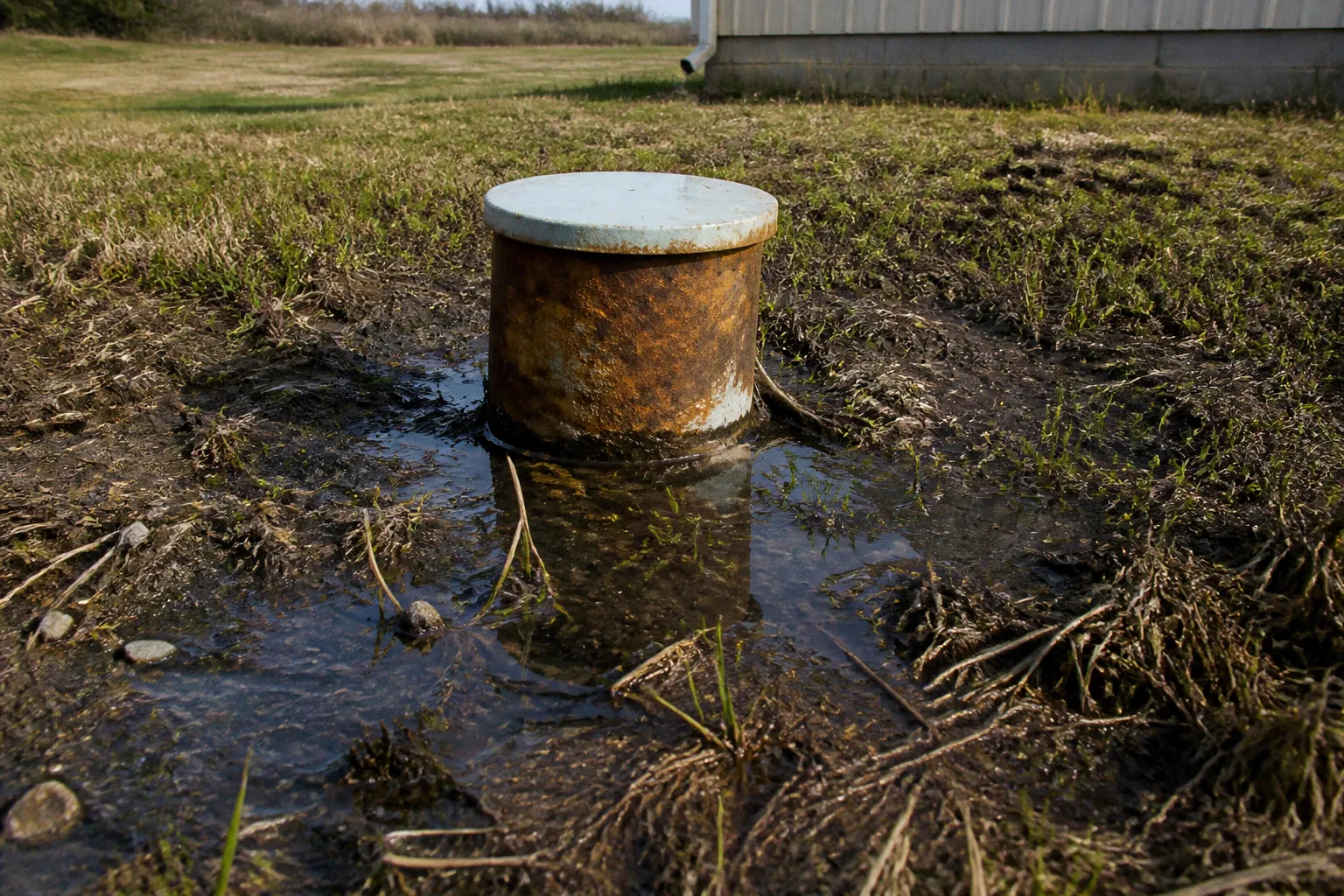
The soil is supposed to provide the treatment: filtering solids, supporting biological breakdown, and slowing the movement of contaminants before they reach groundwater.
When that soil is waterlogged, the machine stops doing its job. There is no useful middle setting. A drainfield either has enough unsaturated soil beneath it to accept and treat effluent, or it does not.
Somerset County sits on the Eastern Shore’s low coastal plain, where seasonal groundwater can rise close to the surface. In wet periods, it may reach or exceed the elevation of a conventional drainfield trench. A system installed at standard depth under those conditions is not treating wastewater in a functioning soil profile. It is discharging into already saturated ground.
That is when effluent may surface in the yard, move toward roadside ditches, or migrate through shallow groundwater toward nearby streams and tidal waters. The tank may still be intact. The pipes may still be open. The failure is in the relationship between the system and the site.
Most septic failures are not mechanical. They are geological. The soil gives up first, and the homeowner is usually the last to know.
A large share of the nitrogen moving through Maryland’s waterways travels through groundwater, and failing or undersized septic systems contribute to that load even when a property is not directly on the shoreline. In a county where public sewer is limited, lots are often separated by open land, and groundwater levels change sharply with the seasons, a marginal site can become a serious sanitation problem quickly.
The mechanics of failure in saturated soils
A conventional gravity-fed septic system depends on unsaturated soil to provide the final treatment step. The tank settles solids and begins biological treatment, but it is not the part of the system that makes the wastewater safe for discharge into the ground. That work happens below the drainfield, where soil pores must remain open and contain enough air and space for wastewater to move gradually.
This is why vertical separation matters. The distance between the bottom of the drainfield and the seasonal high groundwater table is not an administrative detail. It is the treatment zone. If groundwater rises into that zone, the effluent has no clean, unsaturated soil through which to travel.
Three conditions commonly push a drainfield beyond its capacity:
- A high groundwater table. Water rises into the trench from below. Effluent entering the trench then meets saturated soil instead of a dry treatment layer. With nowhere to move laterally or downward, it may rise toward the surface.
- Slow or restrictive soils. Tightly packed silts, clays, or other restrictive layers transmit water slowly. If the groundwater is already high, the trench behaves like a basin with no reliable outlet.
- Hydraulic overload. The household sends more wastewater into the system than the drainfield can accept, or the drainfield is undersized for the actual wastewater flow and site conditions. That can happen when water use is excessive, when plumbing fixtures or occupancy increase, when leaks go unnoticed, or when the original field was designed with too little usable absorption area.
The septic tank itself is not the component that determines how much daily flow the soil can absorb. A larger tank may provide more settling and retention time, but it does not turn a saturated or undersized drainfield into a larger one. Hydraulic loading is a drainfield and site-capacity problem: too much household wastewater for the field, too little field for the wastewater, or both.
That distinction matters when diagnosing an older system. Adding a washing machine, dishwasher, or second bathroom can increase the household’s daily water use, but the problem is not that the tank has become too small to hold the water. The problem is that the added flow reaches the drainfield, where the soil may not have been designed to accept it. A leaking toilet or continuously running fixture can create the same problem without any change in the number of people living in the house.
The visible signs are rarely subtle:
- Toilets gurgle when the washing machine drains.
- Several fixtures become slow at the same time.
- Wastewater backs up through a floor drain or lower-level plumbing.
- A soggy or unusually green patch appears over the drainfield.
- The yard develops a sewage odor, especially after rain.
- Effluent collects at the ground surface or flows toward a ditch.
- The system’s alarm activates repeatedly, if the property has a pump or advanced treatment unit.
An unusually green area is not proof of a functioning drainfield. Grass may grow vigorously where nitrogen-rich wastewater reaches the root zone. The same patch can be a sign that effluent is moving too close to the surface.
A single slow sink is usually a plumbing issue. Wet ground over the field, multiple slow fixtures, or sewage odors after a period of heavy rain point to a system-wide problem. Either way, a homeowner should not begin by adding chemicals, opening inspection ports without precautions, or repeatedly pumping the tank and assuming the underlying issue has been solved. Pumping can remove accumulated solids and relieve a backup, but it does not repair a failed soil profile.
Navigating Somerset County perc testing and seasonal groundwater cycles
A percolation test, commonly called a perc test, evaluates how quickly water moves through soil at a proposed drainfield location. It is one part of a broader site evaluation. The goal is not simply to find a hole where water disappears on a dry day. The evaluation must show whether the site can maintain the required separation from groundwater and whether the soil can support a reliable system under seasonal conditions.
In Somerset County, wet-season testing and land evaluations are important because groundwater levels change through the year. A site that appears workable in late summer may be unsuitable when winter and early-spring precipitation raises the seasonal high water table. Testing during a dry period can hide the very limitation that will cause a future failure.
That is why the timing of a site evaluation matters. If a lot is evaluated when groundwater is unusually low, the result may not represent the conditions the drainfield will face during the wettest part of the year. A marginal site can look acceptable on paper and then struggle through the first prolonged wet season after construction.
The practical questions are broader than whether a hole passes or fails:
- Where is the seasonal high water table in relation to the proposed drainfield?
- Is there a restrictive soil layer beneath the site?
- Does the lot have enough usable area for a replacement field?
- Can the required separation be maintained after grading?
- Will stormwater, roof drainage, or a sump discharge add water to the same area?
- Is there room for an engineered alternative if a conventional system is not approved?
- Will the system depend on pumps, controls, alarms, or a maintenance contract?
A perc test is not a guarantee that a future septic system will never fail. It is a site assessment under defined conditions. Construction changes, altered grades, increased occupancy, groundwater cycles, poor maintenance, and added surface-water flows can all change the system’s performance.
For a site that cannot support a conventional drainfield, the realistic options are limited:
1. Use an approved engineered alternative. This may involve a raised or mound system, advanced treatment, pressure dosing, a sand-based treatment unit, or another design appropriate to the site.
2. Connect to public sewer if service is available. This is often the most durable answer, but collection lines may not reach the property and connection costs can be substantial.
3. Redesign the development or stop construction. Some lots do not have enough suitable area for a conventional or alternative system. A failed site evaluation is not a challenge to outsmart with a deeper trench.
The Somerset County Health Department is the local point of contact for perc scheduling, site evaluations, and permit-related requirements. Advanced systems may also be subject to state approval and continuing operating conditions. Those requirements are part of the system design, not paperwork that can be handled after the installation is complete.
There is also a practical information gap. Individual septic failures are not always visible in a public, real-time database. A homeowner may know that a nearby property has a wet yard or an above-ground mound, but not whether it was built as a repair, an original alternative system, or a response to a previous failure. The absence of a public record is not evidence that the surrounding soil is safe for a conventional field.
Engineered remediation: mound systems, sand bioreactors, and BAT
When a conventional drainfield cannot maintain the required separation from groundwater, an engineered system changes the treatment arrangement. It may raise the drainfield, add specified sand or treatment media, dose effluent more evenly, or improve treatment before the wastewater reaches the soil.
The design has to match the failure mechanism. A mound is not a universal answer to slow soil. A treatment unit does not create more usable land. A pump does not solve a groundwater problem by itself. The system must address the limiting condition identified during the site evaluation.
Three approaches are common in difficult coastal-plain settings, although availability and approval depend on the property.
| System type | How it works | Where it fits | Trade-offs |
|---|---|---|---|
| Elevated mound system | Imported sand fill is placed above existing grade, and the drainfield is installed in the constructed treatment zone. The added elevation helps create the separation that native soil cannot provide. | Sites with high groundwater or shallow restrictive layers where a conventional trench cannot maintain the required separation. | More expensive and visible than a conventional field. It requires careful grading, protection from surface-water runoff, and enough space for the mound and reserve area. |
| Sand-based treatment or bioreactor system | Effluent is distributed through specified sand or other treatment media. Depending on the design, the system can provide additional aerobic treatment and nitrogen reduction before discharge to the soil. | Sites where native soil is tight or nitrogen reduction is a significant concern, including properties near sensitive surface waters. | More components and more design constraints than a passive field. Dosing equipment, controls, and media eventually require service or replacement. |
| Best Available Technology unit | A prefabricated advanced treatment unit provides treatment beyond a conventional septic tank before effluent reaches a drainfield. Some designs use aerobic treatment, filtration, disinfection, or other processes. | Small or constrained lots, repairs requiring nitrogen reduction, and sites where an approved advanced system is required. | Electricity, alarms, service visits, replacement parts, and ongoing maintenance are part of ownership. The unit must be operated as designed. |
The exact remedy should come from a licensed designer working from the site evaluation, not from a catalog of products. The same lot may have different solutions depending on available area, groundwater elevation, soil layers, grading, setbacks, and the required treatment performance.
For an existing failing system, the first step is usually to establish whether the failure is caused by accumulated solids, a blocked pipe, pump or control failure, excessive flow, a saturated field, or a combination of these. A tank that is overdue for pumping should be pumped and inspected. A pump chamber should be checked for floats, alarms, and electrical problems. But if the drainfield is saturated or sealed, restoring the tank does not restore the field.
A replacement or repair design also needs to account for reserve capacity. If the only available area is already being used by the failed field, the property may need a compact engineered solution, a different layout, or a connection to sewer. Digging a second conventional trench beside the first one may simply move the failure a few feet.
For larger subdivisions or clustered development, public sewer is often the more durable infrastructure. Gravity or pressure collection lines can move wastewater to a treatment plant rather than relying on each lot to provide its own final treatment zone. That solution requires a service area, capacity, financing, easements, and construction coordination. It is not a quick fix for a single rural property, but it can be the logical answer where many lots share the same soil and groundwater constraints.
An engineered system is not an upgrade on a marginal site. It is the minimum viable design when the native ground cannot safely support a conventional drainfield.
The cost difference between a conventional system and an engineered repair can be substantial. That is one reason owners sometimes postpone action, rely on repeated pumping, or reduce water use and hope the field will recover. Flow reduction may buy time, but it cannot create missing treatment soil. Once effluent is surfacing or backing up, the property needs a system evaluation and a permitted corrective plan.
Preventative maintenance to extend drainfield lifespan
Maintenance cannot rescue a drainfield installed in the wrong soil or at the wrong elevation. On a site that is fundamentally workable, however, neglected maintenance can shorten the field’s useful life by years.
The septic tank should be pumped on a schedule based on household size, tank capacity, solids accumulation, and actual water use. A common planning interval is every three to five years, but that is not a substitute for inspection and recordkeeping. Some households need more frequent service; others may go longer. The correct interval is the one confirmed by the condition of the tank and the rate at which solids accumulate.
The reason is straightforward. Solids that remain in the tank can move into the outlet line and drainfield. They clog soil pores and reduce the field’s ability to accept wastewater. Pumping removes the solids before they reach the field. It does not remove soil clogging after the field has been damaged.
Water management matters just as much. A drainfield is designed for a certain daily flow, not unlimited discharge whenever the household chooses to send it. The following practices reduce stress on a workable system:
1. Spread out high-volume uses. Avoid running several loads of laundry, the dishwasher, and multiple long showers in the same short period. This is especially important on restrictive soils and during wet weather. Spacing flows reduces peak loading; it does not compensate for an undersized field.
2. Repair leaks promptly. A leaking toilet can send a surprisingly large, continuous flow into the septic system. Because the water is clean, the problem may go unnoticed until the drainfield begins to stay wet.
3. Keep vehicles and heavy equipment off the field. Compacted soil loses pore space and infiltration capacity. The drainfield is underground infrastructure, not a parking area or equipment route.
4. Keep stormwater separate. Roof drains, downspouts, sump pumps, foundation drains, and driveway runoff should not discharge onto the drainfield. On a high-water-table site, additional surface water can be the load that pushes the field into failure.
5. Use only shallow-rooted grass over the field. Trees and large shrubs can invade pipes and disturb the soil structure. Their roots also make future inspection and repair more difficult.
6. Protect the reserve area. A replacement field needs open, undisturbed ground. Do not build sheds, pools, patios, driveways, or retaining walls over the area identified for future use.
7. Keep a complete maintenance record. Save pumping receipts, inspection reports, alarm visits, repair invoices, and design documents. These records help diagnose a failure and matter when the property is sold.
BAT units, pump systems, and sand-based treatment systems require more attention than a passive gravity system. They may need electrical service, alarm testing, periodic inspection, replacement parts, and scheduled servicing. The owner should know who is responsible for maintenance and what happens when an alarm activates.
Reducing water use is useful, but it should be described accurately. Low-flow fixtures, prompt leak repairs, and staggered laundry reduce hydraulic loading. They do not increase the approved capacity of the drainfield or lower the groundwater table. If the field is undersized for the home or unable to maintain separation from groundwater, water conservation is a management measure while a permanent remedy is evaluated.
Sanitation protocols for sewage backups and surface contamination
When a septic failure surfaces in the yard or backs up into the house, it is a public-health problem before it is a plumbing problem. Sewage can contain pathogens, and contamination can spread through floors, carpets, soil, footwear, pets, and stormwater. On properties with shallow groundwater or domestic wells, the concern extends beyond the visible wet spot.
The system itself should be addressed first by a qualified pumper, septic contractor, or designer. Cleanup should then proceed with reasonable protection:
- Keep children, pets, and unprotected adults away from the contaminated area.
- Wear waterproof gloves, boots, eye protection, and protective clothing. Wash hands thoroughly after removing protective equipment.
- Remove sewage solids with tools that can be cleaned and disinfected. Dispose of contaminated material according to local guidance; do not flush solids back through the septic system.
- Clean hard surfaces with water and detergent before applying a disinfectant. Disinfectant works poorly through layers of soil and organic material.
- Use household bleach only as directed for the surface and product. A commonly used mixture for cleaned, hard, nonporous surfaces is approximately ten percent household bleach and ninety percent water, with adequate contact time before rinsing. Never mix bleach with ammonia or other cleaners.
- Discard porous materials that have been saturated, including carpet padding, heavily affected drywall, mattresses, and upholstered items. Some materials may be salvageable only with professional assessment.
- Keep contaminated wash water and cleanup water out of storm drains, roadside ditches, and surface waters. Moving it off the property without treatment only transfers the contamination downstream.
A domestic well should be treated as potentially affected if sewage has surfaced nearby, especially where the well is shallow or groundwater moves toward it. Do not use questionable water for drinking, cooking, brushing teeth, making ice, or bathing until the well has been evaluated and tested. Boiling water is not a complete answer to every contamination concern, and it does not address chemical pollutants or contamination inside the plumbing system.
A failing septic system also needs to be reported or coordinated through the appropriate local channels when sewage is reaching a ditch, stream, neighboring property, or other public area. The faster the source is controlled, the less contamination enters the watershed.
The bigger picture on the ground
Somerset County’s development pressure does not pause because a lot has difficult soil. Properties change hands, parcels are subdivided, and construction continues on land that may have passed an evaluation under conditions very different from those present today. A dry-season result can create false confidence. A house can later receive more occupants, more plumbing fixtures, or an addition that increases daily flow. Stormwater can be redirected toward the field. A system that once appeared adequate may become unreliable without any single dramatic mechanical failure.
The Chesapeake Bay’s nutrient problem makes these local failures more than private property disputes. Wastewater that surfaces in a yard can reach ditches and streams. Wastewater that remains underground can move with groundwater and still carry contaminants toward tidal waters. The route is less visible, not necessarily less important.
The repair is rarely a mystery once the site is properly evaluated. It usually comes down to an engineered system, a sewer connection, or a decision not to place a conventional system on ground that cannot support one. The expensive part is often not the initial diagnosis. It is the accumulated cost of dry-season assumptions, deferred pumping, uncorrected leaks, added water use, and repairs that treated symptoms rather than site conditions.
Start with the soil and groundwater question. Confirm the source of the failure. Separate tank or pump problems from drainfield limitations. Then select a permitted remedy that matches the property’s actual constraints. After that, pump on schedule, control water flow, protect the field, and keep the maintenance record.
That order matters. Skip the site question and the next repair may fail for the same reason as the first. Treat maintenance as optional and the field may lose capacity long before its time. On the Eastern Shore, the ground is part of the septic system. A design that ignores it eventually sends the bill — and the wastewater — somewhere else.