Septic system options for Somerset high water tables
Somerset County septic system options for high water table sites are determined by two constraints: the vertical separation between the absorption area and seasonal groundwater, and the soil’s ability to accept effluent without hydraulic failure.
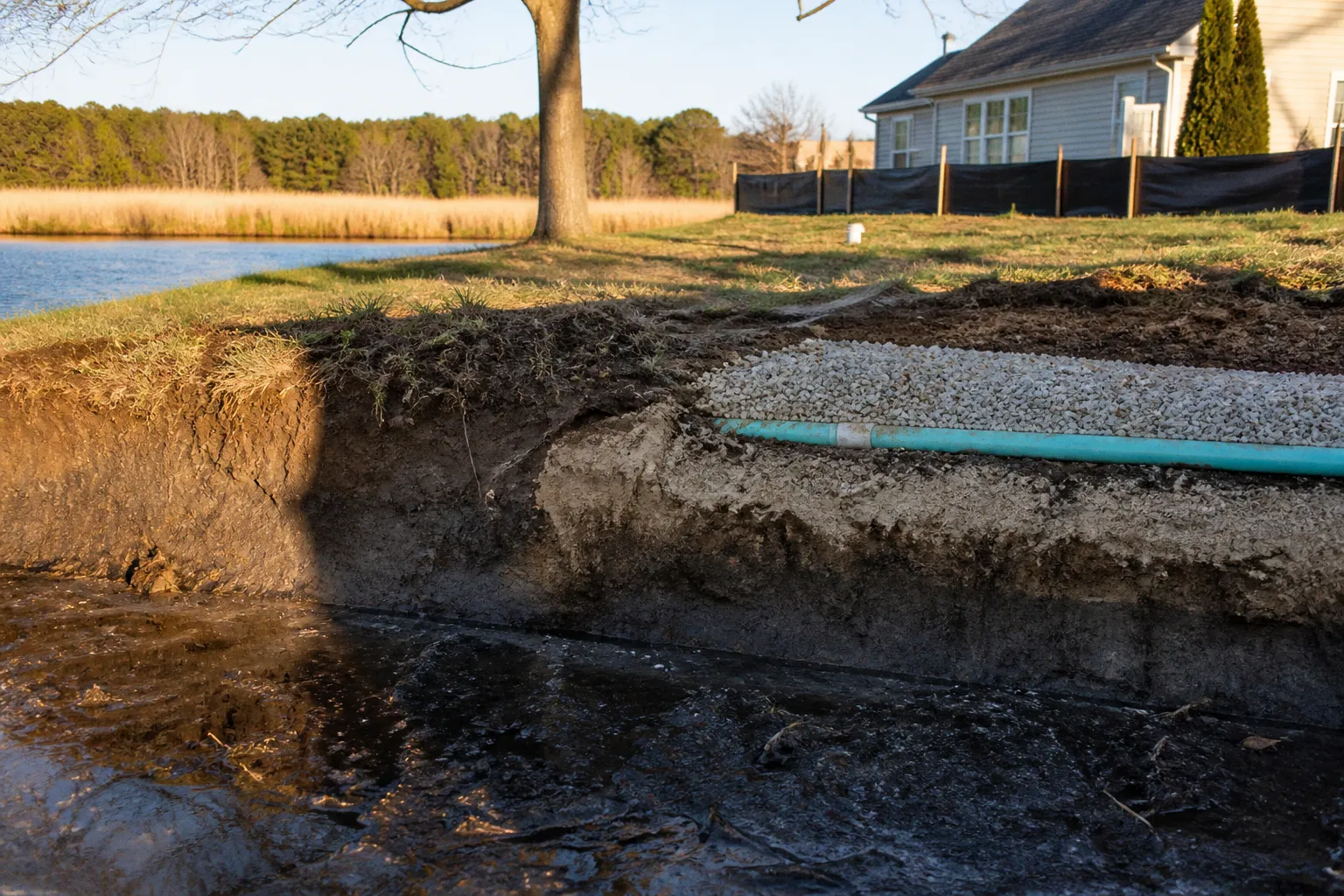
A conventional gravity-fed drainfield is not a default solution where groundwater is shallow, soils drain slowly, or bedrock limits usable depth.
The practical alternatives are engineered systems. The most common configurations include elevated sand mounds, pressure distribution networks, and nitrogen-reducing Best Available Technology units. The correct selection depends on site evaluation, groundwater conditions, parcel location, bedroom count, required setbacks, and whether the property lies within the Chesapeake Bay Critical Area.
Engineering solutions for shallow water tables and poor drainage
A septic system does not simply need an open area in which to discharge wastewater. It needs an approved absorption zone with sufficient unsaturated soil beneath it. That unsaturated layer provides filtration, treatment, and hydraulic storage before effluent reaches groundwater.
High water tables reduce that treatment zone. Slowly permeable soils create a different failure mechanism: effluent cannot move laterally or vertically at the required rate. Shallow bedrock limits the available soil profile. In each case, a conventional deep trench system may lack the separation required for approval or reliable operation.
The main options differ in how they address the limitation.
| System option | Primary site limitation addressed | Hydraulic method | Main regulatory or operational consequence |
|---|---|---|---|
| Elevated sand mound | High water table, slowly permeable soil, shallow usable soil depth | Effluent is distributed through a raised sand absorption area | Requires additional fill, defined mound setbacks, and careful grading |
| Pressure distribution system | Uneven soil conditions or limited usable absorption area | Pumped effluent is distributed through pressurized laterals | Requires pumps, controls, electrical service, and maintenance |
| BAT nitrogen-reducing unit | Nitrogen loading, particularly near tidal waters | Treatment occurs before discharge to the soil absorption area | Requires certified servicing and at least annual inspection |
| Combined mound and BAT system | High groundwater plus nitrogen-sensitive location | Advanced pretreatment followed by elevated soil absorption | Increases design complexity, cost, and long-term service obligations |
These are not interchangeable products. A mound addresses the elevation of the absorption interface. A BAT unit addresses wastewater treatment, especially nitrogen reduction. A pressure network addresses distribution. A property may require one of these technologies or a combination of them.
Elevated sand mound systems
A sand mound system raises the absorption area above existing grade using suitable sand fill. The elevation is not cosmetic. It creates additional unsaturated material between the point of effluent dispersal and the limiting site condition, such as seasonal groundwater or slowly permeable native soil.
The system normally requires:
- An approved mound footprint with sufficient area for the primary system and sewage reserve area.
- Suitable imported sand fill meeting design specifications.
- A distribution network that spreads effluent across the absorption area.
- A pump or dosing arrangement where gravity flow cannot provide even distribution.
- Grading that directs surface water away from the mound.
- Vegetative cover and protection from traffic, structures, and concentrated runoff.
The mound is therefore more sensitive to site layout than a conventional drainfield. A driveway, accessory structure, property line, well, or existing septic component can eliminate the space needed for the mound and its reserve area.
The principal advantage is direct: the system elevates the soil absorption zone without requiring the groundwater table to be lowered. The principal limitation is also direct: the mound occupies visible, protected ground and requires strict control of surface drainage. Compaction, ponding, erosion, or unauthorized grading can reduce performance.
For Somerset parcels, the 25-foot minimum setback between a proposed structure and a sand mound is a material design constraint. It must be measured during the site-planning stage, not after the house footprint has been fixed.
Pressure distribution networks
Pressure distribution uses a pump and network of pressurized laterals to apply effluent across the absorption area at controlled intervals. The objective is to prevent the first section of a drainfield from receiving most of the wastewater while distant sections remain underused.
This approach is useful where:
- The absorption area is elevated above the septic tank.
- The site has limited usable soil and requires uniform dosing.
- A mound configuration is necessary.
- Gravity distribution would produce uneven loading.
- The approved design requires timed or controlled application.
Pressure distribution does not eliminate the need for suitable soil. It improves the delivery of effluent, but it cannot make an unsuitable absorption area acceptable by itself. The system still requires an approved soil profile, adequate separation from groundwater, and a compliant reserve area.
The pump chamber, floats, control panel, alarms, and electrical connection become part of the system’s operating profile. A power outage does not necessarily create immediate failure if the system has adequate reserve capacity, but repeated outages, failed alarms, or neglected pump maintenance create a predictable risk of surcharge.
Best Available Technology units
BAT units provide advanced pretreatment before effluent reaches the soil absorption area. In Maryland, nitrogen-reducing BAT systems are required for new construction and replacement systems on properties within the Chesapeake Bay Critical Area, defined for this purpose as land within 1,000 feet of tidal waters.
The BAT requirement does not mean that every new home throughout Somerset County must use an advanced nitrogen-reducing unit. The Critical Area location is decisive. Parcels outside the applicable regulatory boundary are not subject to a universal BAT mandate solely because they are located in Somerset County. Other site-specific requirements can still produce an engineered design.
A BAT unit is not a substitute for an approved disposal area. It remains connected to a septic system that must collect, treat, distribute, and absorb wastewater. If the property also has a high water table, the approved design may combine BAT pretreatment with an elevated mound or pressure distribution network.
A BAT unit reduces nitrogen loading. It does not solve a groundwater separation problem. A mound raises the absorption area. It does not, by itself, provide nitrogen reduction.
Chesapeake Bay Critical Area BAT mandates
The Chesapeake Bay Critical Area framework changes the comparison between septic system options. A parcel within 1,000 feet of tidal waters is subject to additional protection requirements because wastewater nitrogen can move through groundwater and contribute to degradation of tidal water quality.
For new construction and replacement systems within the Critical Area, Maryland regulations require nitrogen-reducing BAT technology. The requirement applies to the system category and location, not to the owner’s preferred equipment list. A conventional tank and drainfield cannot be substituted merely because it is less expensive or easier to install.
The compliance sequence is straightforward:
1. Determine whether the parcel lies within the Critical Area.
The relevant boundary is based on proximity to tidal waters. Parcel mapping and local review control the determination.
2. Identify whether the project is new construction or a replacement system.
The BAT requirement applies to both categories within the applicable area.
3. Complete the site and soil evaluation.
The evaluation determines whether the BAT unit can discharge to a conventional absorption area or whether the property also requires a mound, pressure distribution, or another engineered arrangement.
4. Select a permitted system design.
Equipment selection must match the approved design and applicable Maryland requirements. A manufacturer’s claim of nitrogen reduction is not, by itself, a permit approval.
5. Include ongoing service obligations in the project decision.
BAT ownership carries continuing maintenance and inspection requirements. The system is not a one-time installation with no further compliance exposure.
The environmental objective is nitrogen reduction. The regulatory mechanism is technology-based treatment combined with local permitting and operating controls. This distinction matters because a property can meet one requirement and fail another. A BAT unit may satisfy nitrogen treatment obligations while the proposed disposal field remains too close to groundwater. Conversely, a raised mound may solve the soil limitation while leaving the Critical Area BAT mandate unaddressed.
What changes outside the Critical Area
Outside the Critical Area, BAT is not universally required for every Somerset County residence under the stated statewide mandate. That does not make conventional systems automatically available. The soil profile, water table, lot geometry, well location, reserve area, and setback requirements still control the design.
A property outside the Critical Area may require an alternative system because:
- The seasonal high water table is too close to the proposed absorption area.
- Native soils are slowly permeable.
- The lot lacks sufficient depth for a conventional trench configuration.
- The structure, well, driveway, or property boundary consumes the available disposal area.
- The site requires pressure dosing for hydraulic reasons.
- The local approving authority requires a specific engineered arrangement based on site conditions.
The result is a two-part analysis. First, determine the environmental and geographic designation. Second, determine the physical feasibility of the parcel. Neither analysis replaces the other.
Somerset County setback and sizing requirements
Setbacks determine whether a system can physically fit on the parcel. They are also a basic groundwater protection mechanism. A septic design that works in isolation may fail once the proposed house, well, driveway, accessory buildings, and sewage reserve area are drawn on the same plan.
Somerset County Health Department requirements identified in the available regulatory material include the following minimum distances for building permit approval:
- 30 feet from a water supply well.
- 25 feet from a sand mound.
- 10 feet from other septic system components.
- 10 feet from a sewage reserve area.
These distances should be treated as design parameters. They are not measurements to be resolved after construction documents are complete. If the house is placed too close to the mound, moving the mound may cause a conflict with the well or property boundary. If the well is installed first without accounting for the wastewater area, the usable septic envelope may be reduced.
The design review should map at least these elements:
- Existing and proposed structures.
- The water supply well and any neighboring wells where applicable.
- Septic tank and pump chamber locations.
- Primary absorption area.
- Sand mound footprint, if applicable.
- Sewage reserve area.
- Property lines and easements.
- Driveways, parking areas, and utility corridors.
- Surface drainage paths and low-lying areas.
- Wetlands, tidal waters, and Critical Area boundaries.
Septic tank capacity and bedroom count
Maryland regulations under COMAR 26.04.02 establish minimum residential septic tank sizes based on the number of bedrooms. The standard minimum is 1,000 gallons for a one- to three-bedroom residence. A four-bedroom residence generally falls within the 1,250- to 1,500-gallon range under the cited requirements.
A garbage disposal changes the loading assumption. Tank capacity increases by approximately 50 percent when a garbage disposal is installed. For a one- to three-bedroom home, that means the standard 1,000-gallon minimum increases to approximately 1,500 gallons.
This is not merely a tank-purchase detail. Garbage disposals add solids and organic loading to the wastewater stream. The tank and treatment design must account for that increased load. Installing a disposal after permit approval can create a mismatch between the approved design and actual system use.
| Design factor | Effect on system planning |
|---|---|
| One to three bedrooms | Minimum residential tank capacity of 1,000 gallons under the cited Maryland requirement |
| Four bedrooms | Tank capacity generally within the 1,250- to 1,500-gallon range |
| Garbage disposal | Approximately 50 percent increase in required tank capacity |
| High water table | May require a sand mound, pressure distribution, or another engineered alternative |
| Critical Area location | Requires nitrogen-reducing BAT for new and replacement systems |
| Limited lot area | Can make setbacks and reserve-area placement the controlling issue |
Bedroom count is a design input, not a description of current occupancy. A room that qualifies as a bedroom under the applicable review standards can affect the required system size even if the owner does not intend to use it as a sleeping room.
The sewage reserve area
The reserve area is not surplus land that can be built over later. It preserves a location for replacement or expansion if the primary absorption area fails or becomes unsuitable. Its required separation from structures must be maintained.
This is a frequent source of site-planning conflict. A parcel may appear to have enough area for the house and initial septic system but lack a compliant reserve area. Decks, pools, sheds, pavement, grading, or future additions can encroach on the reserve location and compromise statutory compliance.
For high water table properties, the reserve area can be particularly difficult to locate. The same soil and groundwater limitations affecting the primary system may affect the replacement area. The reserve area should therefore be evaluated as part of the original engineering analysis.
Comparing cost and operational exposure
Alternative septic systems cost more because they contain more than a tank and buried trenches. A mound may require imported sand, pumps, dosing controls, electrical work, extensive grading, and specialized installation. A BAT system adds treatment equipment, service contracts, inspections, replacement components, and electrical controls.
A typical Maryland cost range cited for engineered alternative systems or advanced treatment units is approximately $10,000 to $20,000 or more. Actual cost varies with site access, mound volume, pumping distance, electrical service, equipment selection, soil conditions, and whether the design combines BAT treatment with elevated absorption.
The cost comparison should separate installation from ownership.
| Cost or risk category | Conventional gravity system | Elevated mound or pressure system | BAT or combined alternative system |
|---|---|---|---|
| Initial earthwork | Lower where soil and groundwater conditions are favorable | Higher because of fill, grading, and protected mound area | Higher; includes advanced treatment and often engineered distribution |
| Mechanical equipment | Limited | Pump, controls, alarms, and electrical components may be required | Treatment unit plus pumps, controls, alarms, and electrical components |
| Critical Area compliance | May not satisfy the BAT mandate | May not satisfy the BAT mandate without nitrogen treatment | Designed to satisfy nitrogen-reduction requirements where applicable |
| Annual service exposure | Generally lower | Higher because of pumps and controls | Mandatory certified inspection at least annually |
| Failure consequences | Hydraulic failure or surfacing | Pump, dosing, or mound drainage failure | Treatment failure, alarm condition, permit noncompliance, or hydraulic failure |
| Site footprint | Usually smaller and lower profile | Larger and elevated | Depends on treatment unit and disposal configuration |
| Indicative installation range | Site-specific | Often within alternative-system cost range | Often within or above alternative-system cost range |
The lowest initial bid is not necessarily the lowest-risk design. A system that is technically unsuitable for the water table can produce repeated pumping, surfacing effluent, soil saturation, and corrective construction. Conversely, an advanced system installed on a suitable site still carries mechanical and inspection obligations that must be budgeted for its full service life.
Mound septic system cost on the Eastern Shore
For Eastern Shore properties, the mound component can be a major cost driver because the system must be elevated and protected from surface water. The required sand volume depends on the absorption area and the elevation needed to obtain compliant separation. Limited access can increase hauling and placement costs. A narrow or irregular lot can increase the amount of grading and reduce equipment flexibility.
The cost estimate should identify, at minimum:
- Sand and aggregate quantities.
- Pump chamber and dosing equipment.
- Electrical connection and control panel.
- Site grading and erosion control.
- Vegetative stabilization.
- BAT equipment, if the parcel is within the Critical Area.
- Initial certification, inspection, and service agreement.
- Reserve-area protection and future replacement assumptions.
A quotation that lists only the tank and installation does not represent the full cost of an engineered system.
Long-term maintenance and inspection obligations
Maryland property owners with BAT septic units must maintain and operate the system for its entire lifespan. The unit must be inspected at least once each year by a certified service provider.
This requirement changes the ownership model. The system is an operating utility with compliance documentation, not a passive underground feature. The owner must maintain access to service components, respond to alarms, preserve electrical supply, and retain evidence of required inspections.
The maintenance program should account for:
1. Annual certified inspection.
The service provider evaluates treatment performance, controls, pumps, alarms, and operating condition.
2. Pump and control maintenance.
Pressure distribution and BAT systems depend on mechanical components. Float failure, pump wear, or control-panel damage can interrupt treatment or distribution.
3. Solids management.
Advanced treatment does not eliminate the need for septic tank pumping. Solids accumulation reduces effective tank volume and can damage downstream components.
4. Protection of the mound and absorption area.
Vehicles, heavy equipment, structures, impervious surfaces, and concentrated runoff should not be placed over the approved area.
5. Record retention.
Inspection reports, service records, pump-out documentation, and repair records establish continued operation and support future property transactions or regulatory review.
6. Prompt response to alarms.
An alarm indicates a condition requiring investigation. Silencing the alarm without correcting the cause converts a visible warning into an unrecorded failure.
The same principle applies to a pressure distribution system even when BAT is not required. Pumps and controls create a maintenance burden. The difference is that BAT systems add a specific nitrogen-treatment obligation and an annual certified inspection requirement.
On a high water table parcel, the permitted system is only half of the compliance decision. The other half is whether the owner can maintain its pumps, controls, treatment unit, and inspection records for the system’s full lifespan.
Selecting the correct option for a Somerset parcel
The best septic system for a high water table in Maryland cannot be selected from a product catalogue. It must be selected from the parcel’s mapped constraints.
A practical comparison follows this order:
1. Establish the site designation
Determine whether the property is within the Chesapeake Bay Critical Area. If it is within 1,000 feet of tidal waters, new construction and replacement systems require nitrogen-reducing BAT technology under the applicable Maryland requirements.
Do not begin with the assumption that county location alone determines the equipment. Somerset County contains different physical and regulatory conditions. The tidal-water boundary and parcel-specific review are controlling.
2. Confirm the soil and groundwater limitation
The site evaluation must establish whether the limiting condition is:
- A shallow seasonal water table.
- Slowly permeable soil.
- Shallow bedrock.
- Insufficient soil depth.
- Restricted lot geometry.
- A combination of these conditions.
A sand mound is suited to elevation-related limitations. Pressure distribution is suited to controlled dosing and uniform application. BAT is suited to nitrogen reduction. A combined design may be required.
3. Reserve the septic envelope before finalizing the building plan
The house, well, septic system, reserve area, driveway, and utility alignments should be coordinated on one plan. The 30-foot well separation, 25-foot structure-to-mound separation, and 10-foot separations from other components and reserve areas must be reflected in the layout.
If the parcel cannot accommodate these relationships, the project may require a redesigned building footprint, a different well location, a different system configuration, or a determination that the lot is not approvable for the proposed use.
4. Size the system to the approved use
Bedroom count controls residential sizing. A garbage disposal increases the tank-capacity requirement by approximately 50 percent. Future additions should not be treated as separate from the original approval. Adding bedrooms or a disposal can change wastewater loading and create a design-compliance issue.
5. Price the operating obligation
The owner should compare not only installation bids but also recurring inspection, servicing, electricity, pumping, alarm response, and component replacement. This is particularly important for BAT units and pressure systems.
6. Obtain local approval before construction
Somerset MD septic permit requirements are implemented through the local health authority and applicable Maryland regulations. The installation must follow the approved design. Substituting equipment, relocating components, reducing setbacks, or changing the building footprint after approval can invalidate the design basis.
Final assessment
For Somerset County parcels with high water tables, conventional gravity-fed drainfields are often unsuitable because they cannot provide the required separation from groundwater or overcome slowly permeable soils. Elevated sand mounds address the elevation problem. Pressure distribution provides controlled hydraulic loading. BAT units address nitrogen reduction within the Chesapeake Bay Critical Area. Many coastal or environmentally sensitive parcels require a combination of these technologies.
The controlling sequence is not preference, price, or equipment availability. It is statutory designation, soil and groundwater conditions, setback geometry, wastewater loading, and long-term maintenance capacity.
A compliant decision therefore has four elements:
- Identify whether the parcel is within the 1,000-foot Chesapeake Bay Critical Area.
- Define the soil and water-table limitation through site evaluation.
- Preserve the required setbacks and sewage reserve area.
- Select and operate the engineered system according to its full maintenance obligations.
That is the relevant comparison. A mound, pressure network, and BAT unit solve different problems. The correct Somerset County septic system option is the one whose engineering matches the parcel and whose operating requirements remain enforceable after construction.