Living shoreline grants: Somerset County application steps
The Maryland Living Shoreline Protection Act of 2008 establishes nonstructural shoreline stabilization as the default for coastal erosion control projects within state jurisdiction.
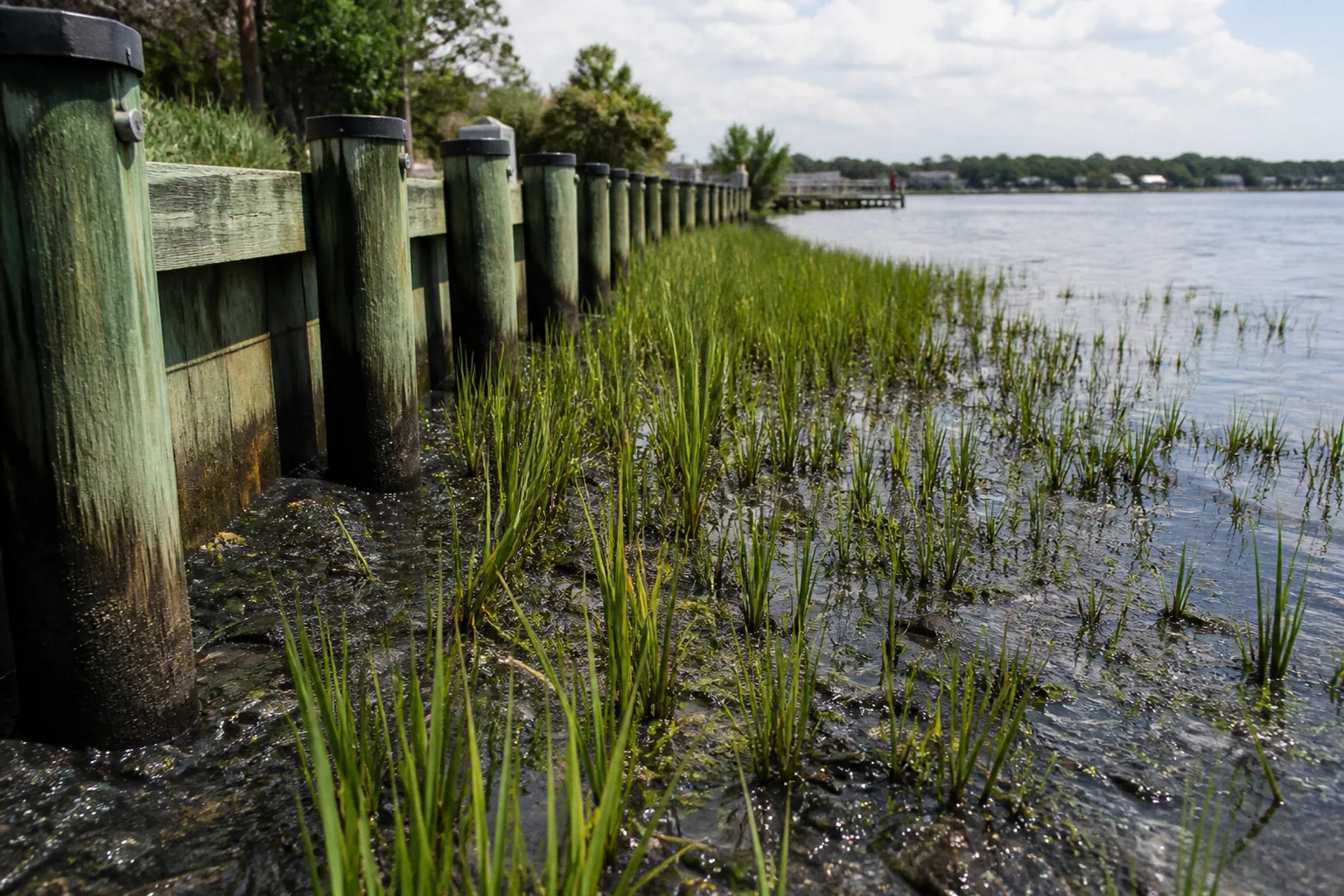
Property owners in Somerset County who want to address tidal erosion must generally use a living shoreline approach or obtain a formal waiver from the Maryland Department of the Environment (MDE). A waiver may allow structural work in limited circumstances, but it does not make bulkheads, riprap, or other hard armoring eligible for state living-shoreline funding.
That distinction matters because the regulatory approval and the financing decision are separate. A project can be permitted and still be ineligible for a grant or erosion-control loan. Before a property owner starts assembling a budget, the site must be evaluated against the Living Shoreline Protection Act, MDE permit requirements, and the eligibility rules of the funding program being considered.
For Somerset County waterfront properties, the process usually turns on five questions:
1. Is a living shoreline technically appropriate for the site?
2. If not, can the owner support a waiver request to MDE?
3. Does the owner have a qualifying sponsor for grant funding?
4. Does the proposed footprint trigger a Wetlands License and adjacent-owner notification?
5. If grant funding is unavailable, can the project be financed through an MDNR erosion loan or another permitted funding round?
Understanding the Living Shoreline Protection Act Mandates
The 2008 Act created a presumption in favor of living shoreline techniques, including marsh plantings, oyster reef construction, coir fiber logs, and other bioengineered approaches. Traditional hard armoring, such as concrete bulkheads and riprap revetments, is not treated as the starting point for a new project.
The burden is on the property owner to show why a nonstructural approach is infeasible before MDE will consider a waiver for conventional construction. That makes the early site assessment more than a design exercise. It is also the foundation for the regulatory record: the applicant needs to explain the erosion problem, describe the proposed response, and show why the selected method fits the shoreline.
In Somerset County, the statutory preference is particularly relevant to properties exposed to the Chesapeake Bay, Tangier Sound, and the county’s network of tidal creeks. Low-lying tidal geography and changing shoreline conditions can make a living shoreline a practical design choice as well as the legally preferred one. The right solution may combine planted marsh areas with biodegradable stabilization materials, reef elements, or other features that reduce wave energy without turning the shoreline into a continuous hard edge.
The main compliance points are these:
1. Living shoreline is the default. New shoreline stabilization projects must use living shoreline methods unless MDE grants a written waiver based on site-specific conditions.
2. A waiver requires justification. MDE may consider wave energy, the amount of available upland buffer, neighboring land uses, and other site conditions. Approval is not automatic, and the application needs technical support rather than a general statement that a bulkhead would be easier to build.
3. A waiver does not create grant eligibility. Even where MDE permits structural armoring, state funding programs generally exclude bulkheads, riprap, and comparable hard structures. An owner who proceeds with a permitted bulkhead should not assume that the project can be reimbursed through a living shoreline grant or MDNR erosion-control program.
4. Pure living shoreline applications may qualify for a fee waiver. MDE waives application fees for Joint Permit Applications that propose exclusively living shoreline construction. The proposal still has to meet the applicable technical and regulatory requirements; the fee exemption does not replace the permit review.
The practical mistake is to treat the Act as a funding rule only. It is first a project-design rule. If the application begins with a hard-armoring plan and attempts to fit that plan into a living shoreline program later, the owner may have to redesign the project, seek a waiver, or finance the work privately.
The 2008 Act does not merely encourage living shorelines. It establishes a statutory presumption, so the design and the permit strategy need to begin with a nonstructural approach.
Accessing the Roots for Resilience Funding Initiative
Roots for Resilience: Strong Roots for a Changing Landscape was presented as a major funding opportunity for living shoreline restoration in Somerset, Wicomico, and Dorchester Counties. The initiative allocated approximately $17 million and set a goal of protecting 400 acres of high-quality tidal marsh habitat.
That particular application window is no longer open. MDNR released the Roots for Resilience Request for Proposals on January 5, 2026, with an April 6, 2026 deadline. As of August 22, 2026, that deadline has passed. A Somerset County property owner cannot rely on the 2026 RFP as an available application route, and the earlier deadline should not be presented as a future step.
The implementation period identified for funded projects was 2026 through 2029, but that does not reopen the application process. It refers to projects selected through the completed funding round. Property owners who did not participate in that round should ask MDNR whether a future Roots for Resilience solicitation is planned, whether an existing sponsor is assembling a regional proposal, or whether another state program is currently accepting applications.
Eligibility and Sponsorship Requirements
Private homeowners cannot apply directly to Roots for Resilience or to the broader MDNR Grants Gateway when the program requires an institutional applicant. State funding generally depends on sponsorship by a local government entity or a qualifying nonprofit organization. In Somerset County, that may involve the county government, a municipal authority, or an environmental nonprofit working in the Lower Eastern Shore.
Sponsorship is not simply a name placed on the application. The sponsor normally carries administrative responsibility for the grant, including submission, compliance, reporting, and coordination with the funding agency. The property owner still needs to provide access, ownership documentation, site information, and authorization for the work.
For a future funding round, the sequence would ordinarily look like this:
1. Identify a potential sponsor. Contact Somerset County, an appropriate municipal authority, or a qualifying nonprofit before the application period begins. A sponsor needs time to decide whether the site fits its regional goals and whether it can assume the reporting obligations.
2. Conduct a site assessment. The sponsor coordinates an assessment of shoreline condition, wave exposure, existing wetlands, submerged habitat, erosion severity, and available room for a living shoreline. The assessment should also identify constraints that could affect construction or permitting.
3. Develop the project concept. The proposal should explain the stabilization method, expected habitat benefits, project dimensions, construction approach, monitoring plan, and budget. The design must be consistent with the Living Shoreline Protection Act and with MDE permit requirements.
4. Confirm the funding cycle. The sponsor should verify the current solicitation, deadline, match requirements, geographic priorities, and eligible costs. A previous RFP is not a substitute for the terms of a future round.
5. Submit through the required channel. When the program is open, the sponsoring entity manages the submission through MDNR’s Grants Gateway or another application channel specified in the solicitation.
6. Coordinate award and permitting schedules. Funding approval does not eliminate the need for MDE permits. The sponsor and property owner should keep the grant schedule aligned with the Joint Permit Application, design revisions, and any Wetlands License process.
There is no verified later Roots for Resilience deadline stated here. That is important for planning: a property owner should not assume that the program is rolling, that the $17 million allocation remains available for new private sites, or that a future round will use the same application terms.
Funding Scope and Exclusions
The Roots for Resilience initiative was designed to support living shoreline restoration, including associated design, permitting, construction, and monitoring costs. Its stated geographic scope covered Somerset, Wicomico, and Dorchester Counties.
The program did not fund:
- Bulkheads, seawalls, or riprap revetments
- Upland landscaping unrelated to shoreline stabilization
- Projects outside the three-county target area
- Applications submitted without a qualifying sponsor
Match requirements can depend on the project type and the category of the sponsoring organization. A property owner should obtain the current match and cost-share rules directly from MDNR rather than carrying forward assumptions from the 2026 RFP.
The broader MDNR Grants Gateway may offer other opportunities, but its availability is cycle-based or program-specific. The existence of the portal does not mean that every shoreline project can be submitted at any time. For a post-April 6, 2026 project, the sponsor should confirm whether an active solicitation covers Somerset County and whether private-property work is eligible under that solicitation.
| Funding element | Roots for Resilience 2026 round | MDNR Grants Gateway generally |
|---|---|---|
| Allocation | Approximately $17 million | Varies by program and fiscal year |
| Geographic scope | Somerset, Wicomico, and Dorchester Counties | Depends on the specific program |
| Eligible methods | Living shorelines | Determined by the individual solicitation |
| Structural armoring | Not eligible | Typically excluded from living shoreline funding |
| Direct private homeowner application | No; sponsor required | Depends on program terms, with sponsorship often required |
| 2026 application deadline | April 6, 2026; passed as of August 22, 2026 | Rolling or cycle-based, depending on the program |
| Implementation period | 2026–2029 for selected projects | Set by the applicable award terms |
The table’s most important line is the deadline. Roots for Resilience should be treated as a completed 2026 application round unless MDNR announces another solicitation. The next actionable step is not to submit an old application; it is to confirm the status of future rounds and other currently available programs.
Navigating the MDE Joint Permit Application Process
Funding status does not change the need for regulatory approval. Living shoreline projects in Somerset County may require a Joint Permit Application filed with MDE. The JPA brings together reviews involving wetlands, waterways, and tidal wetlands into a consolidated application.
For projects that qualify as exclusively living shoreline installations, MDE waives the standard application fee. The owner should still budget for design work, surveys, site assessments, engineering support where needed, and revisions requested during review. A fee waiver reduces the filing cost; it does not make the technical preparation cost-free.
JPA Submission Requirements
A complete JPA should address the project as a site-specific construction proposal, not simply as a request to stop erosion. The application generally includes:
1. Project narrative. Describe the proposed living shoreline, the materials to be used, the dimensions, the construction sequence, and the reason the design is suitable for the site.
2. Site plan. Provide a scaled drawing showing the project footprint in relation to the mean high water line, property boundaries, neighboring structures, access points, and relevant shoreline features.
3. Erosion assessment. Document the current shoreline condition and the basis for intervention. Photographs, site observations, historical information, and other supporting material can help explain why stabilization is needed.
4. Habitat impact analysis. Address potential effects on tidal wetlands, submerged aquatic vegetation, shellfish beds, and other habitat features that may be present near the work area.
5. Property-owner authorization. Include proof of ownership or written authorization if a county, municipality, or nonprofit is submitting the application for work on private property.
6. Funding and sponsorship information. Where a grant sponsor is involved, identify the relationship between the sponsor and the property owner. The permit record should make clear who controls the project, who will authorize access, and who will be responsible for compliance.
MDE reviews the JPA under the Tidal Wetlands Act, the Nontidal Wetlands Protection Act, and the Waterway Construction Permit regulations, as applicable. Review times vary. Applicants should plan for a process measured in months rather than assume that a permit will be issued within a few weeks.
The permit schedule should be considered before a contractor is engaged. Starting construction before the necessary approvals are in place can jeopardize both the project and its eligibility for public assistance. A grant award, a loan application, and a permit are different approvals issued for different purposes.
When the JPA Is Not Sufficient
Some projects trigger additional licensing requirements based on their dimensions. These thresholds should be checked while the concept is still being designed, because changing the footprint after submission can require new drawings, additional notice, and another round of agency review.
Two thresholds are central:
- More than 35 feet channelward of the mean high water line. A living shoreline structure extending more than 35 feet beyond the MHW line requires a Living Shoreline Wetlands License in addition to the JPA.
- More than 500 linear feet of shoreline frontage. A project exceeding 500 linear feet also requires the Wetlands License, regardless of how far channelward the structure extends.
Crossing either threshold is enough to trigger the additional license. The applicant must also provide mandatory notification to adjacent property owners. That notice is procedural: adjacent owners may comment, but they do not receive an automatic veto over the project. Failure to provide proper notice can delay the license process or make the submission incomplete.
Financial Assistance Through MDNR Erosion Loan Programs
A grant is not the only possible source of Somerset County shoreline protection funding. The MDNR Shoreline Erosion Loan Program provides 0% interest loans for qualified living shoreline projects, with repayment terms ranging from five to twenty years.
The loan program serves a different purpose from a sponsored grant. A grant depends on a competitive or program-specific allocation and may require a county or nonprofit sponsor. A loan can provide a way to finance eligible work when a grant is unavailable, when the project falls between grant cycles, or when a grant does not cover the full cost.
The existence of the loan program should not be confused with proof that applications are currently being accepted. Before relying on it in a project budget, the owner should confirm the current application channel, eligibility rules, available funds, required documentation, and whether the proposed work qualifies under the program’s present terms.
Loan Program Parameters
| Parameter | Specification |
|---|---|
| Interest rate | 0% |
| Repayment term | 5 to 20 years |
| Eligible projects | Qualified living shoreline construction |
| Structural armoring | Not eligible under the stated living shoreline funding rules |
| Application channel | Through MDNR |
| Sponsorship | Determined by current MDNR program terms |
A 0% interest loan can make a permitted living shoreline easier to finance, but it is still debt. The principal must be repaid, and the owner should compare the proposed payment schedule with the full project cost and any required maintenance or monitoring expenses.
A combined funding structure may be possible in some cases: a sponsored grant could cover part of the work, with an owner-financed loan covering an eligible balance. That arrangement requires coordination. The sponsor must confirm that the grant permits the proposed combination, while the property owner must separately satisfy the loan program’s underwriting and eligibility requirements. Neither source should be treated as automatic merely because the project uses living shoreline materials.
The strongest loan application is likely to be the one supported by a defined project scope and a clear permit strategy. An owner who is still deciding between a bulkhead and a planted or bioengineered shoreline may not yet have the information needed to establish eligibility.
Regulatory Thresholds for Wetlands Licensing and Notifications
The distinction between a standard JPA and a JPA accompanied by a Living Shoreline Wetlands License is one of the most consequential decisions in the application process. Misreading the project dimensions can result in an incomplete filing, additional notice requirements, and avoidable delays.
Threshold Determination
The basic dimensional analysis is:
- Project extends 35 feet or less channelward of MHW and covers 500 linear feet or less. The standard JPA pathway applies, with no Living Shoreline Wetlands License required under the stated thresholds and no adjacent-property-owner notification triggered by those thresholds.
- Project extends more than 35 feet channelward of MHW or exceeds 500 linear feet. The project requires the JPA plus a Living Shoreline Wetlands License, along with mandatory notification to adjacent property owners.
The word or does the work here. A project that extends only 20 feet channelward but spans 600 linear feet still triggers the license requirement. A project extending 40 feet channelward on a 100-foot parcel also triggers it. The two measurements must be evaluated independently.
The measurement should be shown clearly on the site plan. The applicant should not rely on a rough visual estimate of where the mean high water line falls, particularly where the shoreline is irregular, vegetated, or affected by existing structures. A dimension that appears close to the threshold deserves careful confirmation before the plans are finalized.
Adjacent Property Owner Notification
Once the Wetlands License threshold is met, the applicant must notify adjacent property owners in writing before MDE processes the license. The notice should identify:
- The proposed project
- The location, footprint, and dimensions
- The anticipated construction timeline
- Contact information for the applicant or sponsoring entity
Notification is not the same as consent. Adjacent owners may submit comments to MDE, but an objection alone does not give them authority to block the license. MDE remains the permitting authority.
For a sponsored project, the sponsor and property owner should agree in advance about who will prepare the notice, identify adjacent owners, retain proof of delivery, and respond to questions. That administrative detail is easy to overlook when the focus is on design, but defective notice can hold up an otherwise complete application.
Practical Implications for Somerset County
Somerset County’s waterfront parcels vary considerably in size and configuration. Lots in Crisfield, Deal Island, and the Smith Island communities may have narrow frontages that remain below the 500-linear-foot threshold. Larger agricultural parcels along the Manokin River and the Big Annemessex River may exceed it. Existing shore protection, marsh edges, access constraints, and neighboring structures can make the actual project footprint different from the parcel’s total waterfront length.
The analysis therefore has to be performed parcel by parcel and project by project. The relevant question is not simply how large the property is, but how far the proposed work extends channelward and how much shoreline frontage it covers.
Dimensional thresholds are statutory triggers, not advisory guidelines. A project extending 36 feet channelward of the mean high water line requires a Wetlands License under the stated rule; a project at 35 feet does not.
Putting the Application Sequence in the Right Order
The funding deadline changes the order of operations for Somerset County property owners. The April 6, 2026 Roots for Resilience deadline has passed, so an owner starting now should not build a plan around submitting to that closed round. The sensible approach is to separate the work that remains useful for any future program from the funding opportunity that is no longer available.
The early steps are still largely the same:
1. Define the erosion problem. Establish what is failing, where the shoreline is retreating or washing out, and what assets or habitat the project is intended to protect.
2. Start with a living shoreline design. The design should respond to the Living Shoreline Protection Act rather than treat living materials as an afterthought to a hard-armoring plan.
3. Measure the project footprint. Determine the channelward extension from the mean high water line and the total linear frontage. These measurements decide whether the additional Wetlands License pathway applies.
4. Identify the permitting route. Prepare the JPA and determine whether the project also requires a Living Shoreline Wetlands License and adjacent-owner notification.
5. Contact a potential sponsor. For a future Roots for Resilience round or another MDNR grant that requires sponsorship, the county, municipality, or nonprofit needs to be involved before submission.
6. Check the funding status. Ask MDNR whether a new Roots for Resilience round has been announced, whether another Grants Gateway solicitation is open, and whether the Shoreline Erosion Loan Program is accepting applications under current terms.
7. Build a funding plan that does not assume an award. If no grant round is open, the owner should consider whether an MDNR loan or private financing is appropriate for the permitted project. A future grant may help, but it should not be treated as committed revenue until an award is made.
8. Keep the design, permit, and budget consistent. A change in the shoreline method, dimensions, or project sponsor can affect both regulatory review and funding eligibility.
The 2026 Roots for Resilience allocation remains relevant as evidence that Maryland has directed substantial public resources toward living shoreline work on the Lower Eastern Shore. It is not, however, an open application opportunity as of August 22, 2026. The immediate funding question is whether MDNR has announced a subsequent round or offers another active program that fits the property and the proposed work.
Somerset County property owners who begin with the regulatory thresholds, secure technical support, and verify the current funding cycle will be in a stronger position when an eligible grant round opens. Those who assume that an old deadline remains available, or who try to place a bulkhead project inside a living shoreline program, are likely to encounter the problem at the point where correction is most expensive: after the design, budget, or application has already been prepared.