Tide Gates for Coastal Ditches: Choosing the Right Model
Traditional top-hinged tide gates can require a substantial water-level differential before they open. That condition has direct consequences for coastal drainage: higher discharge velocities, localized scour, delayed drainage, and restricted fish passage.
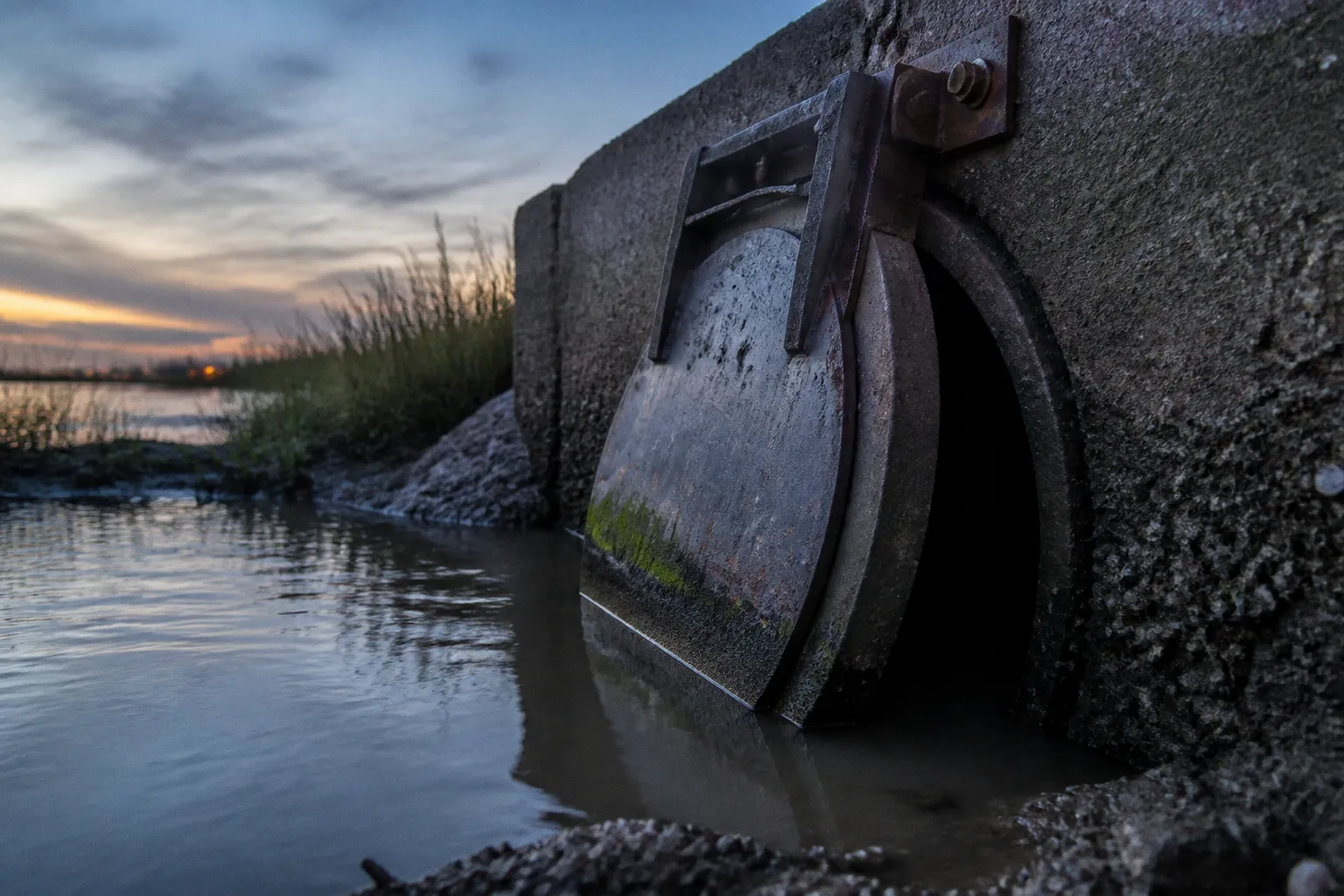
In brackish ditches, the gate is not merely a backflow barrier. It is a hydraulic control structure exposed to corrosion, sediment, debris, tidal cycling, and ecological constraints.
Compare car rental deals in United Kingdom
See available offersPartner link — DiscoverCars comparisonFor Somerset County drainage systems, tide gate selection must therefore be treated as an engineering and statutory compliance decision. The relevant comparison is not simply duckbill valve versus flap gate. The decision concerns headloss, opening behavior, maintenance access, material compatibility, ditch geometry, downstream tidal levels, easement delineations, and the effect of the selected mechanism on aquatic movement.
The correct model depends on the function the structure must perform. A private drainage outlet that requires compact, low-pressure sealing has different requirements from a county-maintained ditch designed for rapid stormwater evacuation. A gate discharging into a Chesapeake Bay tributary also carries ecological considerations that do not apply to an isolated inland conveyance.
The basic function of a coastal ditch tide gate
A tide gate prevents saltwater or tidal water from moving upstream through a drainage ditch. Under normal conditions, the gate should remain closed when the downstream water level exceeds the upstream level. During rainfall or upland drainage events, it should open when upstream hydraulic pressure becomes sufficient to discharge water toward the receiving waterbody.
This operating cycle appears simple. In practice, it is controlled by several variables:
- Head differential. The pressure difference between the upstream and downstream water surfaces determines whether the gate opens and how far it opens.
- Hydraulic capacity. The gate opening must pass the required flow without imposing excessive headloss.
- Closure pressure. The gate must seal against reverse flow at low differential pressure if tidal backflow prevention is the primary objective.
- Debris tolerance. Leaves, sediment, wrack, woody material, and trash can prevent a rigid gate from seating correctly.
- Corrosion resistance. Brackish water accelerates degradation of unsuitable metals and fasteners.
- Maintenance access. A gate that cannot be inspected, cleared, and repaired becomes a failure point regardless of its original specification.
- Ecological operation. Prolonged closure can obstruct fish passage and reduce estuarine flushing.
A tide gate is part of the drainage network. Its performance cannot be assessed independently from the ditch slope, culvert diameter, outfall elevation, bank stability, upstream storage, and receiving-water levels.
A tide gate that prevents backflow but cannot discharge stormwater at the required head is not a compliant drainage solution. It is a restriction installed at the outlet.
The operating problem with conventional top-hinged gates
A conventional flap gate is hinged along its upper edge. Water flowing from the ditch pushes the lower portion of the flap outward. Reverse tidal flow pushes the flap closed against its frame. The mechanism is robust and mechanically uncomplicated.
The limitation is opening resistance. Heavy cast-iron or timber flaps have considerable mass. They may also bind at the hinge, accumulate sediment at the seating surface, or require a greater hydraulic differential to move than the drainage system can consistently produce.
When the gate opens abruptly after a period of closure, discharge velocity can increase sharply. That flow can produce scour at the outfall, undermine the headwall, or erode the receiving ditch. The same operating behavior can limit aquatic movement because the gate remains closed through much of the tidal cycle and opens only under stronger hydraulic conditions.
The conventional model remains applicable where structural simplicity and one-way flow control outweigh ecological performance. It should not be treated as the default for every coastal ditch.
Material selection: HDPE, aluminum, stainless steel, and elastomers
Material selection affects service life, seating performance, maintenance frequency, and the total cost of statutory compliance. Brackish tidal water is an aggressive environment. Galvanic corrosion, salt deposition, ultraviolet exposure, and repeated wet-dry cycling can degrade components that perform adequately in freshwater installations.
HDPE flap gates
High-density polyethylene flap gates are lightweight and corrosion resistant. Their lower mass reduces the opening force required compared with heavy cast-iron or timber assemblies. This is relevant where the upstream drainage system produces only a modest head differential.
Common circular HDPE flap gate diameters range from approximately 600 mm to 1,800 mm. Square or rectangular configurations may range from approximately 600 mm to 2,200 mm, depending on the manufacturer and structural configuration.
HDPE has several operational advantages:
- It does not rust in brackish water.
- It reduces hinge and frame loading because the flap is comparatively light.
- It can reduce the head differential needed to initiate opening.
- It is suitable for custom culvert and headwall configurations.
- It generally requires less corrosion-related maintenance than untreated steel.
The material does not eliminate all failure modes. The frame must still be properly anchored. The hinge must remain functional. The seating surface must be kept clear of sediment and debris. A lightweight flap can also be vulnerable to damage if exposed to floating timber, heavy wrack, or impact from maintenance equipment.
HDPE is generally a strong candidate where the drainage system needs a conventional flap-gate configuration with improved corrosion resistance and lower opening resistance.
Marine-grade aluminum
Marine-grade aluminum offers lower weight than many ferrous assemblies and provides useful corrosion resistance. It may be suitable for larger structures where weight affects installation, hinge loads, or maintenance access.
The specification must address fasteners, dissimilar-metal contact, protective coatings, and connection details. Aluminum components installed with incompatible metals can experience galvanic corrosion at joints even when the main body of the gate remains intact.
Aluminum is not automatically interchangeable with HDPE. The selection must account for structural stiffness, impact resistance, thermal movement, and the method used to connect the gate to the culvert or headwall.
316 stainless steel
316 stainless steel is frequently considered where higher mechanical strength and corrosion resistance are required. Fish-friendly systems may use 316 stainless steel components with thicknesses in the range of 5 mm to 10 mm, depending on the design.
Its advantages include:
- High structural strength.
- Good resistance to brackish exposure.
- Compatibility with precise hinge, damper, and counterweight assemblies.
- Suitability for custom designs requiring controlled opening behavior.
Its limitations are primarily cost, weight, and connection detailing. Stainless steel does not remove the need for inspection. Salt deposits, trapped sediment, hinge wear, and obstruction at the seating line remain operational concerns.
Elastomeric materials
Duckbill valves use an elastomeric sleeve or valve body rather than a mechanical flap and hinge. The valve opens when upstream pressure exceeds downstream pressure and closes when the pressure reverses. The flexible outlet can seal around trapped solids more effectively than a rigid seating surface in some applications.
Polyester flap valves and similar elastomeric products may be available in nominal diameters from approximately 100 mm to 1,500 mm. The applicable diameter range depends on the product design, pressure conditions, and installation details.
Elastomeric materials require separate evaluation for:
- Ultraviolet exposure.
- Temperature range.
- Chemical compatibility.
- Abrasion from sediment.
- Long-term deformation.
- Replacement access.
- Resistance to puncture or vandalism.
The principal advantage is low-pressure sealing without a conventional hinge. The principal risk is that material aging or mechanical damage can compromise the entire check-valve function.
Flap gate versus duckbill valve
The question of duckbill valve versus flap gate in coastal drainage cannot be answered by naming one universally superior product. The mechanisms respond differently to low head pressure, debris, flow surges, and maintenance conditions.
A flap gate is a rigid or semi-rigid closure mounted to a frame. A duckbill valve is a flexible elastomeric outlet that opens through deformation. Both provide one-way flow control, but their operating behavior differs.
| Parameter | HDPE or metal flap gate | Elastomeric duckbill valve |
|---|---|---|
| Opening mechanism | Hinged flap moves outward under upstream head | Flexible sleeve opens under pressure |
| Low-head performance | Depends on flap weight, hinge friction, and seating | Often effective at low head pressure |
| Backflow sealing | Contact between flap and frame | Flexible lips close around solids and irregularities |
| Corrosion exposure | Low for HDPE; controlled for aluminum or 316 stainless steel | No metallic hinge; elastomer remains exposed to aging |
| Debris behavior | Debris can obstruct the seating surface or hinge | Flexible closure can tolerate some trapped solids |
| Maintenance profile | Inspection of hinge, frame, fasteners, and seating line | Inspection for tearing, deformation, abrasion, and material degradation |
| Fish passage | Usually restricted when closed; can be modified with dampers or self-regulating devices | Depends on geometry and operating pressure; not automatically fish-friendly |
| Structural adaptability | Well suited to headwalls and culvert outlets | Requires compatible pipe, flange, or outlet connection |
| Typical control characteristic | Discrete opening and closure | Pressure-responsive flexible opening |
| Main design risk | Excessive headloss or abrupt discharge | Elastomer failure, abrasion, and replacement difficulty |
When a flap gate is the better option
A flap gate is generally more suitable where:
- The outlet requires a rigid structural frame.
- The drainage system has predictable flow and sufficient head to open the gate.
- Maintenance crews need direct access to the hinge and seating surfaces.
- The outlet is exposed to impact from large debris.
- The project requires a controlled opening mechanism, damper, float, or counterweight.
- The culvert or headwall configuration already supports a standard flap-gate assembly.
A lightweight HDPE model may resolve the principal weakness of a traditional gate: excessive opening resistance. A 316 stainless steel or marine-grade aluminum design may be more appropriate where structural control and mechanical adjustment are necessary.
When a duckbill valve is the better option
A duckbill valve is more applicable where:
- The system must seal against reverse flow at low pressure.
- The outlet is compact or difficult to equip with a mechanical hinge.
- The installation must tolerate some solids at the closure line.
- Corrosion of metallic moving parts is a major concern.
- The outlet geometry supports a flexible valve body.
- The owner can provide periodic inspection and eventual elastomer replacement.
The valve is not a substitute for hydraulic analysis. A flexible outlet still imposes a flow resistance that varies with pressure, deformation, and internal condition. Sediment accumulation upstream can alter the effective operating head. A valve selected only by nominal pipe diameter may produce inadequate discharge performance.
Hydraulic performance and headloss
Hydraulic capacity is the controlling issue in most tide gate selection decisions. A gate can have sufficient nominal diameter and still restrict the drainage system if its opening behavior generates excessive headloss.
Headloss is affected by:
- Gate diameter and opening area.
- Flap weight.
- Hinge friction.
- Gate angle during discharge.
- Outlet geometry.
- Culvert alignment.
- Upstream and downstream water levels.
- Sediment deposition.
- Debris at the frame or valve body.
- The duration of the tidal cycle.
- Flow velocity through the opening.
A heavy top-hinged flap gate may remain closed during low-intensity drainage events because the available head is insufficient to overcome the flap weight and hinge resistance. This causes water to remain in the ditch longer. It can also increase the upstream water surface elevation during rainfall.
A lightweight HDPE gate reduces the mechanical component of opening resistance. It does not guarantee unrestricted flow. The gate still requires correct sizing and installation. A narrow culvert, undersized headwall opening, or poorly aligned outlet can control the system before the gate itself becomes the limiting element.
Discharge velocity and scour
When a gate opens after a period of closure, accumulated upstream water can discharge through a relatively narrow opening. The resulting velocity may exceed the erosion tolerance of the ditch bed or outfall.
Scour risk should be assessed at:
- The immediate downstream toe of the gate.
- The culvert outlet.
- The receiving ditch bank.
- Any bend or constriction below the outfall.
- Areas where the bed material changes from vegetated soil to exposed sediment.
- Locations where an existing headwall or apron may become undermined.
A gate with high discharge capacity may still require energy dissipation, outlet protection, or bank stabilization. Installing a larger gate does not independently resolve scour. It may increase the available discharge rate and transfer the erosion problem downstream.
Equalization and opening duration
The timing of gate closure affects both drainage and ecological performance. A gate that closes immediately when the water levels approach equalization may provide strong tidal exclusion but a narrow period for aquatic movement.
Tidal gate dampers can delay closure during water-level equalization. The available research indicates that some dampers can delay closure by up to 25 minutes. That interval can materially change the opportunity for upstream movement by aquatic species, including elvers, while preserving the primary backflow-prevention function.
The design must distinguish between:
1. Opening under upstream drainage pressure.
2. Remaining open while upstream and downstream levels equalize.
3. Closing when reverse tidal pressure develops.
4. Preventing prolonged saltwater intrusion after closure.
These are separate operating requirements. A gate optimized for one may perform poorly against another.
Hydraulic capacity and ecological access are not opposing categories by definition. Opening duration, damping, and low-resistance components can change the operating balance without abandoning tidal backflow prevention.
Fish-friendly gates and tidal gate dampers
A standard flap gate is a physical barrier whenever it remains closed. This is significant in drainage ditches connected to estuarine habitat, tributaries, wetlands, or Chesapeake Bay restoration areas.
Fish-friendly systems modify the gate’s timing or mechanical behavior. They may use:
- Floats.
- Counterweights.
- Tidal gate dampers.
- Modified hinge arrangements.
- Controlled opening angles.
- Side-hinged gate configurations.
- Self-regulating mechanisms.
Self-regulating tide gates are designed to extend the period during which the gate remains open as water levels equalize. The purpose is not to maintain an uncontrolled permanent opening. It is to reduce unnecessary closure and improve aquatic connectivity while retaining a barrier against sustained reverse flow.
Tidal gate dampers can hold a flap open during equalization. They may be particularly relevant where the main ecological restriction is rapid closure rather than the complete absence of a gate. The engineering assessment must establish whether the damper can withstand debris loading, remain adjustable, and operate consistently through the expected tidal range.
Side-hinged and controlled-opening systems
A side-hinged gate can respond differently from a top-hinged flap. Its movement may be adapted to fish passage, controlled release, or lower-resistance operation. The suitability of the design depends on the direction of flow, available clearance, structural framing, and the ability to prevent the gate from becoming jammed against the sidewall.
A controlled-opening system may require more components than a basic flap gate. That increases the number of inspection points. It also creates a greater need for documented maintenance procedures and replacement-part availability.
The ecological benefit is therefore inseparable from operational reliability. A fish-friendly device that remains stuck closed is not functionally fish-friendly.
Estuarine flushing
Gate operation also influences water exchange. Long closure periods can reduce upstream estuarine flushing and alter salinity conditions. The effect depends on the ditch connection, waterbody geometry, tidal amplitude, freshwater inflow, and gate operating schedule.
No single gate model can be declared appropriate for every sensitive coastal wetland or restoration project. The gate must be assessed against the receiving-water conditions and the designated function of the drainage corridor.
Selecting a model for Somerset County conditions
Somerset County includes low-lying coastal and rural drainage environments where tidal backflow prevention may intersect with stormwater management, agricultural drainage, road infrastructure, watershed protection, and Chesapeake Bay critical-area requirements.
The specific local municipal code provisions, parcel restrictions, easement conditions, and permit requirements for a private ditch tide gate must be confirmed for the applicable property. Those requirements cannot be inferred solely from the gate manufacturer’s specification.
A compliant selection process should proceed in a defined sequence.
1. Establish the legal and physical control area
The first step is to determine who controls the ditch, culvert, headwall, and downstream outfall. A private parcel may contain a public drainage easement. A roadside ditch may fall within a transportation right-of-way. A gate installed within an easement delineation may require approval from the easement holder even when the adjoining landowner funds the work.
The review should identify:
- Parcel boundaries.
- Recorded drainage easements.
- Roadway rights-of-way.
- Existing public works assets.
- Wetland or waterway interfaces.
- Critical Area designations.
- Existing outfall permits or maintenance obligations.
- Ownership of the receiving ditch or tidal channel.
A gate cannot be selected correctly if the installation location is legally misidentified.
2. Define the hydraulic objective
The project should state whether the primary objective is:
- Preventing saltwater intrusion.
- Preventing tidal flooding of an upstream parcel.
- Maintaining drainage during rainfall.
- Protecting a roadbed or culvert.
- Reducing ditch water levels.
- Supporting ecological connectivity.
- Replacing a failed or corroded existing gate.
- Managing a larger stormwater or watershed restoration project.
Each objective changes the preferred operating characteristics. A gate designed for low-pressure sealing may not provide the discharge capacity required for a major drainage ditch. A high-capacity flap may impose unacceptable ecological restrictions if it closes rapidly.
3. Measure the controlling elevations
The design should document:
- Upstream ditch invert.
- Downstream channel invert.
- Culvert diameter or opening dimensions.
- Normal upstream water level.
- Typical downstream tidal levels.
- High-water conditions.
- Bank elevations.
- Headwall and apron elevations.
- Adjacent road or structure elevations.
- Sediment depth at the outlet.
The relevant comparison is not the nominal tide gate diameter alone. It is the relationship between the gate and the entire hydraulic profile.
4. Evaluate material and exposure
The selected material should correspond to the actual exposure environment.
For brackish water and repeated tidal cycling, the analysis should address:
- HDPE body and frame performance.
- Marine-grade aluminum compatibility.
- 316 stainless steel fasteners and components.
- Elastomer ultraviolet resistance.
- Galvanic isolation.
- Sediment abrasion.
- Ice or cold-weather exposure where applicable.
- Floating-debris impact.
- Accessibility for cleaning and repair.
Inadequate material selection produces predictable maintenance liabilities. Corroded hinges and failed fasteners can convert a nominally functional gate into an uncontrolled opening or a permanently closed obstruction.
5. Include ecological operation in the specification
Where the ditch connects to fish-bearing or estuarine waters, the design should specify whether fish passage is required and how it will be achieved.
Possible measures include:
- Tidal gate dampers.
- Self-regulating tide gates.
- Counterweights.
- Floats.
- Extended equalization periods.
- Alternative side-hinged arrangements.
- Monitoring of gate opening and closure.
- Removal of unnecessary barriers elsewhere in the drainage network.
The ecological provision must be stated in operational terms. A general claim that a product is fish-friendly is insufficient. The project should identify how long the gate remains open, under what head differential, and how closure occurs during reverse flow.
Comparative application by drainage setting
The following comparisons are more useful than a generic product ranking because they connect gate behavior to site conditions.
Small private outlet with low head pressure
A duckbill valve may be appropriate where the outlet must seal at low pressure and the installation has limited space for a hinge and frame. The owner must accept the need for elastomer inspection and eventual replacement.
An HDPE flap gate may also work if the flap is sufficiently light and the outlet is correctly sized. A heavy cast-iron assembly is less suitable where available drainage head is limited.
Roadside or public drainage ditch
A rigid flap gate may be preferable where the structure must withstand debris, maintenance operations, and repeated inspection by public works personnel. HDPE, marine-grade aluminum, or 316 stainless steel can reduce corrosion exposure.
The design should include safe access, a stable headwall, clear maintenance responsibility, and protection against vehicle or equipment impact. An installation that obstructs routine ditch maintenance is operationally defective.
Ecologically sensitive tidal connection
A self-regulating or fish-friendly gate should be evaluated. The design may require a damper, float, counterweight, or controlled opening mechanism.
A standard top-hinged gate with rapid closure is not an adequate ecological solution merely because it prevents backflow. Its closure timing must be assessed against the movement requirements of the connected waterbody.
High-debris drainage corridor
A gate with a simple, accessible mechanism may be more reliable than a complex system that cannot be cleared in the field. However, the project should not use debris exposure as a reason to default to a heavy traditional gate.
The correct response may involve:
- Upstream debris management.
- A protected intake.
- Improved access for clearing.
- A robust HDPE or stainless steel frame.
- A damper protected from direct impact.
- A maintenance schedule linked to storm events.
Outfall with known scour potential
The gate must be reviewed together with the downstream outlet protection. Higher hydraulic capacity may increase discharge velocity. The project may require a stabilized apron, energy dissipation, bank protection, or grade control.
The gate itself is not an erosion-control structure. Its function ends at flow regulation.
Typical design errors
Several recurring errors result from treating a tide gate as a simple plumbing component.
Selecting by pipe diameter alone
A gate that matches the culvert diameter may still generate excessive headloss. The selection must account for the required flow, available head, opening behavior, and receiving-water conditions.
Installing a heavy gate in a low-head system
If the system rarely generates enough pressure to overcome flap weight and hinge friction, the gate will remain closed during ordinary drainage events. This creates upstream ponding and can increase flooding risk.
Treating corrosion resistance as a complete maintenance strategy
HDPE and stainless steel reduce corrosion risk. They do not prevent sediment blockage, hinge seizure, elastomer fatigue, structural settlement, or damage from debris.
Ignoring the closure cycle
The gate may discharge adequately but close too quickly during level equalization. That can restrict fish movement and reduce flushing. Opening performance and closure behavior must be specified separately.
Omitting downstream scour analysis
A higher-capacity gate can transfer hydraulic stress to the outfall. The receiving ditch may erode even when the gate and culvert remain structurally intact.
Failing to define maintenance authority
A gate installed on a shared ditch requires a documented responsible party. Without a clear obligation to inspect and clear the structure, failure becomes likely after the first major debris event.
Assuming a private installation is exempt from review
The presence of a private parcel does not determine whether the work affects a regulated waterway, public easement, roadway drainage system, wetland, or critical-area resource. Statutory compliance depends on the work and location, not only on ownership.
A practical selection matrix
A preliminary comparison can be organized as follows:
| Site condition | Preferred direction | Principal qualification |
|---|---|---|
| Low available head | Lightweight HDPE flap or duckbill valve | Confirm discharge capacity and sealing pressure |
| Brackish tidal exposure | HDPE, marine-grade aluminum, or 316 stainless steel | Control fastener compatibility and inspect joints |
| Strong low-pressure backflow concern | Duckbill valve | Verify elastomer durability and replacement access |
| Need for mechanical adjustment | Stainless steel or aluminum flap system | Specify hinge, damper, counterweight, and inspection points |
| Fish passage concern | Self-regulating or fish-friendly gate | Document equalization time and closure behavior |
| High debris loading | Accessible rigid gate with debris-management provisions | Protect the mechanism and maintain clearing access |
| Scour-sensitive outlet | Gate plus outlet stabilization | Analyze velocity and downstream erosion |
| Existing public easement | Coordinate with easement holder or public agency | Confirm authority before installation |
| Sensitive wetland or tidal connection | Site-specific ecological and regulatory review | Do not rely on generic product claims |
This matrix is a screening tool, not a final design. The final selection requires site measurements, hydraulic calculations, structural details, and confirmation of applicable Maryland and local requirements.
Installation and commissioning requirements
Installation quality determines whether the selected gate performs according to its specification. A correctly manufactured valve can fail if the frame is misaligned, the culvert settles, or the hinge line is not level.
The installation review should address:
- Frame alignment.
- Anchor-bolt placement.
- Headwall structural capacity.
- Joint sealing.
- Hinge freedom of movement.
- Flap seating.
- Culvert slope and connection.
- Outlet protection.
- Access for inspection.
- Sediment clearance.
- Safe maintenance procedures.
- Protection from equipment and vandalism.
After installation, the gate should be observed under more than one hydraulic condition. A dry inspection confirms alignment and mechanical movement. It does not confirm performance under tidal backflow or stormwater discharge.
Commissioning should document:
1. The direction of permitted flow.
2. The pressure or water-level condition that initiates opening.
3. The closure response under reverse flow.
4. Any delay mechanism used during equalization.
5. The presence of leakage at the seating line.
6. The discharge path and evidence of scour.
7. The condition of adjacent banks and the culvert.
8. The maintenance access route.
9. The responsible inspection party.
10. The replacement components and service intervals.
For a fish-friendly installation, commissioning should also document the actual operating cycle. The design intent must be observable in the field.
Monitoring performance after installation
Tide gates operate in changing conditions. A gate that performs acceptably during moderate water levels may behave differently during a major storm, high tide, or sediment accumulation event.
Monitoring should look for:
- Persistent upstream ponding.
- Saltwater intrusion beyond the intended control point.
- Gate chatter or repeated partial opening.
- Delayed discharge after rainfall.
- Scour at the outfall.
- Bank slumping.
- Hinge corrosion or binding.
- Elastomer cracking or deformation.
- Debris lodged at the frame.
- Structural movement of the headwall.
- Reduced aquatic connectivity.
- Uncontrolled leakage during reverse flow.
The monitoring record should connect observed symptoms to likely causes. For example:
- Persistent upstream water: insufficient opening force, undersized gate, blocked outlet, or inadequate ditch capacity.
- Reverse leakage: damaged seating line, trapped debris, deformed elastomer, or misaligned frame.
- Scour: excessive discharge velocity, concentrated outlet jet, or insufficient downstream protection.
- Rapid closure: lack of damping, inappropriate counterweight, or gate mechanism not matched to the tidal range.
- Repeated mechanical failure: corrosion, impact, settlement, or inadequate access for maintenance.
This is more useful than recording only whether the gate is open or closed. The relevant question is whether the structure is meeting its hydraulic, environmental, and legal function.
The correct selection standard
For coastal drainage ditches, the preferred tide gate is the model that satisfies the full operating requirement with the fewest unmanaged failure modes. That usually requires a comparison of lightweight flap gates, elastomeric duckbill valves, and fish-friendly or self-regulating systems rather than a default selection based on tradition.
HDPE flap gates are strong candidates where corrosion resistance and low opening weight are required. Duckbill valves are useful where low-pressure sealing and compact installation control the design. Marine-grade aluminum and 316 stainless steel support more demanding structural or adjustable systems. Self-regulating gates and tidal gate dampers are relevant where fish passage and estuarine flushing must be integrated into the drainage function.
The final decision should be based on:
- Hydraulic head and required discharge.
- Backflow conditions.
- Material exposure.
- Debris and sediment loading.
- Scour risk.
- Fish passage requirements.
- Maintenance authority.
- Easement delineations.
- Applicable environmental and land-use approvals.
- Structural compatibility with the existing culvert or headwall.
A tide gate is not a standalone product choice. It is a controlled interface between upland drainage and tidal water. In Somerset County, the technically defensible solution is the one that prevents tidal backflow without creating an avoidable drainage restriction, ecological barrier, corrosion liability, or permitting conflict.