Somerset MD Public Meetings: Workshops vs Hearings
Maryland Land Use Code §3-203 mandates that a local planning commission hold at least one public hearing before recommending the adoption of a comprehensive plan or any amendment thereto.
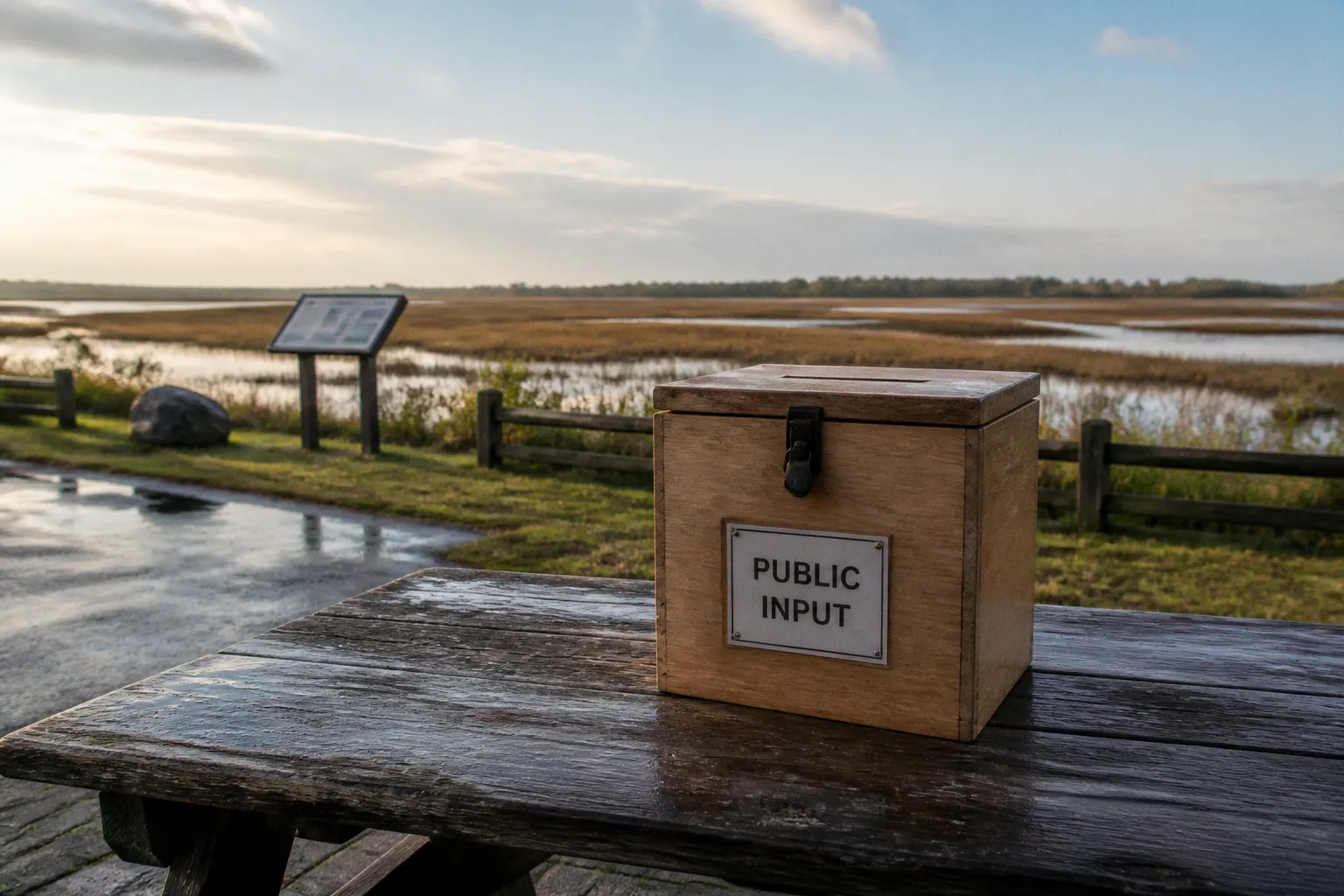
Somerset MD Public Meetings: Workshops vs. Hearings
That statutory obligation defines one axis of public participation in Somerset County's land-use process. The other axis—collaborative workshops—carries no equivalent legal weight but serves a distinct procedural function in the planning cycle. Confusing the two yields misguided expectations, wasted civic effort, and, in adversarial cases, procedural vulnerability for applicants and governing bodies alike. This distinction warrants precise examination.
The Somerset County 2025 Comprehensive Plan update illustrates the operational difference with uncommon clarity. The process generated over 360 public survey responses—surpassing its target of 300—and employed both workshops and formal hearings at sequential stages. Each forum satisfies a different phase of the planning sequence, operates under different procedural constraints, and produces a different category of actionable record. Residents, developers, and advocacy groups who understand this architecture participate more effectively; those who do not often arrive at the wrong forum with the wrong expectation.
The Role of Collaborative Workshops in Shaping Local Vision
Planning workshops in Somerset County function as structured input sessions. They are informal in the legal sense: no statute compels their convening, no court reporter transcribes testimony, and no 60-day advance notification to adjoining jurisdictions is required. Their value is upstream. Workshops such as the Visioning Workshop and Technical Committee workshops convened during the 2025 Comprehensive Plan process were designed to establish draft elements—water and sewer service boundaries, land-use categorizations, infrastructure priority corridors—before a formal recommended plan crystallized.
The format is interactive. Attendees engage with planning staff, consultants, and commission members in working-group configurations. Maps are annotated. Data sets are presented for review. The output is conceptual: themes, priorities, draft policy directions that feed into the technical drafting process.
Key procedural characteristics of Somerset County workshops:
- No legal record. Workshop proceedings are not sworn testimony. Statements made at a workshop do not enter the official evidentiary record that a Planning Commission relies upon when voting on a recommendation.
- No advance statutory notice period. County staff typically publish meeting dates through local media and official channels, but the 60-day notice requirement codified for comprehensive plan hearings under Maryland law does not apply.
- Format flexibility. Workshop agendas adapt to the stage of the planning process. A Visioning Workshop at the outset of the 2025 update solicited broad thematic priorities; later Technical Committee workshops focused on specific service-area delineations and zoning classification drafts.
- No voting action. The Planning Commission does not take binding votes at workshops. Decisions occur at properly noticed public hearings.
Workshops generate the raw material of a plan. Hearings test whether that material withstands public scrutiny and statutory standards.
This separation is not merely procedural bureaucracy. It protects the integrity of the planning record. Input gathered in an informal setting informs drafting; formal adoption proceedings require a distinct evidentiary foundation.
Legal Requirements and the Formal Public Hearing Process
A public hearing before the Somerset County Planning and Zoning Commission is a statutory proceeding governed by the Maryland Land Use Article. Its procedural scaffolding is rigid.
Under §3-203, before the Planning Commission may recommend adoption of the comprehensive plan—or any amendment—it must hold at least one public hearing. The requirements extend beyond simply convening a meeting:
1. Published notice. The Commission must publish notice of the time, place, and subject of the hearing in a newspaper of general circulation within the county.
2. Distribution to adjoining jurisdictions. At least 60 days before the hearing, copies of the recommended plan must be provided to adjoining jurisdictions and the Maryland Department of Planning.
3. Formal testimony. During the hearing, the chair opens the floor to proponents and opponents. Speakers must state their name and address for the official record. Testimony is transcribed or otherwise documented as part of the evidentiary basis for the Commission's recommendation.
4. Commission vote. Following the hearing, the Planning Commission votes on whether to recommend the plan or amendment to the Board of County Commissioners. Critically, the Planning Commission does not adopt the plan—adoption authority rests with the Board of County Commissioners, who hold the final legislative vote.
Somerset County's Planning and Zoning Commission convenes its public hearings in Room 111 of the Somerset County Office Complex, 11916 Somerset Avenue, Princess Anne, Maryland. This is the venue where formal evidentiary proceedings occur.
The following comparison delineates the procedural distinction:
| Procedural Element | Workshop | Formal Public Hearing |
|---|---|---|
| Legal mandate | No statutory requirement | Required by MD Land Use Code §3-203 |
| Advance notice to jurisdictions | Not required | 60-day minimum |
| Published newspaper notice | At staff discretion | Statutory obligation |
| Official record/transcript | No | Yes—testimony on the record |
| Binding Commission vote | No | Yes—vote on recommendation |
| Purpose in planning cycle | Input gathering, draft development | Evidentiary testing, formal action |
| Format | Interactive, working-group | Proponents/opponents testimony |
The distinction is functional, not hierarchical. A workshop without a subsequent hearing produces no legally defensible plan action. A hearing without prior workshops produces a plan built on a thin evidentiary base, vulnerable to challenge on grounds of inadequate public participation.
How Somerset County Integrates Community Feedback into Planning
The 2025 Comprehensive Plan update—the first comprehensive revision since the 1996 plan—deploys a sequential integration model. Community feedback enters the process through multiple channels, each feeding the next stage:
- Public survey. An online survey collected over 360 responses, exceeding the 300-response target. Survey data established baseline community priorities: infrastructure needs, land-use preferences, growth management concerns. This is quantitative input—structured, countable, comparable across respondent demographics.
- Visioning Workshop. The initial workshop translated survey themes into spatial and policy frameworks. Attendees interacted with preliminary maps and draft priority statements. Output: thematic directions for plan elements.
- Technical Committee workshops. Subsequent workshops focused on specific plan components—water and sewer service areas, transportation corridors, environmental constraints mapping. Participants included technical staff, commission members, and subject-matter contributors. Output: refined draft elements with technical justification.
- Public hearing. The formal hearing tests the complete recommended plan. Testimony—pro and con—becomes part of the official record that the Board of County Commissioners reviews before adoption.
This sequential structure ensures that public input is not merely collected but integrated through successive refinement stages. Each channel has a defined output that constrains and informs the next.
The model works because the channels are functionally distinct. Survey data provides breadth. Workshops provide depth and spatial specificity. The hearing provides adversarial testing and legal sufficiency. Collapsing any one channel into another degrades the integrity of the process.
Navigating the SEF Floating Zone and Major Project Reviews
The workshop-versus-hearing distinction acquires heightened practical significance in the context of Somerset County's Solar Energy Facility (SEF) Floating Zone process. Under current county regulations, solar energy facilities generating more than 2 megawatts of electricity must proceed through the SEF Floating Zone, which triggers a two-stage public hearing requirement:
1. Planning Commission hearing. The Commission reviews the application, hears public testimony, and discusses the proposal's compliance with the comprehensive plan and zoning standards.
2. County Commissioners hearing. Following the Planning Commission's review, the Board of County Commissioners conducts its own public hearing and renders the final decision on the floating zone application.
This dual-hearing structure for SEF applications differs materially from the standard comprehensive plan hearing sequence. The applicant faces two formal evidentiary proceedings, each with published notice requirements and public testimony. Community members opposed to or in support of a specific solar installation must prepare testimony for both forums.
Key procedural requirements for SEF Floating Zone applications above 2 MW:
- Application filed with Somerset County Planning and Zoning
- Planning Commission public hearing with published notice
- Public testimony from proponents and opponents, entered into the record
- Planning Commission discussion and recommendation
- County Commissioners public hearing (separate proceeding)
- Final decision by the Board of County Commissioners
For projects below the 2-megawatt threshold, the permitting pathway may not trigger the Floating Zone process or dual-hearing requirement—though site-plan review, setback compliance, and easement delineation standards still apply through the standard administrative process.
The practical implication: residents monitoring solar development in Somerset County should distinguish between community meetings or informational sessions that developers may convene—voluntarily, for stakeholder relations—and the statutory hearings that constitute the actual decision-making proceedings. A developer's community information session is a workshop-equivalent: informative but procedurally non-binding. The Planning Commission hearing is the operative legal proceeding.
From Survey Data to Policy: The Path of the 2025 Comprehensive Plan
The 2025 Comprehensive Plan update represents a generational revision—the prior plan dates to 1996, nearly three decades of deferred update. The intervening period saw significant shifts in Eastern Shore demographics, land-use pressures from utility-scale solar development, infrastructure aging, and evolving Maryland Department of Planning guidance on public participation requirements.
The planning sequence for the 2025 update follows a defined statutory and procedural timeline:
- Community input phase (2024–early 2025). Public survey deployment, Visioning Workshop, Technical Committee workshops. Over 360 survey responses collected. Draft plan elements developed from combined survey data and workshop output.
- Draft recommended plan. Technical staff and consultants compile draft plan based on integrated community input, existing conditions analysis, and statutory requirements.
- 60-day distribution period. Before the public hearing, the recommended plan must be distributed to adjoining jurisdictions and the Maryland Department of Planning, as required by Maryland Land Use Code.
- Planning Commission public hearing. Formal hearing in Room 111, Somerset County Office Complex. Public testimony on the record. Commission votes on recommendation to the Board of County Commissioners.
- Board of County Commissioners adoption. The Board receives the Planning Commission's recommendation and conducts its own review—potentially including an additional public hearing—before formal adoption.
Dates in 2025 have included milestones on January 9, March 6, May 27, and June 5, with the formal adoption date remaining contingent on the completion of the evidentiary and review sequence.
The critical point for civic participants: the survey and workshop phases, while essential for shaping plan content, do not constitute the operative legal proceedings. A resident who submits survey responses and attends every workshop but fails to provide testimony at the formal public hearing has not placed their position on the official record that the Board of County Commissioners will review.
Effective civic engagement requires participation at the correct procedural stage. Survey input shapes the draft; hearing testimony shapes the record.
The Somerset County planning process, when executed correctly, produces a comprehensive plan that is both technically defensible and responsive to documented community priorities. The architecture—workshops for input, hearings for validation—serves that dual objective. Participants who understand the procedural sequence contribute to a more robust outcome. Those who conflate the two forums, or substitute one for the other, leave their positions structurally unrepresented at the stage where decisions are made.
Summary of Procedural Distinctions
For residents, applicants, and advocacy organizations navigating Somerset County's planning process, the operational takeaway is procedural precision:
- Workshops are for shaping what goes into the plan. Attend them, contribute substantively, and track how your input is reflected in draft elements.
- Public hearings are for putting your position on the legal record. Prepare formal testimony, state your name and address, and understand that this is the evidentiary proceeding that precedes binding Commission action.
- The 60-day notice requirement applies to hearings, not workshops. Monitor county publications and legal notices to track hearing schedules.
- The Planning Commission recommends; the Board of County Commissioners adopts. If your objective is to influence final plan adoption, your testimony must reach both bodies through their respective proceedings.
- SEF Floating Zone applications trigger a separate dual-hearing track. Solar facilities above 2 MW face Planning Commission and County Commissioners hearings as distinct proceedings.
The Somerset County planning system, at its structural core, is a sequential input-processing mechanism. Community input enters through workshops and surveys; the recommended plan exits through a statutory hearing and legislative adoption. Every forum in the sequence has a defined function. Misidentifying that function produces participation that is well-intentioned but procedurally inert.