Planning workshop formats: which meeting style works best?
Maryland Land Use Code §3-203 requires every local planning commission to convene at least one formal public hearing before recommending adoption of a comprehensive plan.
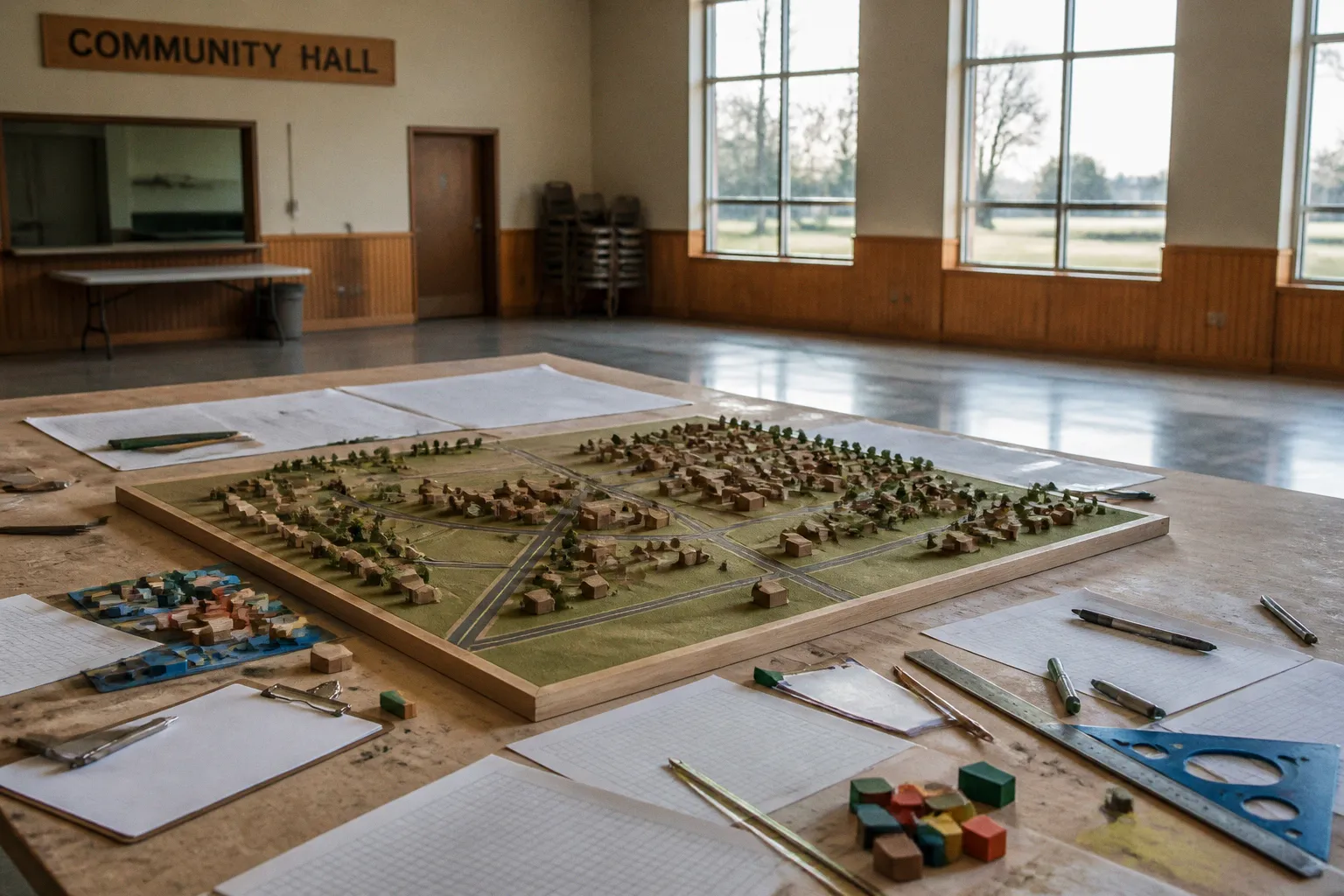
Planning Workshop Formats in Somerset County: Which Meeting Style Produces the Correct Output?
The Somerset County 2025 Comprehensive Plan update recorded more than 360 public survey responses against an initial target of 300. These two figures frame the selection calculus between statutory hearings, informal workshops, and survey instruments — three formats operating on separate procedural axes. The format that "works best" depends on whether the project requires interactive visioning, detailed map annotation, targeted advisory review, or formal testimony. The analysis below isolates the mechanics of each format and identifies the decision rule for matching format to project phase.
Definitional Framework: Three Procedural Axes
Somerset County's civic participation apparatus operates on three distinct procedural tracks. Each carries different evidentiary weight, notification obligations, record-keeping requirements, and downstream binding effect. Conflating the tracks produces procedural defects.
| Parameter | Planning Workshop | §3-203 Public Hearing | Public Survey Instrument |
|---|---|---|---|
| Statutory basis | None (discretionary) | Md. Code, Land Use §3-203 | None (discretionary) |
| Advance notice requirement | Project-defined | Per local rules, typically 14–30 days | Project-defined |
| Court reporter / verbatim transcript | Not required | Required | Not applicable |
| Recorded output | Summary minutes | Verbatim legal record | Quantitative dataset |
| Binding effect on adoption | None | Mandatory prerequisite step | Advisory input only |
| Testimonial weight | Consultative | Sworn or unsworn legal testimony | Anonymous quantitative response |
| Typical location | DTCS conference room, library, school | Somerset County Office Complex, Princess Anne | Online portal + paper distribution |
| Appeal mechanism | None (not an adjudication) | Available per Md. rules | None |
A public hearing under §3-203 is the only Somerset County forum whose procedural output is statutorily prerequisite to plan adoption.
The Department of Technical and Community Services (DTCS) administers all three tracks from the Somerset County Office Complex in Princess Anne. The seven-member Somerset County Planning Commission — appointed to five-year terms by the Board of County Commissioners — sits at the receiving end of each track's output. Both bodies coordinate continuously through the lifecycle of a planning project.
The Statutory Public Hearing
The public hearing is the only Somerset County format with binding procedural status under Maryland land-use law. Its mechanics are non-discretionary. Skipping or improperly scheduling a §3-203 hearing invalidates the adoption chain regardless of how much informal outreach preceded it.
Notice Mechanics
The Planning Commission must publish notice in a newspaper of general circulation serving Somerset County and post the hearing on the DTCS public-meeting calendar. The notice identifies the plan or amendment under consideration, the hearing date, the hearing location, and the comment-submission deadline. Adjoining jurisdictions do not receive a separate statutory notice for Somerset County's local planning hearings, although courtesy notifications may issue at the Commission's discretion. The 60-day interjurisdictional notification regime applies to comprehensive plan amendments of regional significance — a separate procedural pathway that intersects with but does not replace the §3-203 hearing.
Evidentiary Function
Testimony given at a §3-203 hearing becomes part of the verbatim record. Commissioners weigh this record when they vote to recommend plan adoption to the Board of County Commissioners. Speakers addressing the Commission may be sworn in or placed under oath depending on local rule; their statements carry the weight of legal testimony, not consultation feedback. Written comments submitted during the comment window become part of the same record when accepted by the Commission.
Procedural Output
The hearing produces three artifacts:
- A verbatim transcript retained by DTCS.
- A written staff report summarizing testimony and DTCS recommendations.
- A Commission vote recorded in the meeting minutes.
All three artifacts travel with the draft plan through the adoption pipeline to the Board of County Commissioners.
§3-203 is procedural, not aspirational. Skipping the hearing is not a procedural shortcut — it is a procedural defect.
The Informal Planning Workshop
The planning workshop occupies the upstream end of the engagement pipeline. Workshops occur before plan crystallization, not before adoption. Their role is to surface conceptual input, not to generate binding record.
Structural Characteristics
Workshops carry no statutory mandate. No court reporter is present. No verbatim transcript is generated. Attendance is voluntary and variable. Facilitators typically circulate base maps, aerial imagery, and zoning overlays for real-time markup. Facilitators are DTCS staff, contracted consultants, or commission members. The format is interactive: participants annotate, ask questions, and respond to facilitator prompts in real time.
Functional Outputs
Workshops produce four standard output types:
1. Annotated base maps identifying drainage concerns, desired trail corridors, or contested parcel boundaries.
2. Design charrette notes capturing preferred lot configurations, setback preferences, and density tolerances.
3. Stakeholder lists and contact information for subsequent outreach rounds.
4. Issue inventories identifying concerns that require further technical analysis before plan drafting.
Operational Constraints
- Workshop conclusions carry no statutory weight. They cannot be appealed because they are not adjudications.
- Workshop attendance is not a substitute for hearing attendance. The §3-203 hearing remains mandatory even if a workshop drew 200 participants.
- Informal minutes may be drafted for internal use but are not legal documents.
- Facilitator remarks do not bind the Planning Commission to any position.
Comparative Cost Profile
Workshops typically consume the largest share of DTCS outreach budget per session: room rental, facilitator time, map printing, and staff presence. Surveys scale more efficiently across large populations. Hearings incur transcript and legal-notice costs. Detailed cost comparisons are not published in the public record and are not stated here.
The Public Survey Instrument
The 2025 Comprehensive Plan update collected more than 360 survey responses against an initial target of 300. The instrument was administered by DTCS in parallel with workshop sessions. Surveys function as a quantitative complement to qualitative workshop dialogue.
Distribution Architecture
Surveys reach Somerset County residents through multiple channels:
- The county website's planning section.
- DTCS email distribution lists.
- Paper copies available at the Somerset County Office Complex in Princess Anne.
- Partner agencies, including public libraries and municipal offices on the Eastern Shore.
- Community organizations serving agricultural and shoreline populations.
Instrument Structure
A standard Somerset County planning survey contains four element classes:
- Closed Likert items measuring preference intensity on identified issues.
- Ranking questions establishing priority order across competing objectives.
- Open-ended comment fields capturing qualitative concerns.
- Demographic fields enabling representativeness analysis by age, tenure, and geography.
Functional Role
Surveys perform three analytical tasks that workshops cannot:
- They detect statistical patterns across demographic cohorts.
- They extend reach to residents who cannot attend evening workshops due to work, transportation, or caregiving constraints.
- They produce a defensible dataset for the Planning Commission's deliberations on contested items.
Constraints
- Survey data is advisory. The Planning Commission is not bound by majority preference.
- Self-selection bias affects representativeness. Demographic adjustment is not always applied to the published results.
- Survey instruments do not produce the verbatim record required by §3-203.
- Surveys cannot replicate the spatial specificity of map-annotation workshops.
Matching Format to Project Phase
Format selection depends on where the project sits in the planning cycle. The Somerset County Comprehensive Plan carries a 20-year planning horizon, anchored to the 2017 Housing Element update and the current 2025 baseline. A project of this scope requires all three formats across its lifecycle.
| Project Phase | Primary Format | Complementary Format | Output Artifact |
|---|---|---|---|
| Visioning / scoping (12–18 months pre-draft) | Workshop | Survey | Annotated maps, vision document |
| Draft review / option testing | Workshop + advisory committee | Survey pulse | Comment matrix, refinement notes |
| Pre-adoption statutory step | §3-203 Public Hearing | Written comment period | Verbatim record, staff report |
| Post-adoption implementation | Advisory committee | Targeted workshop | Monitoring metrics, amendment inputs |
The visioning phase typically precedes plan crystallization by a year or more. The draft-review phase occurs after the Planning Commission has a working document. The pre-adoption phase is where the §3-203 hearing becomes mandatory. The post-adoption phase involves implementation monitoring, which does not require further statutory hearings unless the plan is amended.
Operational Constraints and Failure Modes
Common Procedural Errors
Four failure modes recur in Somerset County's planning workflow:
1. Treating a well-attended workshop as a substitute for the §3-203 hearing. The hearing cannot be elided regardless of workshop turnout.
2. Failing to publish hearing notice within the locally prescribed window. Procedural defect voids adoption.
3. Survey instrument design that omits demographic fields, undermining representativeness analysis.
4. Workshop facilitation by individuals without authority to commit the Planning Commission to a position, creating expectations that cannot be met.
Inter-Format Coordination
The three tracks are not independent. Workshops surface issues that surveys then quantify. Surveys identify priority rankings that hearings then test against formal testimony. Hearings produce records that the Planning Commission weighs alongside workshop notes and survey datasets. Operating any track in isolation reduces the evidential base available to the Commission.
Geographic Specificity
Procedures discussed here apply exclusively to Somerset County, Maryland, located on the Eastern Shore. Somerset County, New Jersey, operates under a different statutory framework and municipal structure. The Town of Somerset, Maryland, has its own planning jurisdiction and should not be conflated with the county-level process.
Procedural Checklist for Format Selection
Format selection follows a defined sequence:
- Identify the project phase: visioning, draft review, pre-adoption, or post-adoption.
- Determine whether the project output must carry statutory weight.
- If statutory weight is required, schedule a §3-203 public hearing through DTCS at the Princess Anne office complex; no other format substitutes.
- If upstream conceptual input is required, deploy a workshop with annotated base maps and structured facilitation.
- If statistical breadth across the county population is required, deploy a survey instrument with demographic fields and ranking questions.
- If advisory review of a specific element is required, convene a targeted advisory committee meeting.
- Coordinate all active tracks through DTCS to prevent scheduling conflicts and ensure artifact consolidation.
- Retain verbatim hearing transcripts, workshop summary notes, and survey datasets as separate evidentiary records.
- Forward all artifacts to the Planning Commission for incorporation into the recommendation packet to the Board of County Commissioners.
Summary of Position
The question of which Somerset County planning workshop format works best resolves to a procedural question, not a preference question. The Somerset County Comprehensive Plan adoption chain requires a §3-203 public hearing; no alternative format satisfies that statutory threshold. Workshops generate the conceptual input that informs the draft plan. Surveys generate the quantitative breadth that calibrates stakeholder priority weightings. Each format produces a different artifact. Each artifact occupies a different position in the adoption pipeline.
The Planning Commission's seven members, serving five-year terms, weigh all three artifact classes when they vote to recommend adoption to the Board of County Commissioners. Selecting the correct format begins with identifying the artifact required by the project phase. A visioning project requires a workshop. A statistical breadth project requires a survey. An adoption step requires a §3-203 hearing. Confusing these tracks produces procedural defects, not procedural shortcuts.
For projects operating within the 20-year Comprehensive Plan horizon, the operative rule is sequential deployment: workshops first, surveys in parallel, the §3-203 hearing last. Each track feeds the next. The hearing is the only track whose omission invalidates the chain.