Somerset community surveys: the right channel for your feedback
More than 360 residents responded to Somerset County’s initial Comprehensive Plan survey, exceeding the county’s target of 300 responses. That result establishes the survey as a meaningful input source.
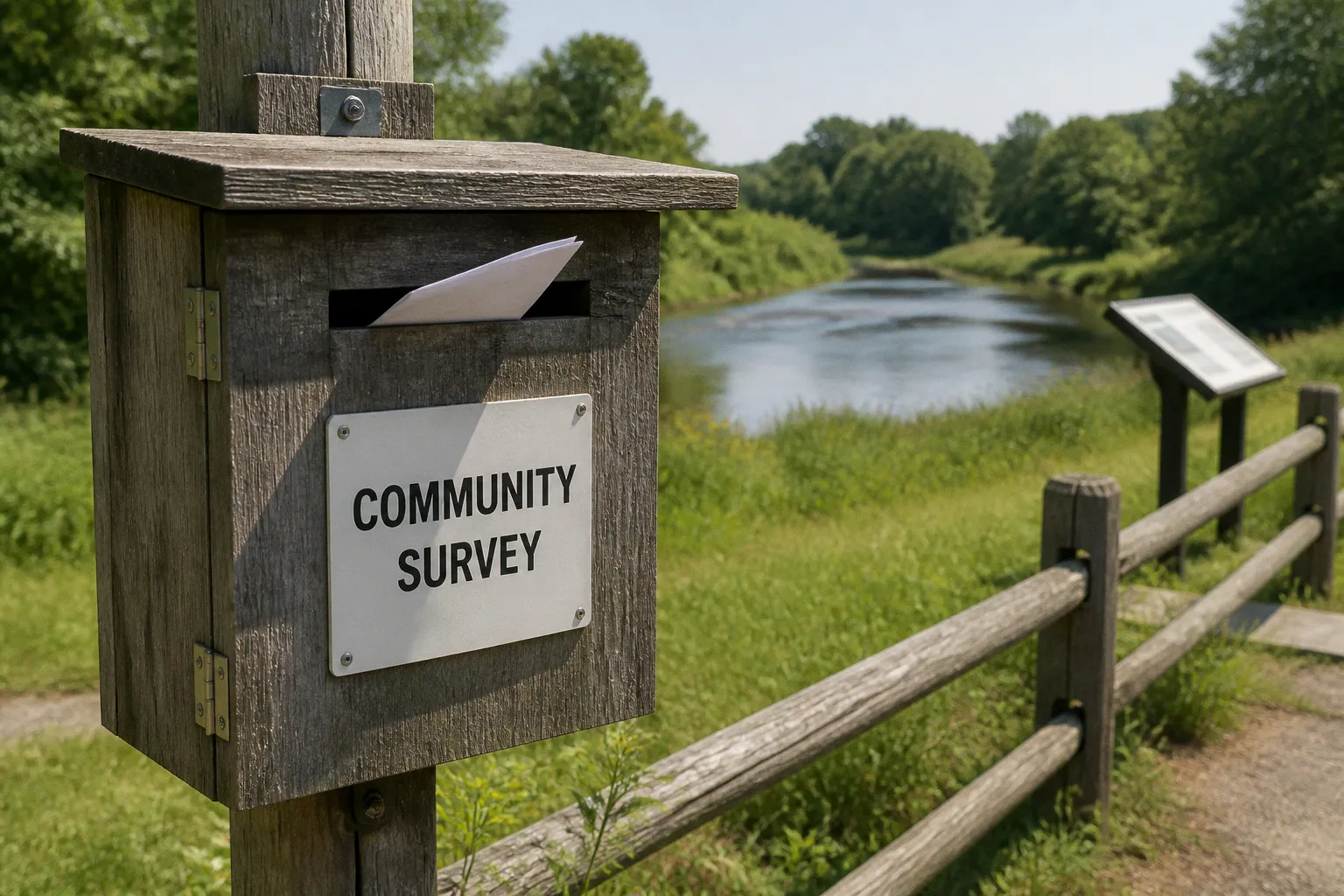
It does not make the survey a permanent submission channel. The primary community survey closed in mid-2024.
Residents still have an active route for Somerset County community survey feedback: the chapter-specific online comment form available through plansomersetmd.org. Formal public hearings and Planning Commission meetings provide a separate channel. Each method serves a different procedural purpose. A general survey captures broad public priorities. Chapter comments identify specific defects or omissions. A public hearing creates a formal record before the Planning Commission makes its recommendation.
The distinction matters because the Comprehensive Plan is not a general opinion document. It is a long-range land-use framework covering a 20-year planning horizon. Its provisions will influence zoning administration, infrastructure priorities, housing policy, sensitive-area protection, transportation planning, and preservation decisions across Somerset County and its municipalities.
The legal and administrative structure of public participation
The update is being led by the Somerset County Planning and Zoning Commission, with assistance from Smith Planning and Design. The consultants are represented in the process by Virginia Smith and Michele King. The project uses plansomersetmd.org as the central document and feedback hub.
The current update is also a substantial administrative correction. The previous Somerset County Comprehensive Plan dates from 1996. A plan prepared on that baseline cannot adequately reflect current demographic conditions, infrastructure constraints, economic activity, housing demand, environmental regulation, or municipal development patterns without systematic revision.
Maryland Land Use Code §3-203 requires a local planning commission to hold at least one public hearing before recommending adoption of a comprehensive plan. This requirement is not interchangeable with an online survey. The statutory hearing is part of the formal adoption process. The survey and chapter comment forms are evidence-gathering mechanisms used during plan preparation and review.
The practical sequence is therefore:
1. Draft preparation. The Planning and Zoning Commission and its consultants assemble the plan chapters and supporting analysis.
2. Public review. Residents, property owners, businesses, municipal officials, and other stakeholders examine the draft material.
3. Written comments. Feedback is submitted through the project website and other designated channels.
4. Planning Commission review. The Commission evaluates the draft and public record.
5. Statutory public hearing. The Commission holds at least one hearing before making its recommendation under §3-203.
6. Recommendation and adoption process. The final procedural steps depend on the applicable county and state requirements. The exact final adoption date has not been established in the available project information.
The legal effect of a comment depends partly on where and when it enters this process. A survey response can identify a countywide preference. A chapter comment can expose an internal contradiction in the draft. Testimony at a public hearing can place an objection or recommendation into the formal hearing record.
A closed survey does not end public participation. It changes the relevant unit of feedback from the general questionnaire to the specific plan chapter and formal hearing record.
What the initial community survey established
The initial survey produced more than 360 responses against a county target of 300. The response total exceeded the target by at least 60 submissions, or more than 20 percent of the stated goal. That is a useful participation metric. It demonstrates that the county was able to obtain a response volume above its minimum planning target.
It does not establish that the sample represents every segment of Somerset County. The available information does not provide the exact division between online and paper responses. It also does not establish the geographic, age, income, tenure, or municipal distribution of respondents. Those limitations do not invalidate the survey. They define how the results should be interpreted.
The county used multiple collection points:
- An online questionnaire was available through the project website.
- Paper questionnaires were placed at local libraries.
- A public survey station was available in the lobby of the Somerset County Office.
- The project team used the responses to inform the plan update and related draft chapters.
The inclusion of paper questionnaires is procedurally significant. A digital-only process can exclude residents with limited internet access, limited device access, or a preference for in-person government transactions. Library distribution and a physical county-office station reduce that exclusion. They do not eliminate it, but they create additional access points.
The survey should therefore be read as a broad diagnostic instrument. It can show which subjects generate public concern or support. It is less suitable for resolving a technical conflict between a proposed land-use designation and an existing easement delineation, identifying a specific transportation design deficiency, or challenging a parcel-level development assumption.
That distinction is central to choosing the correct feedback channel.
Comparing the available feedback channels
The active options do not have equal scope or equal procedural weight. The following comparison separates their functions.
| Feedback channel | Current status | Best use | Record created | Primary limitation |
|---|---|---|---|---|
| Initial community survey | Closed in mid-2024 | Countywide priorities and broad public preferences | Aggregate survey results | Does not provide a current general questionnaire for new submissions |
| Draft chapter comment form | Active for individual draft chapters | Specific corrections, omissions, policy objections, and technical comments | Written project feedback associated with a chapter | Requires the commenter to identify the relevant chapter and issue |
| Public hearing | Required before the Planning Commission recommends adoption under Maryland Land Use Code §3-203 | Formal objections, recommendations, and testimony on the plan | Public hearing record | Exact future hearing schedule is not established in the available information |
| Planning Commission meeting | Meetings provide an additional public setting for plan review | Monitoring deliberations and presenting comments when permitted by the meeting procedure | Meeting agenda, minutes, or public record as applicable | Meeting participation rules and agenda placement control how comments are received |
| Paper or in-person outreach | Used during the initial survey process | Access for residents who do not use online forms | Depends on the specific outreach event or submission process | The original paper survey is not an open replacement for the closed questionnaire |
A resident seeking to influence a specific policy should not treat these channels as interchangeable. The more precise the objection, the more important it is to submit it against the correct draft chapter and identify the relevant language.
For example, a general statement that “the county needs better transportation” has limited analytical value. A more useful submission identifies the transportation chapter, names the corridor or service issue, describes the operational deficiency, and states the policy change requested. The second submission can be evaluated against the plan’s transportation objectives. The first is a preference without a defined planning action.
Navigating the 10 draft chapters
The draft Comprehensive Plan contains 10 chapters. Each chapter addresses a separate planning function, although the final plan must operate as an integrated document. A comment submitted to the wrong chapter can be overlooked or treated as duplicative. A comment that identifies cross-chapter implications is more useful because it exposes how one policy affects another.
The draft chapters are:
1. Community Profile. This chapter establishes the demographic, socioeconomic, and physical baseline for the plan. Comments should address data accuracy, omitted trends, and whether the profile supports the policies that follow.
2. County and Municipal Plan Integration. This section concerns coordination between county planning and municipal planning. Comments should identify conflicts in land-use assumptions, infrastructure responsibilities, or development patterns across jurisdictional boundaries.
3. Economic Vitality. This chapter addresses the conditions that support employment, business activity, commercial development, and the county’s economic base. A technical comment should distinguish between a stated objective and an implementable policy.
4. Affordable Housing. Comments should address housing supply, affordability conditions, residential development constraints, and the relationship between housing policy and transportation or public facilities.
5. Community Facilities. This section concerns public services and facilities. Submissions should identify capacity constraints, facility-location issues, and the relationship between projected growth and capital investment.
6. Transportation. This chapter should be reviewed for roadway, transit, pedestrian, bicycle, access, and connectivity issues where applicable. Comments should identify specific network deficiencies rather than rely on general support or opposition.
7. Sensitive Areas. This chapter concerns land and environmental features subject to heightened planning or regulatory attention. Comments should distinguish between mapped conditions, development limitations, and applicable regulatory requirements.
8. Water Resources. Comments should address water supply, wastewater, stormwater, watershed conditions, and the infrastructure implications of future development.
9. Land Use. This is the primary location for comments on future land-use designations, development patterns, density, compatibility, and the relationship between county policy and zoning administration.
10. Priority Preservation Element. This chapter addresses preservation priorities and the protection of agricultural, natural, or other designated resources. Comments should identify the preservation objective and explain how the proposed policy would affect implementation.
The correct submission format is not merely a matter of organization. Comprehensive plans use internal references. A land-use designation may depend on water and sewer availability. A transportation recommendation may depend on municipal coordination. An affordable-housing policy may be constrained by infrastructure capacity or sensitive-area regulations.
A comment that identifies those dependencies gives the Planning Commission a usable planning issue. A comment that remains at the level of general dissatisfaction does not.
A precise method for submitting chapter feedback
A technically adequate chapter comment should contain four components:
- Location. Identify the chapter, section, page, map, table, or policy statement under review.
- Defect or issue. State the factual error, omission, conflict, ambiguity, or implementation problem.
- Evidence. Provide the relevant local condition, adopted policy, infrastructure fact, map reference, or statutory constraint.
- Requested action. Specify whether the text should be corrected, expanded, removed, mapped differently, or cross-referenced to another chapter.
The request should be proportionate to the issue. If a paragraph contains an inaccurate baseline statistic, request a correction. If two chapters apply incompatible land-use assumptions, request coordinated revisions. If a policy lacks an implementation mechanism, identify the missing mechanism rather than simply labeling the policy ineffective.
Short submissions are acceptable when they are exact. Length does not substitute for a location and a requested action.
Active feedback channels beyond the closed survey
The most direct current option is the online comment form for individual draft chapters on plansomersetmd.org. This channel is more targeted than the original survey. It allows residents to respond to the actual text under review rather than to a general list of planning concerns.
The chapter form is particularly appropriate for:
- Correcting a factual statement in the Community Profile.
- Identifying an omitted road, service area, or facility issue in the Transportation or Community Facilities chapters.
- Challenging a future land-use assumption in the Land Use chapter.
- Requesting stronger coordination between county and municipal plans.
- Pointing out a conflict between development policy and water-resource limitations.
- Recommending a clearer implementation policy for affordable housing or preservation.
- Identifying a map inconsistency, unclear boundary, or missing designation.
Residents should retain a copy of any submitted comment. If the website provides a confirmation page or acknowledgment, it should also be preserved. This is a basic recordkeeping measure. It allows the commenter to restate the issue accurately during a later Planning Commission meeting or public hearing.
The original survey should not be represented as still open. It remains relevant as a completed source of countywide input, but it is not the current mechanism for new responses. The distinction should be stated plainly in community outreach materials. Calling a closed questionnaire an active channel creates a transparency defect.
Public meetings and hearings
Public hearings and Planning Commission meetings are held in the Somerset County Commissioners Meeting Room, Room 111, at the Somerset County Office Complex, 11916 Somerset Avenue, Princess Anne, Maryland.
The hearing and meeting functions differ.
A Planning Commission meeting is part of the Commission’s ongoing administrative review. It may include discussion of draft chapters, consultant presentations, procedural decisions, or other agenda items. Participation depends on the published agenda and the meeting’s public-comment procedure.
A statutory public hearing is a defined stage before the Planning Commission recommends adoption of the Comprehensive Plan. Maryland Land Use Code §3-203 requires at least one such hearing. The hearing provides an opportunity to present testimony that becomes part of the formal public record, subject to the applicable procedural rules.
The available information does not establish the exact schedule for future final-plan hearings in late 2026. Residents should therefore monitor official county and project notices rather than rely on an assumed date. The absence of a confirmed date is not evidence that no hearing will occur. It means only that the date should not be stated as settled.
For a hearing statement, the same technical structure applies:
1. Identify the chapter and provision.
2. State the objection or recommendation.
3. Cite the local condition or planning rationale.
4. Describe the requested revision.
5. Explain any cross-chapter effect.
Oral testimony should not introduce an entirely new issue without identifying its location in the draft. The Planning Commission can evaluate a precise request more effectively than an unbounded statement about county growth or government performance.
Common errors that weaken public comments
Public participation often fails at the point of translation. Residents may identify a legitimate concern but express it in a form that cannot be connected to a plan provision or an administrative action.
The most common errors are procedural and analytical:
- Submitting a general complaint without a chapter reference. The comment may be valid but difficult to route or evaluate.
- Treating the survey as a vote. A survey measures responses. It does not automatically direct the Planning Commission to adopt a policy.
- Confusing the Comprehensive Plan with zoning approval. The plan establishes policy direction. It does not itself approve a specific development application or replace parcel-level zoning procedures.
- Ignoring county-municipal boundaries. A concern may involve a municipal plan, county policy, or both. The responsible jurisdiction should be identified.
- Using unsupported numerical claims. Precise claims about population, housing demand, infrastructure capacity, or development acreage require a source or a clear basis.
- Submitting the same broad statement to every chapter. Repetition without chapter-specific analysis adds volume but not useful information.
- Failing to state the requested result. A comment that identifies a problem but does not propose a correction leaves the administrative response undefined.
- Assuming that online submission replaces the public hearing. Written comments and hearing testimony serve related but distinct functions.
- Ignoring maps and tables. Land-use and infrastructure decisions frequently depend on mapped boundaries, service areas, and spatial relationships rather than narrative text alone.
- Treating a meeting appearance as an informal conversation. Public meetings operate under agendas, minutes, and participation rules. The record is procedural, not conversational.
A credible comment does not need to advocate for development or against development. It needs to connect a position to a planning function. A preservation objection should identify the resource and the proposed policy consequence. A housing recommendation should address supply, affordability, location, infrastructure, or implementation. A transportation comment should identify the network condition and the planning response.
The strongest public comment is not the loudest position. It is the one that gives the Planning Commission a specific provision, a verifiable defect, and an implementable revision.
How residents should select the right channel
The appropriate channel depends on the type of information available and the result sought.
Use the chapter comment form when the issue concerns the wording, data, map, policy, or internal consistency of the draft. This is the most efficient route for a defined technical correction.
Use a Planning Commission meeting when the issue requires public observation of the review process, clarification of how the Commission is handling a chapter, or a concise statement tied to an agenda item. Meeting procedures should be reviewed before attendance.
Use the statutory public hearing when the plan is formally presented for public testimony before the Commission’s recommendation. This is the relevant stage for a structured objection or recommendation concerning the plan as a whole or a specific provision.
Use written and in-person outreach when a resident cannot reliably use digital forms or when an organized community group is collecting distinct local information. Outreach should preserve the distinction between a survey response, a petition, a technical memorandum, and formal testimony. Each has a different evidentiary character.
A simple decision sequence is sufficient:
1. Is the initial survey still open? No. Do not direct new responses to the closed questionnaire.
2. Is the concern tied to a draft chapter? Submit a chapter-specific comment.
3. Does the concern require a public procedural record? Prepare testimony for the applicable public hearing.
4. Does the issue involve county and municipal authority? Identify both jurisdictions and explain the point of coordination.
5. Does the issue concern a map, boundary, easement, service area, or designation? State the spatial reference precisely.
6. Does the issue involve a statutory or regulatory constraint? Name the requirement and describe the conflict without overstating its legal effect.
This approach supports local government transparency in Maryland because it makes the public record more intelligible. It also reduces the risk that substantive feedback is dismissed as an unclassified preference.
The practical standard for effective participation
The Somerset County Comprehensive Plan update is a document review process with a public participation component. It is not a single survey event. The initial questionnaire supplied broad input. The current chapter comment process allows more exact review. Public hearings provide a legally required formal stage before the Planning Commission recommends adoption.
Residents who want their input to affect the draft should focus on traceability. A decision-maker must be able to locate the provision, understand the objection, verify the stated condition, and determine what revision is being requested. That standard applies equally to land use, transportation, housing, public facilities, water resources, sensitive areas, and preservation policy.
The county received more than 360 survey responses, surpassing its 300-response target. That establishes a substantial starting record. The next stage requires narrower work. Broad participation must be converted into chapter-level analysis, written corrections, spatial references, and formal testimony where appropriate.
The operative channel is therefore determined by the issue. The survey is closed. The draft chapter comment form remains the principal route for current written feedback. Planning Commission meetings allow residents to follow the review process. The public hearing required by Maryland Land Use Code §3-203 supplies the formal pre-recommendation record.
That is the complete procedural distinction. Effective participation in the Somerset County plan update requires using the channel that matches the legal and planning function of the comment.