Public hearing testimony in Somerset County: submission steps
A public hearing in Somerset County is not a single moment when residents either speak or stay silent.
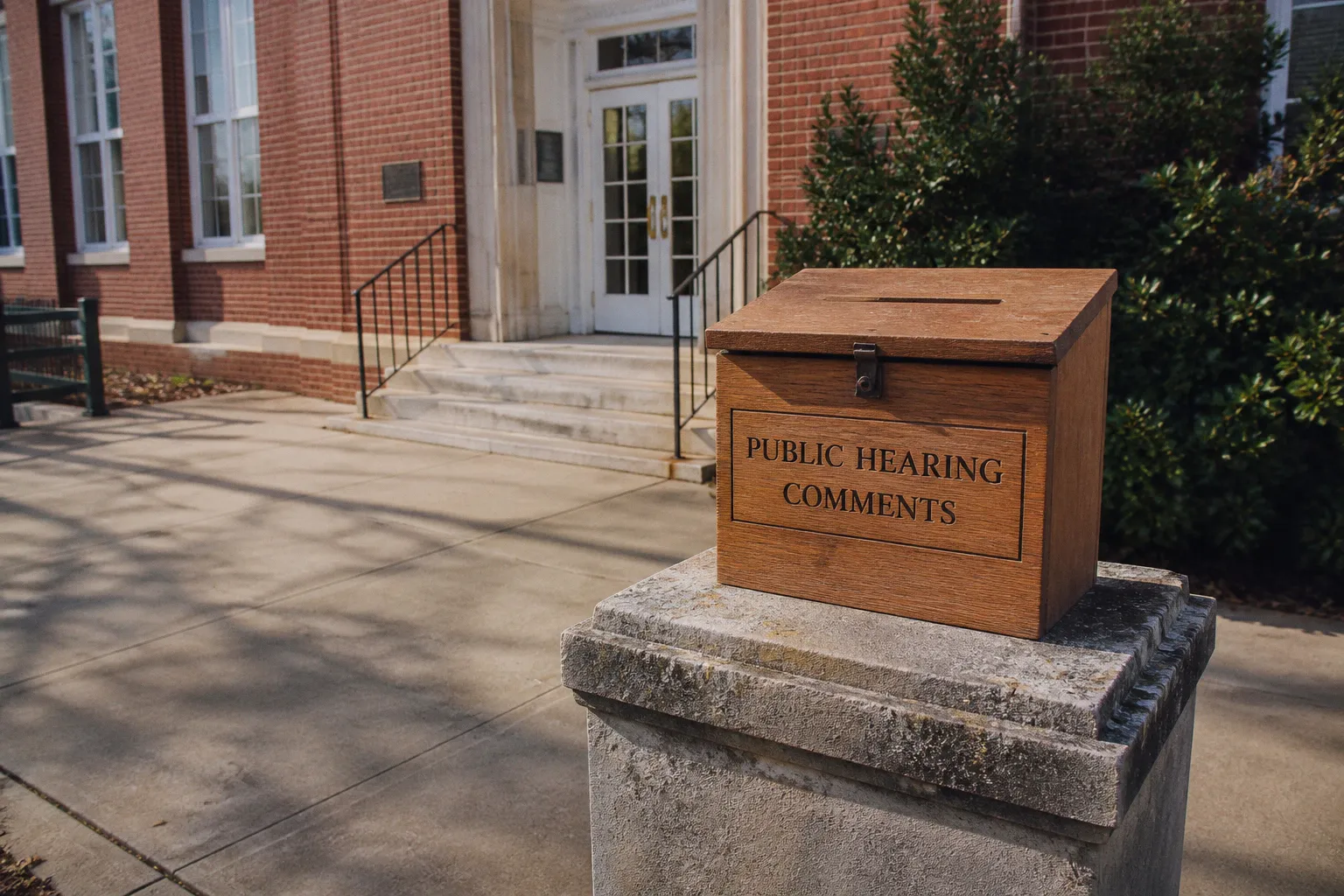
For many zoning, legislative, and land-use matters, the record develops across several stages: a Planning Commission hearing, a recommendation, a Board of County Commissioners hearing, written submissions, and a statutory period that can affect when final action takes place.
That structure matters. A comment delivered to the wrong body, attached to the wrong hearing, or submitted after the documented comment period may not carry the same procedural weight as testimony filed at the right stage. The practical task is straightforward but exacting: identify the hearing, identify the decision-maker, and get your remarks into the record while the process is still open.
For residents looking for a Somerset County public hearing testimony guide, the essential distinction is between oral testimony and written comments. Oral testimony gives you a limited opportunity to address the board directly. Written testimony gives you room to provide parcel information, maps, photographs, planning arguments, and other details that cannot fit comfortably into a few minutes at the microphone.
Navigating the Somerset County Office Complex for Hearings
The Somerset County Office Complex is located at 11916 Somerset Avenue in Princess Anne. Two locations inside the complex are relevant to residents following planning and zoning matters:
- Room 111 — the location identified for public hearings and public comment periods conducted by the Somerset County Planning Commission and the Board of County Commissioners.
- Suite 211 — the office of the Department of Technical and Community Services, or DTCS, which administers planning, zoning, and related public-hearing work and receives written submissions.
The location is only the first point to establish. The more important question is which public body is holding the hearing.
The Planning Commission generally considers the planning and technical side of a proposal. Its review may involve consistency with the Comprehensive Plan, the Zoning Ordinance, staff analysis, surrounding land uses, and the practical effects of a proposed change. In matters that proceed to the Board of County Commissioners, the Commission makes a recommendation rather than taking the final legislative action.
The Board of County Commissioners then conducts its own public hearing when the matter requires one and considers whether to adopt, approve, or otherwise act on the proposal. A resident following a rezoning or zoning text amendment may therefore encounter two separate opportunities to testify:
1. a Planning Commission hearing at the recommendation stage; and
2. a Board of County Commissioners hearing before final action.
Those hearings should not be treated as interchangeable. The same comment can be relevant at both stages, but the audience and the decision in front of each body are different. At the Planning Commission, connect the argument to the Comprehensive Plan, zoning standards, land-use compatibility, and the technical record. At the Commissioners' hearing, explain the broader consequences of the proposed action while still tying those consequences to the ordinance, property, or planning issue under consideration.
The first question is not “How do I speak?” It is “Which body is hearing this matter, and at what stage?” Get that wrong and a well-prepared comment can arrive in the wrong part of the record.
Before attending, read the agenda and the hearing notice together. The agenda tells you what is scheduled for that meeting. The notice supplies the matter's formal description and may identify the applicable comment deadline. If the item concerns a specific property, record the parcel number and the exact name or number of the proposed amendment. Those details make it easier to identify the correct file when you submit written material or ask DTCS for confirmation.
Do not assume that a hearing listed for one body will automatically be repeated on the same date or under the same procedures for the other. Planning Commission comments are part of the Commission's record and recommendation process. Comments to the Board belong to the later stage. If you want both bodies to consider your position, plan to participate at both hearings when the schedule permits.
Rules for Oral Testimony at Board of County Commissioners Meetings
At Board of County Commissioners meetings, members of the public who sign up to speak are limited to five minutes each. The time limit is short enough that preparation matters more than performance. A long introduction can consume half of the available time before the speaker reaches the point that the board actually needs to hear.
The basic sequence is:
1. Review the agenda before the meeting. Confirm that the public hearing or public comment period concerns the matter you intend to address.
2. Sign up to speak. The county's meeting procedure uses a sign-up process for members of the public who want to give oral comments. Follow the instructions available at the meeting and provide the identifying information requested.
3. Wait for the relevant agenda item. Public testimony belongs in the scheduled hearing or comment period, not in an unrelated portion of the meeting.
4. Identify yourself and the matter. State your name and make clear which ordinance, amendment, project, or parcel you are addressing.
5. Make one central argument. Use the remaining time for the strongest fact, the clearest impact, and the action you want the board to take.
6. Stop when the chair calls time. If the argument cannot fit within five minutes, submit the longer version in writing.
The five-minute limit applies to the Commissioners' meetings described in the county process. Planning Commission hearings may use their own ground rules, and there is not necessarily one universal time limit published for every Planning Commission hearing. Listen to the instructions at the beginning of that hearing. If the timing is unclear, ask before the hearing begins rather than assuming that the Commissioners' rule applies automatically.
A useful oral statement usually has four parts:
- Identification: “I am speaking about the proposed zoning amendment affecting [matter or parcel].”
- Position: “I support” or “I oppose” the proposal.
- Reason: explain the effect on land use, traffic, drainage, infrastructure, public services, or consistency with the county's planning documents.
- Request: ask the body to deny, approve, defer, modify, or further study the proposal, depending on the issue.
The goal is not to cover every concern anyone has ever raised about development. It is to put a clear, attributable position into the record. If you have supporting material, mention it without trying to read every page aloud. A drainage photograph, survey plat, traffic information, or relevant passage from the Comprehensive Plan can be submitted as part of a written comment.
Oral testimony is not normally a debate format. The board may ask a clarifying question, but speakers should not expect an extended exchange or an immediate ruling on the merits. Address the chair and the body, not another speaker. Avoid treating the public hearing as a chance to cross-examine an applicant. The hearing is an opportunity to state your position and provide information for the record.
At the Planning Commission, the conversation may feel more technical because the Commission is reviewing planning criteria and making a recommendation. That does not make personal experience irrelevant. A resident who can connect a lived problem—recurring drainage, a difficult access point, or a conflict with an established use—to a specific planning standard gives the Commission something more useful than a general expression of anger.
Submitting Written Comments to the Department of Technical and Community Services
Written testimony is often the stronger route for a complicated land-use issue. It allows the writer to identify a parcel, quote the relevant planning language, attach supporting material, and explain the requested outcome without the pressure of a five-minute clock.
The documented submission channels listed for DTCS are:
| Channel | Contact | Practical consideration |
|---|---|---|
| [email protected] | Identify the hearing date, matter, and ordinance or project name in the subject line. | |
| Fax | (410) 651-2597 | Include enough identifying information for the submission to be associated with the correct hearing file. |
| Somerset County Office Complex, DTCS, Suite 211, 11916 Somerset Avenue, Princess Anne, MD 21853 | Allow time for delivery before the stated deadline. |
When the notice does not clearly explain whether a particular document or format will be placed in the official hearing file, contact DTCS and ask. The relevant question is not simply whether an email can be sent. It is whether the submission will be received in time and associated with the matter that the Planning Commission or Board of County Commissioners will consider.
A written comment should make that association easy. Put the following near the top:
- the name or number of the ordinance, amendment, application, or project;
- the hearing body, if known;
- the scheduled hearing date;
- the writer's name and contact information;
- the position being taken; and
- the requested action.
For a property-specific matter, include the parcel number whenever it is available. A street description may be incomplete or ambiguous, particularly where several properties share a road frontage or a rural address. The parcel number gives DTCS a more precise way to identify the affected land.
The body of the comment should then move from claim to support. “I oppose this rezoning” states a position, but it does not explain why the decision-maker should act differently. A more useful submission might explain that the proposal conflicts with a designated land-use pattern, would intensify traffic at a particular access point, raises a drainage concern documented by attached photographs, or creates a compatibility problem with adjoining uses.
That does not mean every letter needs to sound like a legal brief. Personal observations can be valuable when they are specific. Explain where the problem occurs, when it occurs, and how it relates to the proposal. Distinguish what you personally observed from what you are asking the county to verify. Precision is more persuasive than exaggerated certainty.
Attachments should be labeled and referenced in the text. If you provide a map, photograph, survey, or excerpt from the county's Comprehensive Plan, give it a simple title—“Attachment A: Drainage photograph,” for example—and explain what the decision-maker should notice. A document that arrives without context may still be available to staff, but a well-organized submission makes the relevant point easier to locate.
Sign and date your comment, and keep a copy of everything submitted. A copy allows you to refer to the same text if you speak at the hearing. It also gives you a record of what you sent, when you sent it, and which attachments accompanied it. The county's current procedures should control questions about signatures, intake, and whether a particular submission has been added to the file; do not rely on an assumed practice when the hearing notice or DTCS can confirm the requirement.
The same discipline applies to email. Use a subject line that names the matter rather than sending a message with a generic subject such as “Public comment.” Put the substance in the message or attach a clearly identified document, and retain the sent email and attachments. If timing is close, ask DTCS to confirm receipt rather than assuming that transmission alone means the material has been logged.
Understanding the 10-Day Statutory Review Window
The phrase “ten days” can refer to more than one procedural feature, which is why residents should read the notice carefully instead of treating every ten-day period as the same deadline.
For many legislative and zoning hearings, the county's procedures provide a period after the hearing during which written comments may still be accepted before the matter advances to the next stage or final action. That period is not a universal rule for every public hearing. Its existence, length, and closing point depend on the type of matter and the procedures stated in the applicable notice or county instructions.
The safest approach is to treat the published deadline as controlling. If the notice says written comments are due by a particular date or time, submit by then. If the notice is unclear, ask DTCS how the post-hearing comment period applies to that specific matter. A late submission may still be received, but receipt is not the same as inclusion within the formal period established for the hearing.
The separate statutory rule concerns adoption. Under Maryland Local Government Code § 9-105, the Board of County Commissioners must wait at least ten days after the public hearing before adopting an act, ordinance, or resolution covered by the statute. That waiting period is not automatically a promise that the board will accept new comments throughout the entire interval. It is a limit on when adoption may occur.
This distinction is the point at which many otherwise careful participants become confused:
- A post-hearing comment period, where applicable, is an administrative or procedural opportunity described for the particular matter.
- The statutory waiting period, where § 9-105 applies, controls the earliest point at which adoption may occur.
- Neither period should be assumed to apply identically to every public hearing.
The ten-day adoption rule creates time before final action; it does not, by itself, create an unlimited right to submit new material until the vote.
For a legislative or zoning proposal, the two periods may overlap. A hearing can take place, a documented written-comment window can close, and the statutory waiting period can continue before the Commissioners are legally able to adopt the measure. That remaining time should not be treated as a grace period. If your comment matters, send it during the period identified in the notice.
The distinction also affects how you interpret a meeting schedule. A matter appearing on the next Commissioners' agenda may still be subject to the statutory waiting period, while a matter that is not yet scheduled for adoption may have its written-comment deadline already closed. Look at the actual notice, not just the date of the next meeting.
When a proposal is delayed, continued, or referred back for additional work, the procedural posture can change. A new hearing, revised notice, or additional opportunity for comment may be required depending on what the county is considering. Residents should not assume that a postponed meeting automatically reopens every prior deadline. Confirm whether the county has issued a new notice and what submissions will be accepted for the continued or revised matter.
Public Notice Requirements and Property-Specific Signage
Public notice is the mechanism that gives residents a meaningful chance to participate before a land-use decision is made. For the matters covered by the documented Somerset County process, notice can involve two separate tracks.
First, Maryland law requires publication of notice for covered public hearings. Under Maryland Local Government Code § 9-105, the county must publish notice of the hearing and a summary of the proposed ordinance in a local newspaper of general circulation once a week for two successive weeks. The notice includes the basic information a member of the public needs to identify the hearing, including the date, time, place, and subject of the proposed action.
Second, the Somerset County Zoning Ordinance provides for physical posting on affected property or properties for the relevant planning and zoning matters. In a rezoning case, that can mean a sign at the parcel. The sign is not a substitute for reading the formal notice, but it is a practical signal that a property-specific process is underway.
The two forms of notice serve different audiences. Newspaper publication gives the county a formal public channel for announcing the hearing. Property-specific signage puts the information where nearby owners, tenants, and people who use the surrounding area are more likely to see it.
For residents monitoring a proposal, three habits are useful:
1. Read the public-notice section of the local newspaper. The legal-advertisement pages may be easy to overlook, but they contain formal hearing information for covered matters.
2. Check the property itself when the issue is parcel-specific. A sign can alert you to a proposal even if you have not yet located the newspaper notice.
3. Review Planning Commission and Board of County Commissioners agendas. The agendas help distinguish a recommendation-stage hearing from a later hearing before the Commissioners.
A property sign can raise questions without answering all of them. It may tell you that a rezoning, variance, or related matter is pending, but the hearing notice and agenda provide the more complete description of what is being proposed and which body will hear it. Note the parcel, photograph the sign if necessary for your own records, and then verify the matter through the county's published information or DTCS.
Notice problems should be raised promptly. A missing or defective notice can affect the validity or timing of a proceeding, but the consequence depends on the type of notice, the governing rule, and the facts of the case. It is better to ask a specific procedural question—whether the required publication occurred, whether the affected parcel was posted, or whether a revised notice was issued—than to assume that any irregularity automatically resets the process.
The Eastern Shore context makes property-specific notice especially important, but it also argues for restraint in describing impacts. A proposed change may affect drainage, traffic, access, neighboring uses, views, or public services; the relevant point is the documented relationship between the proposal and the affected properties. Avoid broad claims about the county's geography unless they are necessary and supported. A strong comment identifies the particular parcel and the particular consequence rather than relying on a sweeping description of Somerset County.
Making the Record Work for You
The public hearing process rewards specificity. A board cannot act on an argument it cannot connect to the matter before it. The most common problems are procedural rather than dramatic: the speaker attends the recommendation hearing but not the later Commissioners' hearing, the letter names a general concern without identifying the amendment, or the comment arrives after the deadline stated in the notice.
A few distinctions are worth keeping in view:
- Planning Commission comments are not the same as Commissioners' comments. The bodies occupy different stages of the process.
- Oral testimony is not a substitute for a detailed written record. Use the microphone for the central argument and the written submission for supporting detail.
- A statutory waiting period is not automatically a comment period. The notice for the specific hearing controls when written comments are accepted.
- Late comments are not guaranteed the same treatment as timely comments. They may be received, but they may arrive after the formal record has been assembled or after deliberation is effectively complete.
- A property sign is an alert, not the entire file. Use it to locate the matter, then confirm the hearing body, agenda item, and deadline.
- Remote participation is not guaranteed. If the agenda does not confirm a virtual option, plan around in-person attendance or use the written channel.
If you are preparing testimony for a zoning amendment or reclassification, start with the hearing notice and work outward. Copy the exact matter name. Note the hearing body and date. Find the parcel number. Then decide what belongs in a five-minute statement and what belongs in the written submission.
A concise oral statement might explain that the proposal is inconsistent with a specific Comprehensive Plan policy, would change the intensity of use at an identified parcel, and creates a documented concern about access or drainage. The written version can add the relevant policy language, photographs, maps, and a clear request for action. That division of labor keeps the spoken testimony focused without sacrificing the evidence.
There is also value in submitting a comment even when you plan to speak. A written comment gives the board something precise to review after the meeting and reduces the risk that an important detail is lost in a hurried transcription or incomplete recollection. Conversely, speaking can make the written material easier to understand by highlighting the one point that should receive attention first.
The process is formal, but it is not mysterious. Somerset County's planning and zoning hearings are built around identifiable decision-makers, published notice, property-specific information, public testimony, written submissions, and—when the applicable law requires it—a period before final adoption. The resident's job is to follow those stages closely.
Do not wait for the final vote to begin assembling an argument. By then, the relevant hearing may have passed and the applicable comment window may be closed. Find the notice, establish whether the matter is before the Planning Commission or the Board of County Commissioners, submit written material through the documented DTCS channel, and use oral testimony to make the central point clearly. That is how public participation becomes part of the record rather than merely a reaction after the decision has already been made.