Planning staff reports: what they are and how they work
A planning commission agenda can look deceptively simple: a site plan, a rezoning request, a floating zone application, and a recommendation from county staff.
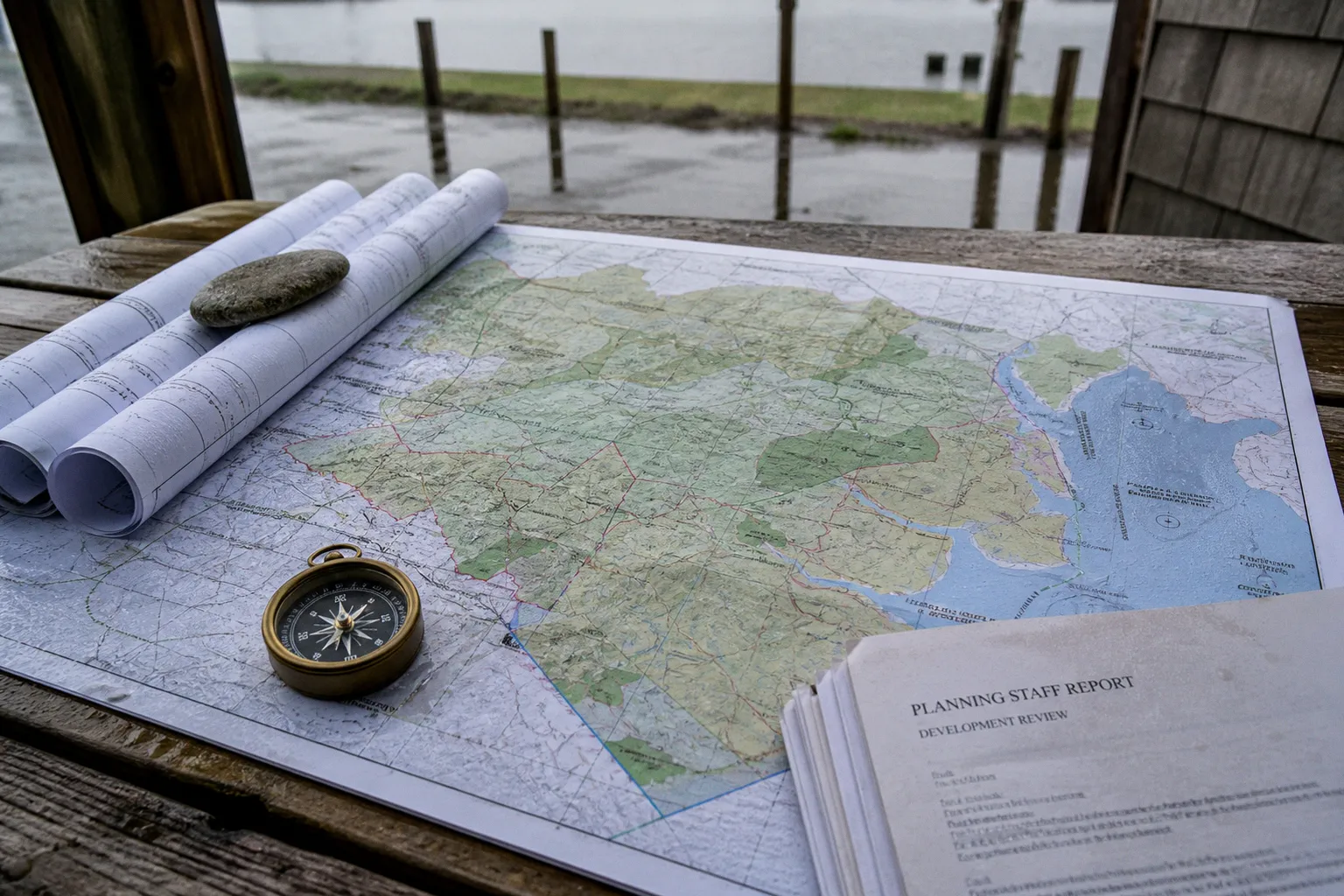
But behind that short agenda entry is usually a much fuller document—the planning staff report—that explains what is being proposed, how it fits local rules, what the surrounding area looks like, and what decision-makers should consider before voting.
For residents, this report is often the most useful place to begin. It is where a development proposal becomes more than a drawing or a notice about a public hearing. The report connects the proposal to the comprehensive plan, zoning requirements, public facilities, environmental constraints, and the practical question that matters on every block: what this means for our community fabric.
Understanding the planning commission staff report purpose helps us participate more confidently. We do not have to be land-use attorneys or professional planners to read one. We need to know what information the report contains, which conclusions are advisory, and where the document leaves room for public questions.
The technical anatomy of a planning staff report
So, what is a planning staff report in practical terms? It is a technical and analytical document prepared for a planning commission, local officials, applicants, and the public. Its job is to organize the facts and policies surrounding a land-use decision before the hearing takes place.
In Somerset County, Maryland, the Department of Technical and Community Services prepares and presents planning staff reports for development matters that come before the Planning Commission, including site plan reviews and floating zone applications. The report becomes part of the official public record, which means it is not simply an internal memo. It is one of the documents residents can use to understand how the county evaluated a proposal.
Most reports follow a recognizable sequence, even when the headings differ from one case to another.
| Part of the report | What it usually covers | Why it matters to residents |
|---|---|---|
| Background and site description | Applicant, property location, proposed use, surrounding parcels, existing conditions | Establishes what is changing and what sits around the site now |
| Technical and regulatory analysis | Zoning standards, land-use policies, comprehensive plan consistency, public facilities, environmental requirements | Shows how the proposal fits—or conflicts with—the rules and plans that guide growth |
| Staff recommendation | Approval, denial, postponement, or approval with conditions | Identifies the professional staff position, while leaving the final decision to the appropriate public body |
| Suggested conditions | Design changes, access requirements, buffers, infrastructure measures, or other safeguards | Gives the commission and applicant specific tools for addressing identified concerns |
The background section may appear straightforward, but it sets the foundation for everything that follows. A proposal for housing on a vacant parcel raises different questions from a commercial expansion beside an established neighborhood. The report may describe adjacent roads, nearby properties, existing land uses, drainage patterns, or the relationship between the site and public utilities.
This is where we should slow down. The location is not just an address. It is part of a network of streets, homes, businesses, farms, waterways, public services, and future plans. A site plan that appears reasonable when viewed by itself may raise very different questions when considered in the context of the surrounding area.
The technical analysis then moves from description to evaluation. Staff may examine whether the requested use is allowed in the applicable zoning district, whether the layout satisfies development standards, whether the proposal aligns with the comprehensive plan, and whether public facilities can support the change.
A planning staff report is therefore not the same thing as a project brochure. It is designed to place the proposal inside the framework the county uses to make land-use decisions.
A staff report turns a development proposal into a public question with facts, policies, and a documented path for discussion.
Why comprehensive plan alignment matters
The comprehensive plan is one of the most important policy references in a staff report because it describes the community’s long-term intentions for land use, growth, transportation, housing, infrastructure, environmental protection, and other areas of public policy.
That does not mean the comprehensive plan answers every development question by itself. It is not a parcel-by-parcel approval document. Instead, it provides the broader direction against which individual decisions can be evaluated.
When a report discusses comprehensive plan alignment, we should look for more than a passing reference. A useful analysis explains how the proposal relates to the plan’s goals and whether there are tensions between the requested action and the county’s stated direction.
For example, a report might address questions such as:
- Is the proposed use located in an area identified for growth, reinvestment, conservation, agriculture, or another long-term purpose?
- Does the project support or complicate the transportation pattern envisioned for the area?
- Are water, sewer, stormwater, or other public facilities available or planned?
- Would the proposal reinforce an existing community or create a new demand for services?
- Are there environmental or shoreline policies that change how the site can develop?
- Does the request require a zoning change in order to achieve a use that the comprehensive plan does not clearly anticipate?
The answer is rarely as simple as “the plan supports it” or “the plan does not support it.” Planning is a matter of applying broad policy to a specific place. A report should explain that connection in a way that lets the public follow the reasoning.
National research on land-use staff reports offers a useful caution here. In a study of reports from 94 cities, 79% of simple rezoning reports referenced a comprehensive plan. That shows how commonly the plan appears in the record. But a reference alone is not the same as a meaningful analysis. The real question is whether the report explains which policy applies and how the proposal advances, conflicts with, or falls somewhere between the plan’s goals.
This distinction matters on our block. If a project is described as consistent with the comprehensive plan, we should be able to see why. Which land-use designation is relevant? Which policy supports the conclusion? Are there policies pointing in another direction? Does the recommendation depend on conditions that have not yet been agreed upon?
A clear report does not pretend that planning decisions are automatic. It makes the judgment visible.
How to read the analysis without getting lost in jargon
Planning reports can be dense because they have to bring several kinds of information together: maps, code standards, engineering comments, policy documents, agency requirements, and site-specific facts. We can make the document more manageable by reading it in layers rather than treating every paragraph as equally important.
Start with the decision being requested
Before examining the details, identify the exact action before the commission. Is the applicant asking for site plan approval, a floating zone, a rezoning, a comprehensive plan amendment, or another land-use action?
The type of request determines the questions staff must answer. A rezoning request may focus heavily on the relationship between the proposed district, surrounding uses, and the comprehensive plan. A site plan review may concentrate more on the arrangement of buildings, access, parking, landscaping, stormwater, and compliance with development standards.
If we do not identify the requested action, it becomes easy to debate the project in general terms while missing the legal and policy test the commission actually has to apply.
Read the site context next
Look for the description of neighboring properties and existing conditions. Pay attention to roads, intersections, nearby residential areas, commercial uses, farmland, waterways, public facilities, and utility availability.
This section can help translate a technical application into everyday consequences:
- Will traffic use an existing residential street or a larger connector?
- Is the proposal an extension of an established pattern or an isolated change?
- Are homes, businesses, or agricultural operations close enough to experience noise, light, traffic, or drainage impacts?
- Does the site depend on infrastructure that is already in place, or would the decision encourage new investment and expansion?
- Are there natural features that affect what can be built and where?
These are not separate from planning policy. They are the local conditions that give the policy meaning.
Then examine the standards
The regulatory section may refer to zoning districts, dimensional standards, permitted uses, site design requirements, public facilities, or environmental rules. We should distinguish between standards that are clearly met, standards that require interpretation, and standards that may be addressed through conditions.
A helpful way to organize notes is to sort findings into three columns:
1. Confirmed compliance: The report explains that the proposal meets a stated requirement, and the supporting information is clear.
2. Open question: The report identifies an issue that needs clarification, additional documentation, or further review.
3. Proposed condition: The report suggests a specific measure to reduce an impact or complete a requirement before approval.
This approach is more useful than simply counting how many pages the report devotes to a topic. A short paragraph may resolve a straightforward requirement, while a longer section may reveal that a key issue remains unsettled.
Look for the evidence behind the conclusion
The most important passage is often not the conclusion itself but the explanation that leads to it. If staff say that a request is consistent with the comprehensive plan, what policy or designation supports that finding? If the report identifies adequate public facilities, what information is that conclusion based on? If a concern can be handled through a condition, is the condition specific enough to be enforceable and understandable?
This is also where residents can identify productive questions for a public hearing. Instead of asking whether staff “like” the project, we can ask how a particular conclusion was reached and whether the recommended conditions address the concern fully.
Recommendations are important—but they are not the final vote
A planning commission staff recommendation is the professional position offered by planning staff after reviewing the application and relevant policies. It can recommend approval, denial, postponement, or approval subject to conditions. But it is advisory.
The planning commission or elected officials with voting authority make the final decision within the applicable process. Staff do not issue a legally binding order simply by writing a recommendation, and an applicant does not receive approval merely because a report is favorable.
That distinction is central to how we navigate the board and participate in a hearing. A staff recommendation carries weight because it reflects technical review, but it does not close the public conversation.
Research on land-use staff reports found that 80% of the reviewed reports included staff recommendations to the planning commission. Yet only 40% provided a clear written justification for the recommendation. That finding points to a common weakness: the report may tell readers what staff recommend without fully showing how the analysis supports that position.
When reading the recommendation section, look for four things:
- The decision: What action does staff recommend?
- The reasoning: Which facts, standards, and policies support it?
- The conditions: What must happen before or after approval?
- The unresolved issues: What remains uncertain, disputed, or dependent on another agency?
A recommendation with conditions deserves especially careful reading. Conditions can be valuable because they give the commission a way to address access, landscaping, buffering, drainage, public facilities, or other concerns. But a condition should be concrete. It should be clear what must be done, by whom, and at what stage of the process.
A general promise to “address traffic concerns” is not as informative as a condition that identifies a required access change, review, plan, or approval. Residents do not need to write the condition themselves, but we should be able to understand what protection or improvement it is supposed to provide.
The recommendation also should not be treated as a substitute for the report’s underlying analysis. If the reasoning is thin, the public has a legitimate reason to ask for clarification before the commission acts.
The recommendation is a signpost, not the destination; the record should still show how the decision was reached.
Maryland Critical Area review adds another layer
Somerset County’s coastal geography means that some land-use decisions may involve Maryland Critical Area requirements. The Critical Area generally concerns land within 1,000 feet of tidal waters and tidal wetlands, where development decisions must account for shoreline resources, growth allocation, water quality, and environmental protection.
For proposals in these areas, a local planning staff report may be accompanied by a state-level staff report addendum from the Maryland Critical Area Commission or another relevant state review. That addendum provides technical analysis related to land growth allocations within the shoreline buffer and other Critical Area requirements.
This additional layer can make a proposal feel more complicated, but the basic reading strategy remains the same. We can ask:
1. Is the property within the applicable Critical Area boundary?
2. Does the report identify the relevant shoreline buffer or environmental designation?
3. Is growth allocation required, and if so, how is it addressed?
4. Does the state addendum support the local analysis, add conditions, or identify a conflict?
5. Which issues are within the local commission’s authority, and which require state coordination?
The presence of a state review does not mean local participation becomes unnecessary. It means the decision is being evaluated through more than one level of planning policy. Public comments can help identify site-specific facts, such as drainage patterns, access conditions, or neighborhood impacts, that may not be obvious from a plan set alone.
At the same time, we should avoid treating environmental review as a catch-all argument against every project near the water. The strongest comments connect a concern to a particular feature of the site, a stated requirement, or a policy objective. Specificity helps the commission understand what needs attention.
What a staff report can—and cannot—tell us
A planning staff report is a powerful public document, but it has limits. It is not a guarantee that every future detail of a project will unfold exactly as described. It may not resolve matters assigned to another agency, and it does not replace the public hearing itself.
The report can help us understand:
- What the applicant is asking the county or municipality to approve.
- Which rules, plans, and policies staff applied.
- What staff believe the major impacts and compliance issues are.
- Whether public facilities and infrastructure appear adequate under the information available.
- Which conditions staff believe should accompany approval.
- What reasoning has entered the official record before the hearing.
It may not answer every operational question, particularly where later permits, engineering review, utility approvals, or construction-stage decisions are involved. That is not necessarily a flaw, but the boundary should be clear. A good report tells readers what has been evaluated and what remains outside the current decision.
This is why the public record matters. Meeting agendas, staff reports, exhibits, maps, testimony, questions from commissioners, and the final action together create a fuller account than any single document can provide.
For residents, the report is often the best starting point because it gives us the vocabulary and structure to engage with the rest of the record. Instead of arriving at a hearing with only a general impression, we can refer to the exact land-use request, the relevant plan policy, the staff finding, or a condition that needs clarification.
Bringing the report to a public hearing
Public participation does not require us to summarize the entire report at the microphone. A focused comment is usually more useful than a long list of every possible concern.
Before a Somerset County public hearing or Planning Commission meeting, we can prepare by following a simple sequence:
1. Identify the requested action. Write down whether the matter involves a site plan, floating zone, rezoning, plan amendment, or another decision.
2. Mark the site context. Note nearby roads, homes, businesses, farms, waterways, utilities, and public facilities that may be affected.
3. Find the policy connection. Locate the comprehensive plan designation or policy discussed in the report, then compare it with the proposal.
4. Separate evidence from assumption. Distinguish what the report confirms from what it leaves open.
5. Review the recommendation and conditions. Ask whether the conditions respond directly to the impacts identified in the analysis.
6. Prepare one or two specific questions. A question about traffic access, public facilities, Critical Area requirements, or plan consistency is easier for the commission to address than a broad objection.
7. Connect the concern to place. Explain what the decision could mean for your street, neighborhood, shoreline, farm operation, or daily route.
That last step is especially important. Planning decisions are technical, but their effects are lived locally. A question about public facilities may be about whether children can safely reach a bus stop. A question about access may be about emergency vehicles, school traffic, or the safety of people walking along a narrow road. A question about a buffer may be about whether an existing neighborhood retains privacy and drainage protection.
When we explain the connection between the policy and the lived experience, we make public participation more useful for everyone in the room.
A clearer record makes better decisions
Planning staff reports do not eliminate disagreement, and they are not meant to. Their value is that they make the basis for a land-use decision more visible. They gather the proposal, site conditions, regulations, comprehensive plan, infrastructure questions, environmental review, and staff judgment into a document that can be examined by commissioners and residents alike.
For our community, the most important habit is not memorizing planning terminology. It is learning to follow the chain of reasoning:
- What is being requested?
- What conditions exist on the site?
- Which rules and policies apply?
- What does the analysis show?
- What does staff recommend?
- What remains unresolved?
- Who has authority to decide?
Once that chain is clear, a public hearing becomes less intimidating. We can participate without pretending to know everything, and we can ask questions that are grounded in the record rather than in speculation.
That is the real purpose of a planning commission staff report: not to replace public judgment, but to give the public and decision-makers a common foundation for exercising it.