What is a planning commission work session in Maryland?
You see "Planning Commission Work Session" on the agenda outside the County office — sandwiched between items like a zoning text amendment, a sketch plan for a subdivision on the edge of town, and a revision to the comprehensive plan chapter on growth.
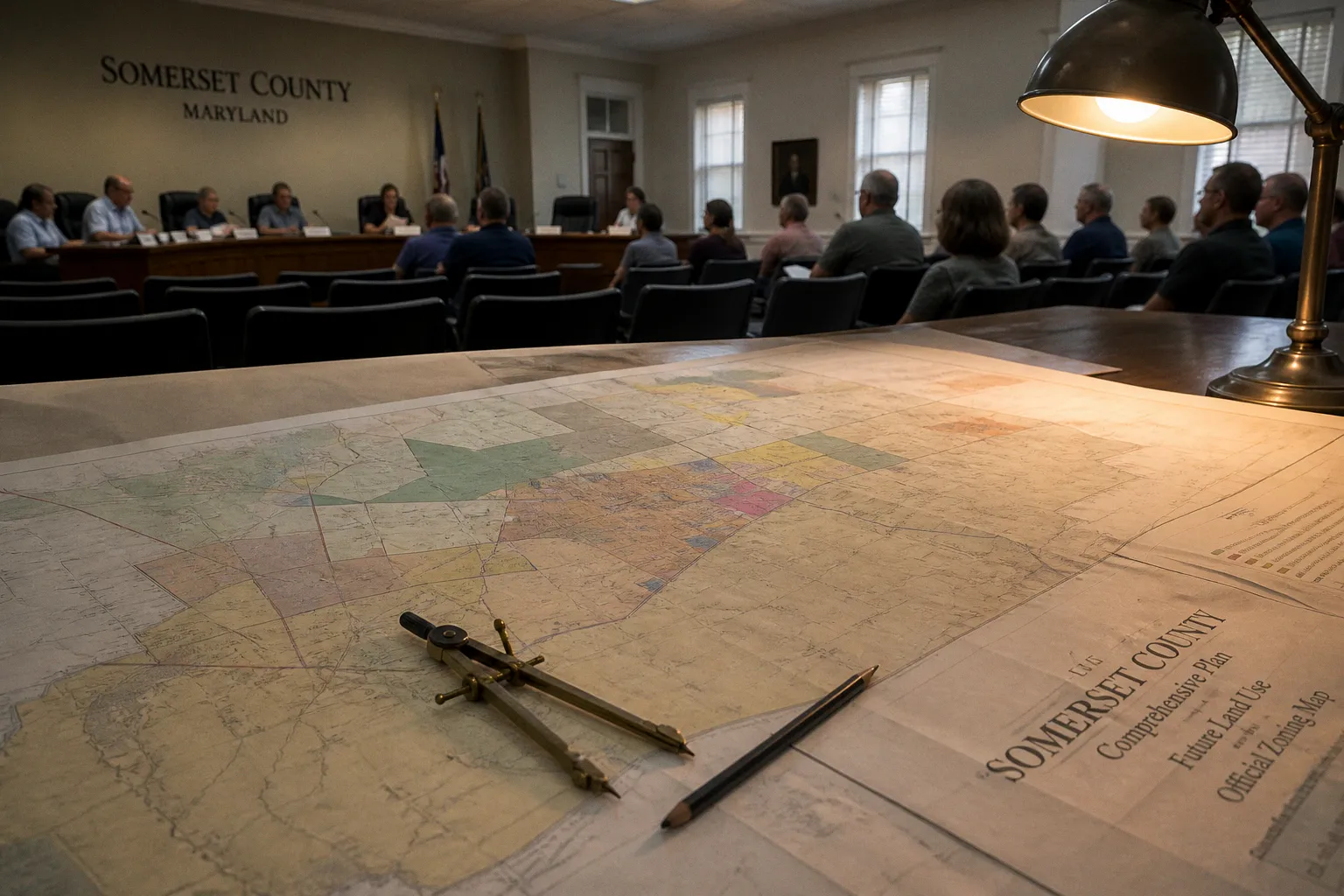
Your first question, more often than not, is whether you can show up and speak. The honest answer is layered, and it's the answer that determines whether you walk into the room prepared or walk out frustrated.
A work session is a public meeting where your local commissioners dig into the technical side of land use decisions before anything gets voted on — reviewing site plans, working through zoning text amendments, pressing applicants on stormwater and traffic counts, and shaping the language of comprehensive plan chapters. It's governed by the same Maryland Open Meetings Act that covers school boards, town councils, and every other public body in the state, so you have a legal right to be in the room, take notes, and observe the conversation as it happens. But unlike a public hearing, you're generally not signing up to testify at a work session — and that single difference changes what the meeting is for and what you do once you're there.
The Role of Work Sessions in Maryland Land Use Planning
The planning commission in any Maryland county or municipality — including Somerset County's planning commission — is the body that turns the community's long-range vision into something concrete enough to act on. Maryland's planning commissions draw their authority from the Land Use Article of the Annotated Code, which replaced the older Article 66B in 2012 and reorganized how counties and municipalities handle subdivision, zoning, and comprehensive planning. That authority is broad, but it's also procedural: the commission reviews proposals, holds hearings, makes recommendations to the legislative body (in most cases the county council or board of county commissioners), and updates the comprehensive plan that guides growth over a roughly twenty-year horizon.
A work session is one of the two main formats the commission uses to do that work. The other is the formal public hearing, and the differences between them are worth getting clear on, because they shape what you as a resident can expect and what you can accomplish by being there.
What makes a work session distinctive is that it's structured for depth, not for the public record in the same way. Commissioners sit around a table — sometimes a literal conference table, sometimes a slightly rearranged council chamber — with planning staff, the applicant or their consultants, and occasionally a county attorney. They walk through plans page by page, ask about setbacks and lot coverage, debate whether a proposed use fits the character of the surrounding neighborhood, and revise the language in a draft comprehensive plan chapter until the wording actually reflects what the commission means.
None of this is secretive. The room is open. The agenda is posted in advance under Maryland's open meetings rules. But the format is conversational and iterative in a way that a formal hearing isn't. Someone might say, "I can't support this density unless we see a transition plan for the adjacent parcels," and then everyone works through what a transition plan would actually look like, and two weeks later there's a revised sketch plan back in front of them. That's the texture of a work session — slow, deliberate, and focused on getting the technical questions right before the public hearing where testimony gets recorded.
Work Sessions vs. Public Hearings: Why the Distinction Matters for You
This is the part of the process that trips up more residents than anything else, and it's worth untangling carefully. The two meeting types look similar from the outside — same commissioners, same applicants, same dais — but they do different jobs and give you different levers.
| What you're trying to figure out | Work Session | Public Hearing |
|---|---|---|
| Main purpose | Technical review and deliberation on proposals, plan drafts, and revisions | Formal public testimony and a recommendation or decision on the record |
| Public testimony | Generally not taken; conversation runs between commissioners, staff, and the applicant | Standard feature; residents sign up, step to the microphone, and comments become part of the official record |
| What gets decided | Usually nothing binding — direction, revisions, questions to revisit | A recommendation to the legislative body, or in some cases a final decision |
| Format | Conversational, iterative, often around a table | Structured: staff presentation, applicant presentation, public comment, commission discussion, vote |
| Best time to attend if you want to... | ...understand how a project is actually being shaped | ...have your opinion formally entered into the record |
If you've ever wondered why a project you care about seems to keep moving even after a hearing, this table is part of the answer. Work sessions are where the substantive conversation happens. Hearings are where the public voice is captured. They're complementary, not interchangeable, and navigating the board well means knowing which one you're walking into.
A work session is where the commission thinks out loud. A public hearing is where they listen on the record. Knowing the difference changes what you do when you get there.
The Legal Framework: Maryland's Open Meetings Act and Your Right to Be There
Work sessions are public meetings, full stop. That status comes from Title 3 of the General Provisions Article of the Maryland Code, more commonly known as the Maryland Open Meetings Act. The Act has been the backbone of public access to county and municipal decision-making for decades, and it applies to planning commissions the same way it applies to your town council.
What the Act guarantees, in practical terms, is this:
- Adequate public notice before the meeting, generally including the date, time, place, and the items that will be discussed. For most planning commissions, that means the agenda is posted at the county office and on the county's meeting portal a few days ahead of the session.
- Open observation as a default. The meeting happens in a space the public can access, and you can be there. You don't need to explain why you're attending, and you don't need permission.
- Minutes or a recording that captures what was discussed. The level of detail varies — some commissions keep thorough minutes, others rely on audio recordings — but the conversation doesn't disappear into a void.
There are a few practical corollaries worth knowing. You can take notes. You can record the meeting within ordinary bounds of reason — no one wants a microphone three inches from a commissioner's face. You can hand a written comment to the planning staff or the commission chair before or after the meeting, even if the meeting itself doesn't include a public comment period. None of that requires you to be an attorney or a land use professional.
Where residents sometimes get tripped up is on the difference between attending and participating. Attending is your right under the Open Meetings Act. Participating — speaking from the floor, making a motion, questioning a witness — is governed by the commission's own bylaws, its adopted procedures, and the chair's discretion. The Act opens the door; local rules determine what you can do once you're through it.
When a Commission Can Legally Close the Door
The Open Meetings Act is built around the presumption of openness, but it isn't absolute. Maryland General Provisions § 3-305 lists fourteen specific statutory exceptions that allow a public body to recess into a closed executive session. These aren't loopholes — they're narrowly drawn categories where closing the door serves a legitimate purpose the legislature has already weighed.
For planning commissions, the exceptions that come up most often look something like this:
- Consulting with legal counsel about pending or potential litigation, or to preserve attorney-client privilege on a specific legal question tied to a land use matter.
- Preliminary proposals for the acquisition of real property — most relevant when a commission is advising the county on a potential land purchase and public discussion of price or negotiation strategy could undermine the county's bargaining position.
- Personnel matters involving a specific employee, where the individual's privacy interests outweigh the public interest in disclosure.
- Collective bargaining negotiations — a narrower exception than general contract discussions, applying specifically to labor negotiations between the public body and its employees' bargaining units.
Two things matter here. First, the vote to close the session has to happen in public, with a citation to the specific exception being invoked. You should be able to hear which of the fourteen grounds the commission is relying on. Second, the closed session is for discussion, not action. Any vote that comes out of an executive session has to be taken back in open session and reflected in the meeting minutes. So even when the door closes, the book isn't sealed.
If you're at a work session and the commissioners start moving toward a motion to close, listen for the citation. If they cite an exception that doesn't obviously fit the topic at hand — closing into executive session to discuss a routine zoning text amendment with no litigation and no property acquisition involved — that's worth following up on after the meeting. Most often, though, work sessions stay open from start to finish, and the closed-session machinery only kicks in when something genuinely sensitive has surfaced.
Sitting In: How Residents Observe and Make Themselves Useful
Watching a work session well is a skill, and like most civic skills, it pays off more than people expect. Here are a few habits that experienced attendees across Somerset County and the Eastern Shore tend to develop over time:
1. Read the agenda packet before you go. Planning commissions usually post staff reports, draft ordinances, and applicant materials a few days in advance. Twenty minutes with the packet tells you what the conversation is actually about, which saves you from sitting through an hour of unrelated business.
2. Arrive a few minutes early and introduce yourself to the planning director or staff. They are the people who can answer your procedural questions, tell you when a particular item is likely to come up, and explain what a confusing acronym means. Most planning staff genuinely want residents to understand the process.
3. Take notes on what the commission seems uncertain about. If three different commissioners ask the same question about traffic, that's a signal. If the applicant has to come back twice with the same kind of information, that's also a signal. Patterns matter more than any single answer.
4. Respect the format. Even though work sessions are more conversational than hearings, the chair is still running the meeting. If you want to make a comment, the usual move is to wait for a break or to talk with staff after the session — not to interrupt the conversation mid-thought.
5. Follow up in writing if a work session left you with a question. A short, polite email to the planning office — "I attended the work session on the Smith subdivision and wanted to follow up on the commission's question about the access easement. Where can I find more information?" — is welcomed and usually answered.
6. Watch for the next hearing date. Work sessions often tee up items for a future public hearing. If a project mattered to you, the hearing is where your testimony lands in the formal record.
There's one more habit worth naming, because it doesn't get talked about enough: bring a friend. Work sessions are not crowded affairs. They rarely draw more than a handful of residents, and that's actually one of their strengths — you can ask questions, read the documents on the table, and have a real conversation with staff. If you bring someone else, you double the eyes on the project and you make the meeting less easy to forget. Civic participation scales at the level of a coffee invite, not a petition.
You don't have to speak at every meeting to be part of the planning process. Showing up, paying attention, and following up after the fact is how the work of a community actually gets done.
What This Means for Our Block
Planning commission work sessions are where the bones of a community get their shape. They're less dramatic than a public hearing, less photogenic than a town hall, and they almost never make the local news. But the questions asked in those rooms — how dense should this neighborhood be, what should the setbacks look like, does this use belong next to a school, how do we phase the infrastructure that follows the rooftops — are the questions your block will be living with for the next thirty years. The Open Meetings Act gives you a guaranteed seat at the table; the only thing left is taking it.
The next time you spot "Planning Commission Work Session" on a posted agenda, walk in. Sit down. Listen. Take notes. Talk to staff afterward. You don't need a degree in planning or a folder of exhibits to be a meaningful part of the conversation. You just need to be there, alongside the rest of us who are quietly doing the slow, unglamorous work of weaving the community fabric — one work session, one sketch plan revision, one thoughtful question at a time.