Somerset public hearing sign-up errors and how to fix them
There is one hearing room for Somerset County land-use matters: Room 111 of the Somerset County Office Complex, 11916 Somerset Avenue in Princess Anne.
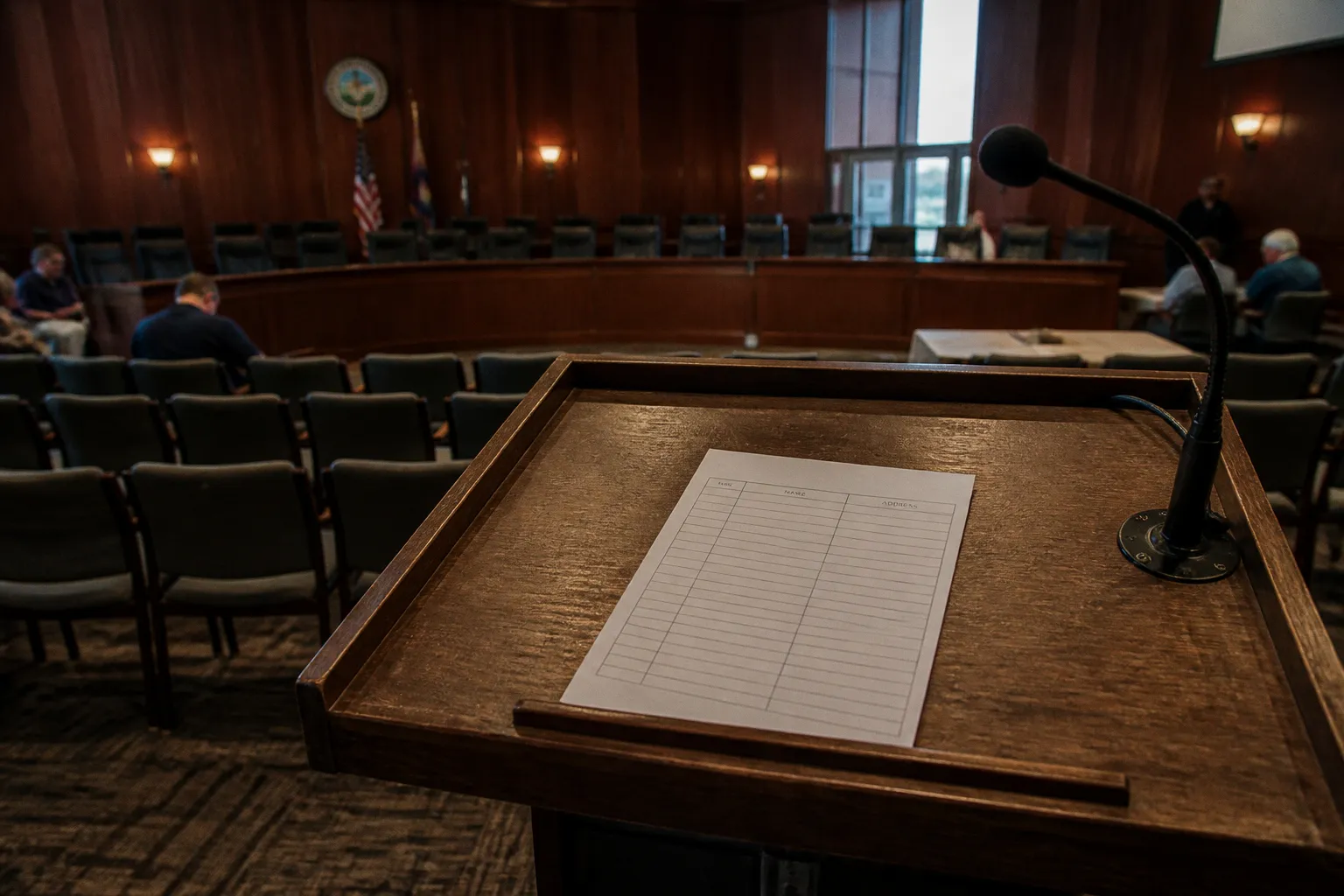
There is one intake office for written submissions: the Department of Technical and Community Services, Suite 211 of the same building. There is one clock to watch closely: five minutes per speaker at Board of County Commissioners meetings. And there are two decision-making bodies that share the address but not the function.
Residents regularly lose the thread between those four facts. A person attends a workshop believing it is the statutory hearing. Someone sends a detailed letter to the wrong office. A speaker signs up to address the Planning Commission when the relevant decision has already moved to the Board of County Commissioners. Another arrives with a strong argument but no case number, no written copy, and no clear idea which agenda item is being discussed.
The fix is not civic heroism. It is civic mechanics. Get the four facts right — body, room, office, case number — and the process becomes manageable. Get one of them wrong and your comment may be routed incorrectly, treated as advisory input rather than formal testimony, or left out of the particular hearing record you intended to address.
Distinguishing Between Informal Workshops and Statutory Hearings
The most consequential Somerset public hearing sign-up error is treating a community workshop like a public hearing. They are not the same event. They do not perform the same function, and they do not create the same kind of record.
Community workshops connected to a Comprehensive Plan update, online surveys, drop-in open houses, and stakeholder roundtables are generally designed to gather information before a decision is made. They give planning staff a way to hear concerns, identify subjects that need more explanation, and test how proposed policies or map changes are received. The resulting input may influence staff memoranda, marked-up maps, revised draft language, or the issues discussed at a later hearing.
That input matters. It is simply not a substitute for testimony submitted through the applicable formal hearing process.
Signing an attendance sheet at a workshop, completing an online survey, or placing a comment in a chat window during a virtual session does not by itself make the comment statutory-hearing testimony. Informal input is advisory and operates at a different stage of the process. It may help shape a draft or alert staff and officials to public concerns, but residents should not assume that it satisfies the filing or participation requirements for a later public hearing.
The distinction is especially important when the subject is the Somerset County Comprehensive Plan. A workshop can help staff understand whether residents are concerned about growth patterns, agricultural land, transportation, drainage, housing, shoreline issues, or the effect of a proposed policy. A formal hearing is the point at which the public is invited to submit testimony as part of the legally required consideration of the plan or related land-use action.
Under Maryland Land Use Code §3-203, a local planning commission is required to hold at least one public hearing before recommending adoption of a comprehensive plan. The Planning Commission’s hearing is therefore not just another public meeting. Testimony delivered there, along with written material properly submitted for the matter, can become part of the official file considered in the recommendation process. Later action by the Board of County Commissioners may involve a separate stage and a separate opportunity for public participation.
A workshop comment can shape the draft. A public-hearing comment addresses the decision-making record. Those functions overlap in subject matter, but they are not interchangeable.
The practical question is not whether one type of meeting is more important than the other. It is what you want your participation to accomplish.
If your purpose is to influence a draft before it reaches a recommendation, a workshop or survey may be the appropriate channel. If your purpose is to place a position before the body conducting a statutory hearing, you need to participate in that hearing or submit materials through the procedure that applies to it. When in doubt, ask which event is being noticed as the public hearing, which body is conducting it, and how written testimony should be filed.
What informal input can and cannot do
Informal participation can:
- identify a problem that staff had not considered;
- point out a local condition on a map or proposed development area;
- help residents compare the practical effects of competing policy choices;
- prompt staff to clarify language in a draft;
- show that a subject is generating public interest before the formal hearing stage.
Informal participation does not necessarily:
- replace testimony at a later statutory hearing;
- satisfy a case-specific submission procedure;
- guarantee that a comment will be entered under a particular land-use application;
- give the speaker the same procedural position as a person who submits testimony to the noticed hearing.
That last point is where many residents misread the process. Advisory input is not worthless, and it is not automatically erased. It is simply handled as advisory input. Whether and how it is considered later depends on the process, the officials involved, and the stage of the decision. The safe assumption is narrower: if a formal hearing is scheduled, take part through that formal channel rather than relying on an earlier workshop comment to do the same work.
Navigating the Correct Administrative Channels for Testimony
The structural problem is easy to describe: Somerset County uses two different bodies in the course of many land-use decisions. The Planning Commission reviews land-use applications, rezoning requests, and plan amendments for consistency with the Comprehensive Plan, the zoning ordinance, and applicable state requirements. It then issues a recommendation. The Board of County Commissioners receives that recommendation and takes the final legislative action where the matter requires action by the Board.
The two bodies may meet at the same building, but they are not the same audience.
A resident who speaks only at the Planning Commission hearing has addressed the recommendation stage. That testimony can be important to the Commission’s work, but the recommendation is not the same thing as the Board’s final action. If the matter proceeds to the Board of County Commissioners, residents should look for the Board’s agenda, notice, and public-comment instructions rather than assuming that an earlier appearance before the Planning Commission completes the participation process.
The same principle applies in reverse. Speaking at a Board meeting does not necessarily replace participation at an earlier Planning Commission hearing. The bodies have different responsibilities, and the record developed for one stage should not be confused with the opportunity provided at another.
There is no need to turn this into a legal theory exercise. Before signing up, identify three things:
1. Which body is meeting? Is the agenda for the Somerset County Planning Commission or the Board of County Commissioners?
2. What action is under consideration? Is the body discussing a workshop draft, a recommendation, a rezoning request, a plan amendment, or final legislative action?
3. What does the notice say about participation? Look for the public-hearing designation, the relevant agenda item, the submission method, and any time limit.
The recurring routing mistakes
Several procedural errors appear again and again in Somerset County planning matters.
- The wrong case number on a written submission. A letter may identify the correct property or project in ordinary language but still carry the wrong application or case number. Because staff use identifying information to route materials, the case number should be copied directly from the agenda, hearing notice, or application materials rather than reconstructed from memory.
- A letter sent to the wrong destination. A message to an individual commissioner, a general county mailbox, or a planning staff member may communicate your position, but residents should not assume that it has been accepted as a formal exhibit or filed under the relevant case. For a document that needs to be part of the official land-use file, confirm the intake route with the Department of Technical and Community Services.
- Confusing staff with the decision-making body. Planning staff can explain process, identify the assigned matter, and receive or route documents. They do not vote on behalf of the Planning Commission or the Board of County Commissioners. A staff conversation can clarify the mechanics without becoming a substitute for testimony.
- Treating a workshop sign-in as a formal record entry. An attendance sheet shows participation in an event. It does not necessarily identify the speaker’s position on a particular application, and it does not replace testimony at a properly noticed hearing.
- Assuming the Planning Commission’s action ends the matter. In matters that proceed to the Board, the Commission’s recommendation is one stage of the process. The Board may consider the recommendation and take its own action under its authority.
- Showing up for the right topic on the wrong date. A meeting about the Comprehensive Plan update may not be the hearing for a particular rezoning request, and a work session may not be the hearing listed in the notice. The title of the subject is not enough; match the date and agenda item to the case.
These are not arguments about whether a resident’s position is persuasive. They are errors in routing. A strong argument placed in the wrong procedural channel remains a poorly placed argument.
Common Procedural Pitfalls in Somerset County Planning
The phrase “somerset public hearing sign up errors” sounds like an administrative problem, and in practice that is exactly what it is. Most residents do not lose an opportunity because they lack a sophisticated position on land use. They lose it because the mechanics are unclear at the moment they need to act.
Mistaking the building for the body
The Somerset County Office Complex is a location, not a decision-maker. Because the Planning Commission and the Board of County Commissioners use the same address, residents sometimes treat any meeting in the building as an interchangeable opportunity to speak.
It is not.
The room tells you where the meeting is. The agenda tells you which body is meeting. The notice tells you what action is being considered. Read all three pieces together.
A resident concerned about a Comprehensive Plan recommendation should not rely on the fact that the same room hosted an earlier workshop. A person who spoke before the Planning Commission should not assume that the Board’s later meeting is merely ceremonial. The correct location is necessary, but it is not sufficient.
Treating every public comment period as a hearing
Public comment periods can appear on regular meeting agendas, while statutory hearings are separately noticed or tied to a specific action. The fact that a chair recognizes members of the public does not, standing alone, establish that the meeting is the formal hearing for your case.
This matters when you want to discuss an individual application. General comments about growth or county policy may be appropriate during a public comment period, but a case-specific submission should identify the application and follow the instructions for that matter. If the meeting notice names a public hearing, use the hearing’s procedures. If it lists only general public comment, ask how comments about a particular case should be submitted.
Relying on an earlier conversation
A conversation with a planner can be useful. It can help you understand the timeline, locate a document, or determine which body is handling the next stage. But it is not a reliable substitute for filing testimony.
The same is true of a conversation with a project representative, an elected official, or another resident. Those conversations may inform your position, but they do not place your position into the official hearing record. If the issue matters enough to raise, put it in the appropriate written or oral channel.
Bringing evidence without identifying it
Residents often arrive with photographs, maps, drainage concerns, traffic observations, or pages of notes. The material may be relevant, but relevance does not automatically make it part of the record. Identify the case, explain what the material shows, and ask how it should be submitted.
If you intend to speak, prepare a short oral version and a complete written version. The oral statement should tell the body what you want it to do and why. The written material can provide the detail that cannot fit within the time limit. Keep a copy for yourself and, if possible, record when and where you submitted it.
Assuming silence means rejection
A document may be accepted without producing an immediate response. A staff member may need to log it, associate it with a case, and distribute it for the relevant meeting. If you need confirmation, ask whether the submission was received and under what case number it was filed.
That question is more useful than asking whether officials agree with you. Intake confirmation addresses the procedural problem. The merits of the submission will be considered through the decision-making process.
Adhering to Oral Testimony Limits and Submission Deadlines
At Board of County Commissioners meetings, oral public testimony during the public comment period is subject to a five-minute limit per speaker. Five minutes is enough to make a focused argument. It is not enough to read a long brief, narrate every history of a property, and answer every possible objection.
A typed statement can quickly exceed what a speaker can deliver comfortably. Prepare for the clock rather than discovering its effect at the podium.
A useful oral structure is:
1. identify yourself and the agenda item or case number;
2. state whether you support, oppose, or seek a change to the proposal;
3. give the two or three reasons that matter most;
4. identify any document you are submitting;
5. state the action you want the body to take.
This structure is not a legal requirement. It is a way to keep the central point from being buried under background.
Prepare the written version separately
A written statement is not merely a transcript of a rushed speech. It can include a fuller explanation, attachments, photographs, map references, and specific questions. If the material is intended for the official file, submit it through the appropriate intake process and identify the case number clearly.
The written and oral versions should agree on the requested outcome. If the speech asks for denial but the written document asks for a delay, explain the difference. Conflicting requests make it harder for the body and staff to understand your position.
For residents preparing testimony about a comprehensive plan, useful subjects may include:
- the relationship between the proposal and existing plan policies;
- impacts on nearby land uses;
- transportation access and traffic patterns;
- drainage or stormwater conditions;
- agricultural or environmental concerns;
- the practical effect of proposed map or text changes;
- whether the proposal creates a precedent that the plan does not address.
The point is not to mention every possible issue. It is to connect your concern to the decision before the body.
Do not wait for the last possible moment
Maryland public participation planning mistakes often begin with a late discovery of the hearing date. Once a hearing has closed, a late comment may still be received as correspondence, depending on the circumstances, but residents should not assume that a late submission carries the same procedural position as testimony submitted through the noticed hearing process.
The safer practice is to treat the hearing date and submission deadline as separate deadlines:
- the date by which you must sign up or appear to speak;
- the date by which written material should be delivered for intake;
- the date of the meeting at which the body will consider the item;
- any later date associated with the Board’s action.
Do not infer these dates from a social-media post, an older agenda, or a neighbor’s recollection. Use the current notice and agenda, then confirm with the appropriate office if anything is unclear.
The five-minute limit is not the main risk. The main risk is arriving with a prepared argument for a hearing that is not the hearing you actually need.
Sign up before the public-comment item
For Board meetings, speaker lists are commonly distributed near the start of the meeting and collected before the public-comment period is reached. Late arrivals may be allowed to speak at the chair’s discretion, but that is not a dependable plan.
Arrive early enough to:
- locate Room 111;
- read the agenda;
- identify the body conducting the meeting;
- find the correct case number;
- complete the speaker card or sign-in sheet;
- ask where supporting documents should be delivered;
- settle on a short version of your statement.
If the agenda is unclear, ask before the meeting begins. It is easier to correct a routing error in the hallway than after the public-comment period has ended.
Locating the Right Office for Official Land-Use Submissions
Somerset County’s land-use process uses distinct physical channels inside the same building. Keeping them separate prevents the most basic submission errors.
Public hearings and public comment periods for the Somerset County Planning Commission and the Board of County Commissioners take place in Room 111 of the Somerset County Office Complex, 11916 Somerset Avenue in Princess Anne. That is where you appear to speak and where the meeting’s sign-in process takes place.
Written submissions — including exhibits, supporting documents, longer statements, photographs, drainage or traffic materials, and other information you want considered — go to the Department of Technical and Community Services, Suite 211 of the same building. Staff handle intake, associate the material with the relevant matter, and route it to the appropriate body.
The distinction can be summarized this way:
| Submission type | Function | Practical destination |
|---|---|---|
| Oral testimony at a public hearing | Allows you to address the body during the noticed hearing and have your remarks considered through that process | Room 111, 11916 Somerset Avenue |
| Written statement or exhibit | Provides a fuller record of your position and supporting material | Department of Technical and Community Services, Suite 211 |
| Workshop, survey, or open-house comment | Provides advisory input during the planning or draft-development stage | The workshop organizer, planning office, or identified online portal |
| Email to an individual official or general mailbox | Communicates your position but may not satisfy formal filing instructions | Confirm with DTCS whether and how it was received for the case |
The last row deserves particular attention. Sending an email is easy; proving that it was received as a properly filed case submission is a separate question. If you send materials electronically because the deadline is close, follow up with the Department of Technical and Community Services and ask whether the document was accepted, under which case number, and whether anything else is required.
What to bring to the intake office
Bring the information that allows staff to identify the matter without guesswork:
- the case number or application number;
- the property address or other identifying description;
- the date of the relevant hearing;
- your name and contact information;
- the title of the document;
- a clear statement of whether you support, oppose, or request a modification;
- copies of attachments that you want considered.
If your submission concerns the Comprehensive Plan rather than a single application, identify the plan section, map, policy, or proposed language at issue. General opposition to growth is less useful to staff and decision-makers than a specific explanation of which policy or map change concerns you and why.
Do not assume that the person receiving a document can determine its purpose from a stack of pages. Put the case number on the first page and, where appropriate, on each attachment. Keep a complete copy of everything submitted.
Confirming that a submission was logged
The most useful follow-up question is procedural: was the document received and associated with the correct case?
Ask for confirmation rather than relying on the fact that someone accepted an envelope or acknowledged an email. A receipt, intake note, or confirmation of the case number can prevent a later dispute about where the material belongs. If you learn that the document was routed incorrectly, resubmit it promptly and explain the correction.
This is also the point at which residents can clarify whether a particular meeting is a workshop, a Planning Commission hearing, a Board hearing, or a regular meeting with general public comment. Those labels determine what the meeting can accomplish and how your participation should be recorded.
A More Reliable Way to Prepare
The simplest preparation method is to make a one-page record of the matter before you leave home. It should contain:
- the name of the decision-making body;
- the meeting date and time;
- the room;
- the case or application number;
- the action under consideration;
- the sign-up procedure;
- the written-submission destination;
- the deadline or hearing date;
- the requested outcome.
This is not bureaucracy for its own sake. It is a defense against the way land-use matters are actually organized. The same property can appear in several documents. The same building can host several bodies. A Comprehensive Plan update can generate workshops before a statutory hearing, while a separate application may move through its own schedule. Memory is not a filing system.
For oral testimony, mark the sentences you must deliver even if the chair cuts you off at the end of the allotted time. For written testimony, label attachments and explain their relevance. For both, use the exact name of the body and the exact case number whenever possible.
If you are speaking with neighbors, coordinate on facts rather than producing identical scripts. Repeated identical statements may show shared concern, but individual speakers can be more useful when each person describes a distinct local effect: access, drainage, traffic, farming, nearby residents, or a specific policy conflict. The goal is clarity, not theatrical volume.
The Position
Somerset County’s public participation system is easiest to navigate when residents stop treating every meeting as the same kind of event. A workshop is advisory input. A statutory hearing is a formal opportunity to submit testimony through the process that applies to the decision. Planning Commission review and Board of County Commissioners action are related stages, but they are not identical stages. A comment submitted at one point should not be assumed to replace participation required or available at another.
The practical corrections are straightforward:
- identify the body before you sign up;
- distinguish a workshop from a statutory public hearing;
- use the case number on every written submission;
- speak in Room 111 when the agenda calls for oral testimony;
- take written exhibits to the Department of Technical and Community Services in Suite 211;
- prepare for the five-minute limit at Board meetings;
- submit written materials early enough to confirm intake;
- ask which hearing applies if the agenda or notice is unclear.
Informal comments may help shape a draft, and they should not be dismissed simply because they are not statutory-hearing testimony. But they should also not be treated as a replacement for testimony submitted through the applicable formal hearing process.
Fix the body. Fix the channel. Fix the timing. Once those are clear, the substance of your argument has a fair chance to reach the people responsible for the next decision.