Public comment options: written vs oral testimony
Maryland Land Use Article §3-203 requires formal public hearings for proposed comprehensive plans and amendments. The statutory process includes advance notice, coordination with adjoining jurisdictions, and review by the Maryland Department of Planning.
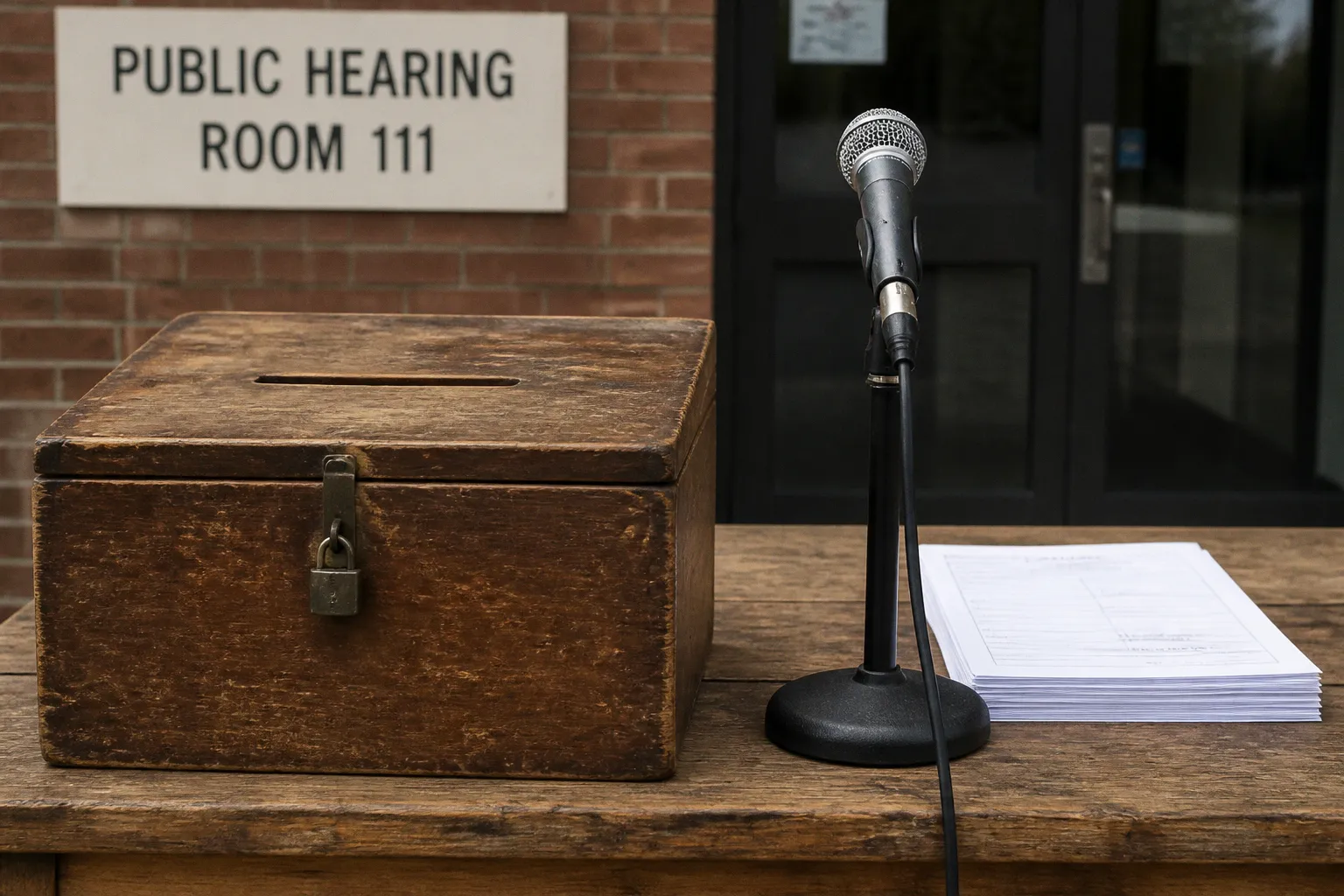
Public Comment Options: Written vs. Oral Testimony
In Somerset County, residents generally have two principal methods to participate in that process: oral testimony at the hearing and written testimony submitted through the Department of Technical and Community Services.
These methods are not interchangeable. Oral testimony creates a direct but time-limited opportunity to address the Planning Commission or Board of County Commissioners. Written testimony permits a more complete evidentiary submission, including parcel information, photographs, maps, and technical analysis. The correct method depends on the type of argument, the available preparation time, and the point at which the decision-making process has reached.
For residents assessing the Somerset planning commission public comment options, the operational distinction is direct:
| Parameter | Oral testimony | Written testimony |
|---|---|---|
| Primary setting | Formal hearing in Room 111 | Submission administered by DTCS in Suite 211 |
| Location | Somerset County Office Complex, 11916 Somerset Avenue, Princess Anne, Maryland | Department of Technical and Community Services, Suite 211, same office complex |
| Time available | Brief and timed | Not limited by speaking time at the hearing |
| Best use | Clear position, concise explanation, direct response to the proposal | Parcel-specific evidence, maps, photographs, technical arguments, and detailed findings |
| Main limitation | Limited time and no guarantee that every supporting detail can be stated | Requires organized preparation and confirmation of the applicable submission procedure |
| Decision-making context | Direct address to the public body | Written material incorporated into the administrative record |
Oral testimony establishes presence and position. Written testimony establishes detail.
Navigating the Somerset County Office Complex for Public Hearings
Formal Planning Commission and Board of County Commissioners hearings on planning and land-use matters take place in Room 111 of the Somerset County Office Complex at 11916 Somerset Avenue in Princess Anne. Written planning and zoning submissions are administered by the Department of Technical and Community Services, located in Suite 211.
That physical separation is limited but consequential. A resident attending a hearing and a resident submitting a technical document are using different channels within the same county facility. The hearing room is the forum for public presentation. DTCS is the administrative point associated with written planning and zoning materials.
The basic sequence is as follows:
1. Identify the decision-making body.
The Planning Commission evaluates planning and technical consistency. The Board of County Commissioners holds final legislative adoption authority for comprehensive plans and zoning amendments.
2. Identify the matter under consideration.
A comprehensive plan amendment, zoning amendment, map change, or related land-use proposal may require a different level of supporting documentation. The relevant agenda or hearing notice should establish the subject under review.
3. Separate the public hearing from the final authority.
A person may address the Planning Commission during its hearing, but that does not mean the Commission can finally adopt the plan or amendment. Its role is advisory in the legislative sequence. The Board of County Commissioners retains adoption authority.
4. Select the submission method.
Oral testimony is suitable for a concise statement directed to the public body. Written testimony is suitable when the argument depends on parcel boundaries, maps, photographs, ordinance language, infrastructure conditions, or a structured analysis of consistency.
5. Preserve the identifying information.
Written submissions should identify the proposal, affected parcel or area, submitting party, and specific action requested. An unsupported objection is difficult to evaluate. A documented objection can be compared against the proposal, the applicable plan, and the relevant land-use standards.
The Somerset County Office Complex is therefore not merely a meeting location. It is the physical point at which public participation is divided between presentation and documentation. A resident who arrives at Room 111 without written material has chosen a narrower format. A resident who submits material to DTCS has chosen the format that can carry greater technical detail into the record.
The available factual record does not establish a universal hourly cutoff for written comments before a particular Planning Commission meeting. That detail should not be inferred from procedures used by another Maryland jurisdiction. Anyone relying on written testimony should confirm the applicable deadline and delivery procedure with DTCS for the specific matter.
The Strategic Value of Written Testimony for the Official Record
Written testimony is the stronger method when the claim depends on evidence rather than preference. A speaker may state that a proposed land-use change would affect drainage, access, setbacks, traffic, adjoining parcels, or infrastructure capacity. A written submission can show the relevant location and explain the causal connection.
For planning matters, useful written material commonly includes:
- The street address, parcel identification, or other precise location information.
- A map showing the affected parcel, adjoining properties, access points, easements, and nearby public infrastructure.
- Photographs with dates and locations identified.
- The specific comprehensive plan policy, zoning provision, map designation, or development standard that supports the position.
- A description of the requested action, such as denial, modification, additional conditions, or further review.
- A concise explanation of how the proposal affects land-use consistency, public facilities, access, drainage, setbacks, or adjoining properties.
- Supporting documents that allow the decision-making body to verify the claim without reconstructing the argument from general statements.
This is not a requirement to produce a legal brief. It is a requirement to make the argument administratively usable. Technical terminology has value only when it is tied to a location and a proposed consequence. “The project violates planning policy” is incomplete. “The proposed parcel designation conflicts with the adopted land-use map because the subject area is identified for a different use” is a claim that can be evaluated.
The same distinction applies to physical conditions. A statement that a road is unsafe is less useful than a documented description of the road segment, sight-distance constraint, intersection location, access pattern, or drainage condition at issue. A statement that a proposal affects neighboring property is less useful than a parcel map showing the relationship between the proposal, adjoining lots, access easements, and required setback lines.
Build the written argument around a traceable sequence
A technically effective submission should permit the reader to follow a short chain of cause and effect:
1. Identify the proposal.
2. Identify the affected land or regulatory designation.
3. State the applicable plan, zoning provision, or land-use criterion.
4. Describe the existing condition.
5. Explain the specific inconsistency or impact.
6. State the requested decision.
Each step should be independently understandable. Avoid combining several issues in one paragraph. If a submission addresses access, drainage, and land-use consistency, those subjects should appear under separate headings or numbered points.
Written testimony also allows the submitter to distinguish between established facts and requests for further review. That distinction is necessary. A resident may know the location of an easement or the existence of a recurring drainage problem. The resident may not know whether the applicant’s final engineering design resolves that issue. The submission should state what is documented and identify what remains unverified.
A written submission is not stronger because it is longer. It is stronger when each assertion can be located, tested, and connected to a requested action.
The administrative record benefits from specificity. It does not benefit from repetition, unsupported accusations, or general objections that do not identify the provision or physical condition at issue. A detailed submission can also preserve the distinction between a policy disagreement and a compliance objection. Those are different claims and should not be presented as if they were the same.
Maximizing Impact During Timed Oral Testimony in Room 111
Oral testimony is the more direct format. The speaker addresses the public body in Room 111 and can present a position to officials at the hearing. The limitation is time. Oral testimony is brief and timed, which restricts the number of facts, citations, and supporting details that can be stated.
The proper objective is not to reproduce a written report aloud. It is to identify the decision, establish the principal reason for the position, and direct officials to any written evidence that supports the argument.
A concise oral statement should contain four components:
1. Identification.
State the speaker’s name and identify the proposal or parcel under consideration.
2. Position.
State whether the speaker supports, opposes, or requests modification of the proposal.
3. Controlling reason.
Present the single most material planning, zoning, infrastructure, access, or land-use issue.
4. Requested action.
State what the public body should do: recommend denial, request a modification, require additional information, or consider the written submission as part of the record.
A speaker should prioritize one principal issue and, if time permits, one secondary issue. A list of ten objections without supporting detail is less effective than two precise objections tied to the applicable planning framework.
For example, an oral statement can distinguish between a general neighborhood concern and a regulatory argument:
- General: “This proposal will change the area too much.”
- Specific: “The proposed change is inconsistent with the existing land-use designation for the subject parcel, and the Commission should address that consistency issue before recommending adoption.”
The second statement does not resolve the issue by itself. It identifies the legal and planning question that the public body must evaluate.
Oral testimony and written testimony should be coordinated
The two methods can be used together. A speaker may provide a short oral statement and submit a written document containing maps, parcel details, photographs, and technical analysis. This combination preserves direct communication while preventing the time limit from excluding relevant evidence.
The oral statement should summarize the written submission rather than introduce unrelated claims. If the written document addresses three issues, the speaker should identify those issues in the same order. Consistency reduces the risk that officials hear one argument while reviewing another.
A coordinated presentation should follow this order:
- Identify the proposal and affected location.
- State the principal position.
- Summarize the strongest documented issue.
- Identify the written materials submitted through DTCS.
- State the requested action.
The speaker should not assume that a reference to an attachment substitutes for an explanation. Officials need the conclusion and its basis in the oral statement. The written material then supplies the supporting detail.
The absence of live video streams or standard archived video recordings for Somerset County Planning Commission meetings makes the written record particularly important. The official public record consists of written minutes approved after meetings. Oral testimony may be heard directly by officials, but a written submission provides a more durable and reviewable form of documentation than a spoken statement alone.
This does not reduce oral testimony to a procedural formality. A direct presentation allows a resident to identify an issue in the public forum and address the decision-making body without relying solely on a document. It does mean that oral testimony should be prepared with the assumption that speaking time is limited and that the approved minutes will not function as a verbatim video archive.
Planning Commission Review Is Not Final Legislative Adoption
The legal sequence must be understood before a resident decides where to direct a comment. The Somerset County Planning Commission evaluates technical and planning consistency. The Board of County Commissioners holds final legislative authority for adopting comprehensive plans and zoning amendments.
That division affects the form of the argument.
A submission to the Planning Commission should address planning consistency, technical deficiencies, land-use relationships, and the adequacy of the proposal for legislative consideration. It should not describe the Commission as the final adopting authority. A statement that asks the Commission to “adopt” a zoning amendment misstates the Commission’s role. The appropriate request may be for a recommendation, a finding of inconsistency, a request for additional information, or a recommendation for modification.
The Board of County Commissioners occupies a different position. Its action is the legislative step for plans and zoning amendments. Public participation directed toward the Board should therefore identify the requested legislative outcome and explain why the proposal should be adopted, rejected, or revised.
The distinction can be summarized in operational terms:
- Planning Commission: technical and planning review; recommendation to the legislative authority.
- Board of County Commissioners: final legislative adoption authority for comprehensive plans and zoning amendments.
- Resident or property owner: submission of facts, planning arguments, parcel evidence, and requested action.
- DTCS: administrative channel for written planning and zoning submissions.
- Public hearing: formal forum for oral testimony and public presentation.
A resident may submit the same written material for consideration at different stages, but the requested action should match the body’s authority at that stage. The argument should not rely on an assumption that every public body can grant the same remedy.
The significance of planning consistency
Planning consistency is not a substitute for every zoning or engineering analysis. It is one component of the decision. A comprehensive plan may establish policy direction, land-use designations, infrastructure objectives, or development principles. A zoning amendment may change the regulatory classification of a parcel. The relevant submission should identify which instrument is being evaluated and avoid treating broad policy language as if it were a precise dimensional standard.
Where the issue concerns setback requirements, easement delineations, access, or parcel configuration, the submission should identify the applicable source and show the location of the condition. Where the issue concerns comprehensive-plan consistency, the submission should cite the relevant plan designation or policy and explain the conflict.
These are separate analytical tracks:
- Policy consistency: whether the proposal aligns with the adopted comprehensive plan.
- Zoning classification: whether the requested district or amendment is legally and spatially appropriate.
- Site standards: whether dimensional requirements, including setback requirements, can be met.
- Property rights and access: whether easement delineations, access points, or adjoining interests affect the proposal.
- Infrastructure: whether roads, drainage, utilities, or public facilities create a documented planning issue.
A submission that merges all five tracks into a general objection is difficult to process. A submission that separates them permits the Planning Commission and Board to evaluate each issue according to the relevant authority.
Maryland Land Use Requirements and the 60-Day Notice Window
Maryland Land Use Article §3-203 establishes procedural requirements for proposed comprehensive plans and amendments. Formal public hearings are required. Notice must be published in a local newspaper. Copies must be provided to adjoining jurisdictions and the Maryland Department of Planning at least 60 days in advance.
The 60-day notice window has two consequences for public participation.
First, it indicates that formal plan and amendment processes are not designed to begin and conclude through an informal comment exchange. Notice, intergovernmental distribution, and public hearing requirements create a defined procedural sequence. Residents should therefore review the notice when it becomes available rather than wait for the hearing date.
Second, the notice should be treated as the controlling document for the matter’s procedural details. It should identify the proposal, the hearing, the affected area or regulatory subject, and the applicable method for participation. The statute establishes the framework. The specific notice provides the operational information for the particular proceeding.
The statutory notice period does not mean that every planning or zoning question has identical procedural requirements. The classification of the action matters. A comprehensive plan amendment and a site-specific land-use issue may involve different documents and decision points. The resident’s first task is to determine what action is actually pending.
Use the notice period to assemble evidence
The 60-day period also provides a practical preparation interval when the matter is a proposed comprehensive plan or amendment. A disciplined preparation process should proceed in stages:
1. Read the proposal as issued.
Identify the proposed text, map change, parcel area, or policy revision. Do not rely on a summary that omits the operative language.
2. Locate the affected land.
Review the parcel boundaries, adjoining parcels, road access, easements, and existing land-use designations.
3. Separate policy and site questions.
Determine whether the objection concerns the comprehensive plan, zoning classification, dimensional standards, infrastructure, or a combination of those subjects.
4. Collect supporting material.
Use photographs, maps, parcel information, and other documents that establish the physical or regulatory condition.
5. Prepare a written submission.
Organize the material so each issue includes a factual basis, a planning or legal connection, and a requested action.
6. Prepare the oral summary.
Reduce the written argument to a timed statement. Retain the proposal identification, principal issue, and requested action.
7. Confirm the administrative procedure.
Contact DTCS regarding the method and deadline for written testimony for the specific hearing. The available information does not establish a single universal submission cutoff hour.
This sequence prevents a common failure: arriving at the hearing with a position but no evidence that addresses the proposal under review.
Common Defects in Public Testimony
Public participation is not made more effective by volume alone. Several recurring defects reduce the usefulness of both oral and written testimony.
The objection does not identify the land
A statement about “the neighborhood” may fail to identify the parcel, road segment, or affected area. Land-use analysis is spatial. Parcel boundaries, adjoining properties, access points, and easements must be identifiable.
The objection cites no governing document
A planning argument should identify the relevant comprehensive plan policy, land-use designation, zoning provision, or development standard. Without that connection, the public body must determine whether the statement is a policy objection, a compliance claim, or a general comment.
The submission confuses recommendation with adoption
The Planning Commission does not hold final authority to adopt comprehensive plans or zoning amendments. A submission should address the Commission’s review and recommendation function, then direct the final legislative request to the Board of County Commissioners.
The speaker uses the entire time on background
Oral testimony is timed. Background material should be reduced to what is necessary to establish the issue. The remaining time should state the operative concern and requested action.
The written material repeats the same conclusion
Repetition does not create evidence. A document should use separate sections for separate issues and attach the material necessary to evaluate each one.
The speaker assumes a video record exists
Somerset County Planning Commission meetings do not have a live video stream or standard archived video recordings. Residents should not treat a spoken statement as if it will later be available through an on-demand recording. Written minutes are the official public record after approval, and written testimony supplies additional documentation for the matter.
The argument imports another jurisdiction’s procedure
Maryland counties and municipalities may use different hearing rooms, portals, deadlines, and submission rules. Procedures from Annapolis, another county, or a non-Maryland jurisdiction do not establish the procedure in Somerset County. The applicable local notice and DTCS instructions control.
Selecting the Appropriate Method
The choice between oral and written testimony can be made by matching the method to the evidence.
Use oral testimony when:
- The position can be stated clearly in a short presentation.
- The primary objective is to address officials directly.
- The issue is straightforward and does not require extensive supporting material.
- The speaker can identify the proposal, principal concern, and requested action without relying on a long chronology.
Use written testimony when:
- The argument depends on parcel details, maps, photographs, or easement delineations.
- The issue involves multiple planning policies or zoning provisions.
- The speaker needs to document existing conditions.
- The submission must distinguish several independent grounds for support or objection.
- A precise technical record is more important than direct presentation.
Use both when the matter is consequential and the argument contains technical detail. The oral statement should function as an index to the written submission. The written submission should function as the evidentiary foundation for the oral statement.
The distinction is not between a “strong” method and a “weak” method. It is between a presentation format and a documentation format. A short oral statement may be highly effective when it identifies the controlling issue. A long written submission may be ineffective when it lacks a parcel reference, governing provision, or requested action.
Definitive Summary
Somerset County public hearings provide two distinct public comment options. Oral testimony in Room 111 at the Somerset County Office Complex offers a brief, timed opportunity to address officials directly. Written testimony submitted through the Department of Technical and Community Services in Suite 211 allows residents to place detailed evidence, maps, photographs, parcel information, and planning arguments into the official record.
The Planning Commission reviews technical and planning consistency. The Board of County Commissioners retains final legislative authority for comprehensive plans and zoning amendments. Maryland Land Use Article §3-203 requires formal hearings and establishes a 60-day notice period for specified proposed plans and amendments, including notice to adjoining jurisdictions and the Maryland Department of Planning.
The correct procedure is therefore clear. Identify the pending action. Determine the authority of the public body. Match the comment method to the evidence. Use oral testimony for a concise direct statement. Use written testimony for a documented technical record. Use both when the matter requires direct presentation and detailed support. Confirm the specific written-submission deadline with DTCS, because the available county information does not establish a universal cutoff hour.