Somerset planning commission meetings: speaker checklist
That notice in your mailbox, or the small line in the back of the local paper, telling you that a developer wants to put a 40-unit project on the old field behind the elementary school — it's easy to…
Somerset Planning Commission Meetings: Your Speaker Checklist
That notice in your mailbox, or the small line in the back of the local paper, telling you that a developer wants to put a 40-unit project on the old field behind the elementary school — it's easy to read it, feel a knot in your stomach, and then set it on the counter and hope someone else handles it. We hear that from neighbors all the time, and we want to walk you through exactly how this works in Somerset County, because the truth is, your voice at a Planning Commission meeting is not a formality. It's a real lever in how our county grows, and the rules around it are more approachable than they look once you see them laid out.
Think of this as the checklist we'd hand you if we were sitting across the kitchen table with a cup of coffee, the meeting agenda open between us. We will cover where you go, what to bring, who is actually sitting up there making recommendations, and the timelines that are already on the books to protect you. By the end, you should feel ready — not just willing — to step up to that microphone.
Getting Oriented at the Somerset County Office Complex
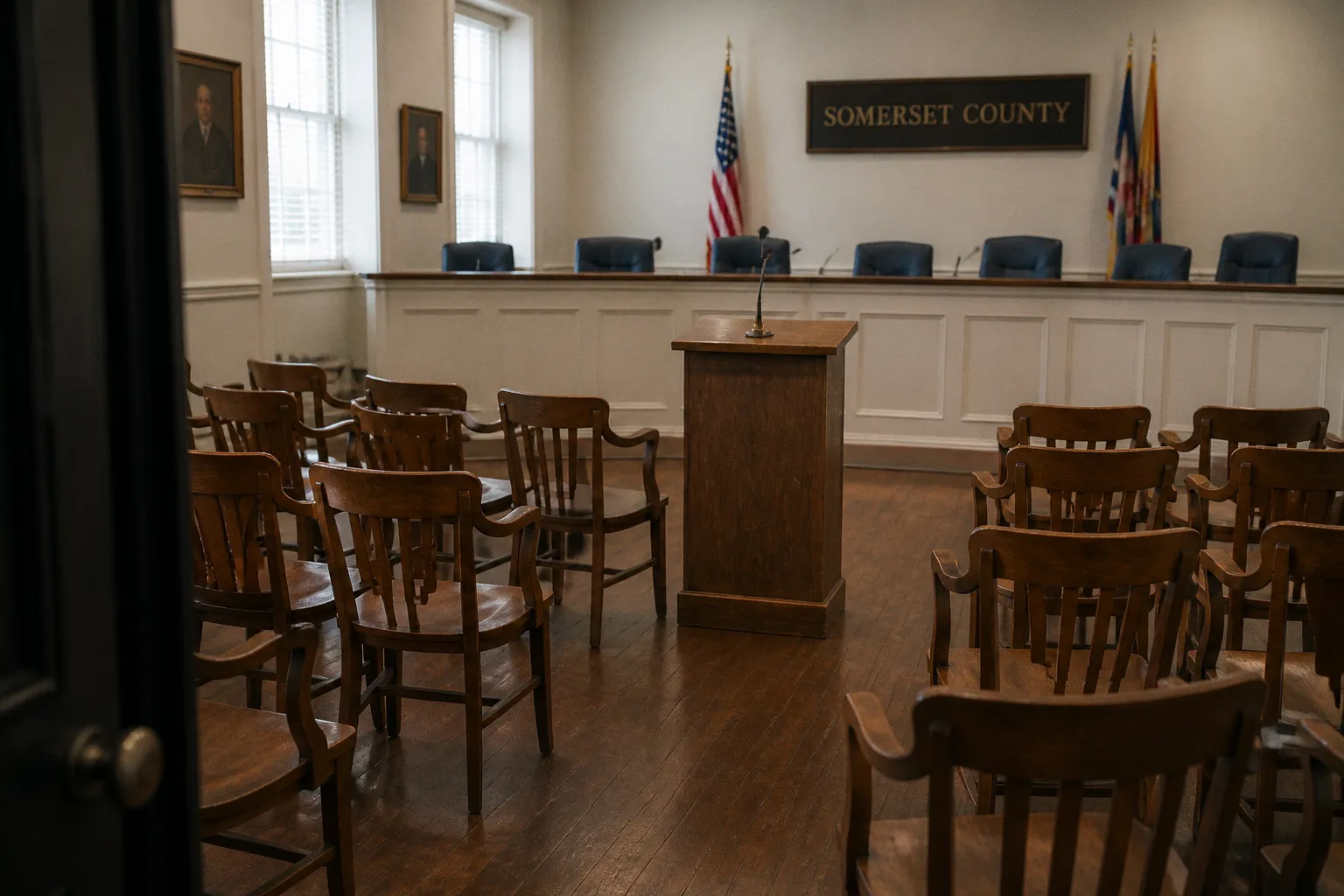
The very first thing to clear up is the simple logistics, because nothing discourages participation faster than not knowing where to park. Somerset County Planning Commission meetings and public hearings are held in the Commissioners Meeting Room, Room 111, on the first floor of the Somerset County Office Complex at 11916 Somerset Avenue in Princess Anne. That is the same building, the same room, and the same address for both regular commission meetings and the special sessions when a public hearing is on the docket. Knowing this in advance means you are not circling the parking lot while the chair calls your case.
You will want to give yourself more time than you think you need. Eastern Shore traffic feels predictable until the day of a contested hearing, when the lot fills with neighbors, applicants, lawyers, and staff. Aim to arrive ten to fifteen minutes early. That buffer does two quiet but important things: it lets you sign in on the speaker sheet before the meeting is called to order, and it gives you a few minutes to read the room, see who else is there, and calm your nerves before you speak. We have watched seasoned advocates use that window to introduce themselves to a neighbor they didn't know shared their concerns, and we have watched first-timers use it just to breathe.
Dress is whatever you would wear to a school board meeting or church on a weekday evening — comfortable, respectful, no formal expectation. The room itself is a working government space, not a courtroom. There is no jury, no judge, no swearing in. The seven commissioners and the planning staff sitting up front are your neighbors and fellow residents, and the dais is set up for conversation, not cross-examination.
Your voice is the part of the record no planner can produce on their own.
The Essentials for Providing Public Testimony
Now to the heart of it: what actually gets you into the record. Somerset County does not publish a glossy, pre-printed "speaker checklist" PDF for the public — we want to be honest about that, because searching for one and not finding it can feel like a wall. What does exist is a clear, established set of procedural expectations that apply every time the floor opens for public comment. Once you know them, the absence of a glossy handout stops feeling like a barrier and starts feeling like an open process.
Here is what is expected of you, in the order it tends to happen on the night:
1. State your name and address for the record. This is the single non-negotiable element. The Planning Commission is required to capture it, and it is what makes your testimony part of the official record that staff, the commissioners, and ultimately the Board of County Commissioners can refer back to. Providing this information is a standard procedural step that helps the body identify participants.
2. Indicate whether you are speaking in support, in opposition, or as a neutral party offering information. The chair will typically open the floor in that order: proponents first, then opponents, then anyone wishing to provide general information. Knowing which category you fall into ahead of time keeps things moving and shows respect for everyone else's time.
3. Stay focused on the matter under consideration. This is where preparation pays off. Whether the topic is a zoning amendment, a comprehensive plan update, or a specific rezoning application, your testimony should connect directly to the criteria in front of the commission. We will get to those criteria in a moment, because understanding them is what turns a heartfelt comment into a comment that influences a vote.
4. Be respectful in tone and in length. Even when you are frustrated — and there are real, legitimate reasons to be frustrated with how a project is unfolding — the Planning Commission is a recommending body, not the final decision-maker. Your strongest asset in the room is being the person who was clear, specific, and easy to listen to.
5. Submit any written materials you reference. If you bring photos, maps, a petition, or a one-page summary, hand a copy to the staff up front. Materials entered into the record carry your point beyond the time you have at the microphone and into the file that travels with the case, allowing commissioners and staff to review them later.
One thing we want to name plainly: timing expectations can vary. For Planning Commission hearings, the chair manages the floor, and it is perfectly appropriate to ask the chair at the start of the public comment period how much time speakers are being given that evening. Asking is not awkward — it is exactly what the protocol is designed for. At hearings before the Board of County Commissioners, members of the audience who sign up to speak are allotted five minutes each. The key is to be prepared to be concise and to confirm the format for the specific meeting you are attending.
Five minutes is enough if you know the one thing you want them to remember.
Who You Are Actually Talking To: The Seven-Member Commission
It helps, when you are standing at that microphone, to picture the seven people in front of you not as a wall of authority but as a body with a specific job description. The Somerset County Planning Commission is made up of seven members who are appointed to make and approve plans that they then recommend to the Board of County Commissioners for adoption. They are not deciding whether your project gets built. They are deciding whether the plan or amendment in front of them is the right shape for the county to recommend.
Their authority flows from state law. Under Maryland Land Use Code § 3-203, the local planning commission is required to hold at least one public hearing before it can recommend the adoption of a comprehensive plan, a plan part, or an amendment to the legislative body. That statutory language matters because it is the reason the public comment period exists at all — it is not a courtesy. It is a required step in the process, and the commission cannot move a recommendation to the Board of County Commissioners without it.
Sitting behind them, you will usually see staff from the Somerset County Department of Technical and Community Services (DTCS), which provides the technical backbone for the commission's work. The Director and the Assistant Director, who also serves as the Zoning Administrator, prepare the staff reports, run the application review, and field the questions the commissioners ask. When you are listening and you hear a staff member say, "The applicant has not addressed the finding regarding access on the parcel," that is the planning lens being applied to your concern in real time. Your public comment, when it lands in that same conversation, becomes part of how that lens gets calibrated.
Knowing this changes how you shape what you say. You are not pleading with seven strangers. You are giving input to a body that is, by statute, supposed to weigh what you say before it forwards a recommendation onward.
You are speaking to the people who write the recommendation the County Commissioners read.
Timelines, Notice Requirements, and Why They Protect You
A lot of the anxiety we hear from residents comes from a feeling that decisions move faster than they can keep up with. The reality, once you pull up the procedural rules, is that there are real built-in windows designed to do the opposite — to slow things down enough that you have a chance to be heard. We want to walk you through those windows so you know what is yours to use.
Newspaper notice. Before a Planning Commission public hearing, notice of the time and place must be published at least once in a newspaper of general circulation in the county. That is your first signal. If you want to stay ahead of what is coming, the legal ads and public notice section of your local paper — and the county's own meeting postings — are worth checking once a week. The cost of missing that notice is that you arrive late to a process that has been publicly advertised, and the cost of never checking is that a decision can feel like it came out of nowhere when it didn't.
Sixty days for adjoining jurisdictions. Maryland Land Use Code § 3-203 also requires the planning commission to provide copies of the recommended plan or amendment to adjoining jurisdictions and to state and regional units at least 60 days before the hearing. This is not just a courtesy to other counties and agencies — it is the window in which those neighboring entities can register concerns that come back into your hearing as additional considerations. When you hear a commissioner ask about a school capacity memo from the state or a transportation comment from a neighboring county, that 60-day notice is the reason it is on the table.
Thirty days to render a decision. Under the Somerset County Zoning Ordinance, after a public hearing is held, the Planning Commission has 30 days to render its decision. That does not mean the decision is made in the room with you — it means the commission has up to a month to deliberate and issue its recommendation. This matters because your comment is not a moment that passes; it is filed, it is read, and the commissioners are required to engage with the record before they sign a resolution.
Resolution and signature. When the Planning Commission does approve a plan or amendment, it does so by resolution approved by a majority of the commission, and that resolution has to be signed by the chair or the secretary. That signature is your assurance that the recommendation you saw discussed is the formal, official version moving up to the Board of County Commissioners — not a draft that can quietly shift.
The timelines are not red tape. They are the breathing room the process owes you.
Planning Commission Testimony Versus Board of County Commissioners Testimony
This is the piece that trips up more residents than any other, and we want to spend a real moment on it, because if you go to the wrong hearing expecting the format of the other one, the experience can feel confusing even when nothing is going wrong.
The Planning Commission is where the technical and land-use conversation lives. This is where the staff report is presented in full, where the commissioners ask detailed questions of the applicant and of staff, and where the public weighs in on the planning merits of a proposal. Rezoning applications like the recent Nexamp solar project, zoning text amendments, and updates to the comprehensive plan all flow through this body first. Their vote is a recommendation.
The Board of County Commissioners is the legislative body that actually adopts plans, amendments, and zoning code changes. When a recommendation comes up from the Planning Commission, the Board holds its own public hearing — for example, the Board held a public hearing on the zoning code amendments on June 17, 2025, after the Planning Commission's special session on May 27, 2025. At Board hearings, members of the audience who sign up to speak are given five minutes each, and the chair is strict about the clock because the Board runs a tight agenda.
What this means for you practically:
- If your concern is about how a project fits the plan — land use, density, compatibility with surrounding properties, traffic patterns, environmental considerations — the Planning Commission hearing is your primary moment. That is where the recommendation gets shaped.
- If your concern is about the broader policy — should this amendment to the zoning code exist at all, what does it mean for the county's direction — the Board of County Commissioners hearing is where that final conversation happens. Both are worth attending, and many residents speak at both.
- Do not assume that not speaking at one means you cannot speak at the other. The record is treated as continuous, but each body votes independently, and your comments are heard fresh.
We have sat through enough of these to know that the residents who feel most effective are the ones who pick the hearing that matches their concern, prepare around that body specifically, and then show up ready. Trying to do everything at once usually means doing nothing as well as it deserves.
A Practical Night-Of Checklist
Before we close out, here is the short version you can screenshot or scribble on the back of the agenda:
- Confirm the location. Room 111, Somerset County Office Complex, 11916 Somerset Avenue, Princess Anne. Same place, every meeting.
- Arrive 10–15 minutes early. Sign the speaker sheet, read the room, and settle in.
- Prepare your opener. Name, address, and which side you are speaking to — support, opposition, or general information.
- Identify the one thing you want them to remember. Land use, traffic, water, school capacity, character of the neighborhood — pick your thread and stay on it.
- Bring written materials if you have them. Hand a copy to staff so it enters the record.
- Ask the chair about the time limit if it is not announced. The chair will clarify the format at the start of public comment.
- Stay for the deliberation if you can. Watching the commission discuss your point is how you learn what landed and what didn't — and it sets you up to be sharper next time.
Where We Go From Here
If you have read this far, you are already more prepared than most people who walk into a Planning Commission meeting, and that is not a small thing. Our community fabric in Somerset County is woven from the people who show up — not just the applicants, not just the staff, but the residents who take the time to read the agenda, drive to Princess Anne, and say the thing that no planner could have said without them.
The county's growth and infrastructure are not abstract forces happening to us. They are decisions being made, recommendation by recommendation, hearing by hearing, and we have a real seat at the front of that process every time the public comment period opens. The Somerset County Zoning Ordinance, the Maryland Land Use Code, the published notices, the 60-day window, the 30-day decision clock, the seven-member commission, the staff who support them — all of it is structured so that your voice has somewhere to land.
So when that next notice arrives in your mailbox, don't set it on the counter. Pull up the agenda, mark your calendar, and bring your one thing to say. We will see you in Room 111.