Public hearing errors that invalidate citizen comments
The Somerset County Planning Commission has 30 days after a public hearing to issue a written decision containing findings of fact and conclusions. That is a statutory deadline for the Commission’s decision.
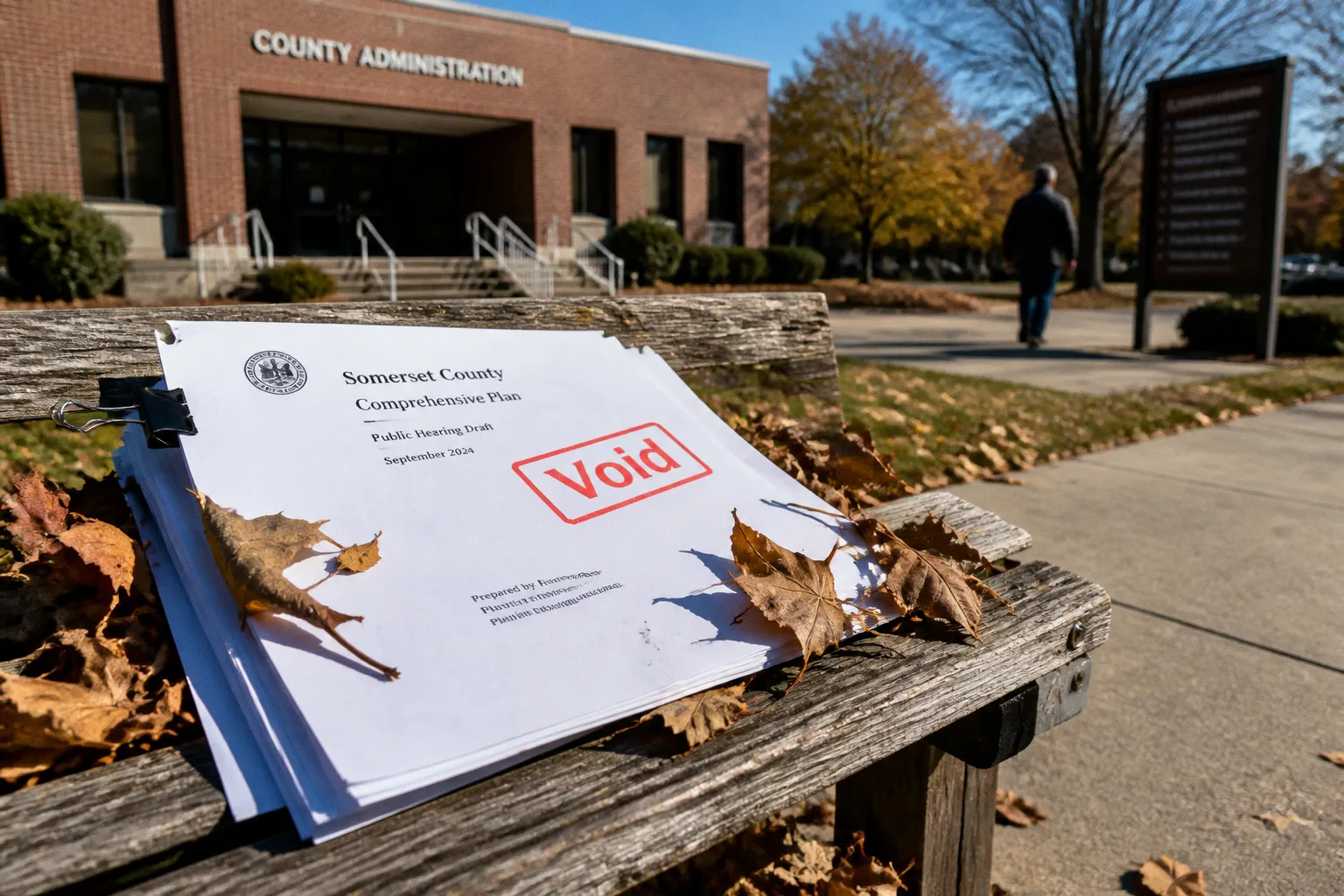
Public Hearing Errors That Invalidate Citizen Comments in Somerset County
It is not, by itself, a deadline for every comment, and it does not mean that the administrative record automatically closes on the thirtieth day.
That distinction matters. Residents often treat every public meeting, email, and conversation as if it carried the same legal weight. It does not. A developer-hosted information session is not the same as a formal Planning Commission hearing. An oral statement is not identical to a written submission. A late comment may be handled differently from a timely one, depending on the proceeding and the applicable rules. And a pending update to the Comprehensive Plan is not the same thing as an adopted plan that has already displaced the prior document.
This is the machinery of Maryland land-use law, and it does not care about good intentions alone. It cares about procedure, the standards that govern the decision, and the record assembled for the particular matter. The practical question is not simply whether a resident spoke. It is whether the concern reached the right proceeding, addressed an issue the Commission is authorized to consider, and was preserved in a form the decision-makers can evaluate.
The Legal Weight of Statutory Zoning Standards vs. Personal Opinion
The most common mistake at a Somerset County public hearing is also the most understandable one: a resident arrives with a strong personal objection and assumes that the strength of the feeling will determine the weight of the comment.
It will not.
A statement about a project being unwanted, unattractive, disruptive, or harmful to the character of a neighborhood may explain the community’s reaction. It may also help the Commission understand the practical stakes for nearby residents. But a Planning Commission does not decide a land-use matter by counting how many people dislike the proposal. Its authority comes from the applicable statute, ordinance, zoning standards, Comprehensive Plan provisions, and the facts presented in the proceeding.
That is why testimony becomes more useful when it connects a personal concern to a legal or planning criterion. A resident worried about a new commercial use may be raising questions about traffic circulation, road capacity, parking, emergency access, noise, lighting, drainage, or compatibility with surrounding uses. A resident concerned about a development near sensitive land may be pointing toward environmental effects, stormwater management, wetlands, agricultural preservation, or the adequacy of public facilities. The concern begins as an experience or observation, but it becomes legally relevant when the testimony explains how that fact bears on the standard the Commission must apply.
Maryland’s land-use framework requires local decision-makers to follow formal procedures and maintain records of their proceedings. The written decision must explain the factual and legal basis for the result. That does not mean every sentence spoken at a hearing will appear in the findings. It does mean that comments tied to the governing criteria give the Commission something it can analyze, address, and, where appropriate, incorporate into its reasoning.
Turning a concern into testimony
The difference is not academic. Compare the structure of these two approaches:
| Less useful approach | More useful approach |
|---|---|
| The project is too large for the neighborhood. | Explain which surrounding uses, road conditions, site constraints, or plan policies make the proposed scale incompatible. |
| Traffic will be terrible. | Describe the affected intersection, the time or condition in which congestion occurs, and why the proposal may exceed the road or access system’s capacity. |
| This will damage the environment. | Identify the drainage, erosion, habitat, water-quality, or site-development concern and connect it to the applicable review standard. |
| Property values will fall. | If the concern is about land-use compatibility, explain the physical impacts that may affect nearby properties rather than relying on an unsupported prediction. |
| Nobody wants this here. | State the specific planning, infrastructure, safety, or compatibility issue that the Commission has authority to consider. |
The more useful version is not necessarily longer. It is simply more precise. It tells the Commission what the resident believes is wrong, where the problem appears, and which decision criterion the problem implicates.
A comment that names a feeling will be heard. A comment that explains the governing standard can be evaluated.
Personal experience still has a place. A resident who lives beside a road may know something about recurring flooding, dangerous sight lines, or morning traffic that does not appear clearly in a general map. That information can matter. But it should be presented as evidence relevant to the decision, not as a substitute for the legal standard.
The same principle applies to opposition based on general growth or development. A Planning Commission may hear broad community concerns, but it must decide the application or amendment before it. The question is not whether the County should ever change. The question is whether this particular request complies with the criteria that control this particular proceeding.
Distinguishing Between Informal Workshops and Formal Planning Hearings
Somerset County’s public participation process can include several kinds of meetings: developer-hosted information sessions, community workshops, surveys, public meetings, and formal statutory hearings before the Planning Commission. They may all be described as opportunities for public input, but they do not perform the same legal function.
An informal workshop can be useful precisely because it occurs before the decision has hardened. Residents can ask how a proposal works, identify missing information, point out local conditions, and encourage revisions. County staff, applicants, and community members may learn from the discussion. But attendance at a workshop does not automatically mean that a resident has testified in the formal proceeding.
A developer-hosted session presents the same problem in a different form. It may be open to the public, but it is not necessarily a County hearing. Questions raised there may influence the applicant’s proposal or later discussions, yet they should not be assumed to form part of the Planning Commission’s official record unless they are submitted or repeated through the channel designated for the formal matter.
The distinction is especially important during the update of Somerset County’s Comprehensive Plan. A planning process may involve public outreach long before a final document is presented for formal consideration. A resident who participates in a workshop has contributed to the planning process, but that participation should not be confused with testimony on a later ordinance, amendment, or hearing item.
What changes from one meeting to another
The practical differences are substantial:
- Purpose: An informal session may gather ideas or explain a proposal. A formal hearing is connected to a defined decision.
- Decision-maker: A workshop may be hosted by staff, an applicant, or a consultant. A statutory hearing is conducted by the public body responsible for the matter.
- Record: Materials from an informal session may be retained, but they do not necessarily become part of the administrative record for a later decision.
- Notice: A formal hearing follows the notice and procedural requirements applicable to that matter. A workshop may be announced under a different process.
- Submission rules: A hearing notice or meeting agenda may identify how and when written testimony can be submitted. An informal event may have no equivalent filing procedure.
- Legal effect: A workshop can shape discussion without deciding anything. A formal hearing provides an opportunity to address the criteria the decision-maker must apply.
The answer is not to ignore workshops. They can be one of the best places to discover what needs to be asked. The answer is to use them for what they are, then participate separately in the formal hearing when the matter reaches that stage.
A resident who speaks at an early meeting should keep track of what happens next. Is there a later Planning Commission hearing? Will the proposal be revised? Is a written report or ordinance being prepared? Has the County announced a separate period for comments on the Comprehensive Plan update? Each of those questions affects how a person preserves a position.
The formal hearing is not merely a more official version of the workshop. It is a different procedural event. A resident who wants the Commission to consider a specific objection should restate it in the proceeding where the Commission will make its decision, following the instructions given in the notice or other official materials.
The Critical Role of Written Testimony in the Administrative Record
Oral testimony matters. It establishes that a person appeared or participated and communicates the resident’s position directly to the decision-makers. Depending on the procedure, the hearing record may include a transcript, recording, minutes, staff summary, or other documentation of what was said. It is too absolute to claim that oral comments can never be cited or considered.
The problem is different: oral testimony can be difficult to preserve, locate, interpret, and connect to the exact issue being decided. A short written statement gives the Commission a stable document. It allows the resident to identify the relevant application, explain the facts, and state the requested action without relying entirely on a spoken presentation or a later recollection.
Written testimony also helps prevent a common failure in public participation: a resident raises one concern orally, adds another in a follow-up message, and later assumes that both were treated as one complete submission. A clear written statement puts the argument in one place. It can identify the project or plan provision, describe the factual basis, and distinguish personal knowledge from questions that still require investigation.
There is no universal rule in the facts available here that every submission must contain a particular combination of name, address, docket number, or other mandatory fields. Nor is there a basis for saying that staff must reject or permanently lose a submission if one of those details is missing. Still, basic identifying information is sensible. It helps staff determine which matter the comment concerns and how to contact the commenter if clarification is needed.
A useful written submission should generally make clear:
- the matter, proposal, parcel, ordinance, or plan section being discussed, if that information is available;
- the commenter’s position, including support, opposition, or a request for modification;
- the facts the commenter personally knows or wants the Commission to examine;
- the planning or zoning standard connected to those facts;
- the specific action the commenter wants the Commission to take; and
- the date and method of submission.
Those are practical safeguards, not a substitute for the official rules of the proceeding. If the hearing notice sets a particular deadline, delivery method, or format, that instruction controls. If the notice does not answer a procedural question, asking the County’s planning staff or clerk before submitting is safer than guessing.
Oral and written testimony work together
The strongest approach is usually not oral testimony versus written testimony. It is both.
Prepare a written version of the main argument. Bring it to the hearing or submit it through the designated channel. When called to speak, summarize the statement rather than improvising an entirely different argument. If new information arises during the hearing, identify it clearly and explain why it matters. Keep a copy of what was submitted, along with confirmation of delivery when available.
This does not guarantee that the Commission will agree. It does make the position easier to understand and harder to mischaracterize.
A written submission also matters if the decision is later challenged. A reviewing court generally examines the record made in the administrative proceeding. That does not mean every written comment automatically controls the outcome, or that a person can create an appeal simply by sending an email. It means that an argument absent from the record is harder to evaluate later than one that was clearly presented through the appropriate process.
The 30-day period belongs in this discussion, but it must be placed correctly. The confirmed rule is that the Commission has 30 days after the hearing to issue its written decision with findings and conclusions. That deadline does not establish a universal rule that all comments must arrive within those 30 days, and it does not prove that every comment submitted afterward is permanently excluded. Whether a late submission can be accepted, considered, or included depends on the governing procedure and any applicable record-closure rule.
Residents should therefore avoid waiting until the decision deadline. The fact that the Commission has up to 30 days to issue its decision is not an invitation to treat that period as an open-ended comment window. Submit material as early as the applicable process allows, and do not assume that a late submission will receive the same treatment as testimony presented before or during the hearing.
The decision deadline and the record-closure deadline are not automatically the same thing.
Avoiding Ex Parte Communications with Planning Commission Members
A direct conversation with a Planning Commission member can feel efficient. A resident may believe that a short email, phone call, or conversation at a community event will ensure that an important fact is not overlooked. In a contested land-use matter, that instinct can create a procedural problem.
An ex parte communication is a contact with a decision-maker about a pending matter outside the formal proceeding, without the ordinary opportunity for the other participants to see and respond to the information. The concern is not that every casual greeting or logistical question is forbidden. The concern is that one-sided substantive advocacy can give a decision-maker information that is not available to everyone else.
That risk exists for residents on every side of an issue. A private message from an opponent can raise the same fairness concern as a private message from a supporter. If the matter is being decided on a record, the safer course is to put substantive information into the official channel identified for the proceeding.
The consequences should also be described carefully. Ex parte contact can create a challenge to the fairness or validity of a decision, but it is not accurate to say that every private email automatically invalidates the proceeding. The legal effect may depend on what was communicated, who received it, whether it was disclosed, whether other parties had an opportunity to respond, and what rules govern the particular body and matter.
For residents, the practical rule is simple:
1. Do not ask a Commissioner privately to decide the matter before the hearing.
2. Do not send substantive evidence to one member while keeping it away from the applicant or other participants.
3. Submit written arguments and supporting materials through the official process.
4. If a Commissioner contacts you about the substance of a pending matter, ask how the communication should be handled or disclosed.
5. Reserve questions about hearing logistics, public access, or meeting procedure for the appropriate administrative contact.
The purpose is not to make public participation colder or less human. It is to keep the decision-making process visible. A public record allows interested parties to answer one another and allows a reviewing body to see how the decision was reached.
The same caution applies to elected officials and other County representatives who may not be the formal decision-maker. A conversation with a Commissioner, county employee, or official can be useful for learning where to submit a document. It should not become a private substitute for submitting the document.
Navigating Notice Requirements and Submission Deadlines
Notice rules tell the public that a formal action is going to occur. They do not necessarily answer every question about how comments may be submitted.
Maryland Local Government Code § 9-105 is associated with publication of notice and a summary of a proposed ordinance in a local newspaper of general circulation once a week for two successive weeks before adoption. That requirement should not be expanded into a claim that every Somerset County hearing has the same notice schedule or that the interval between the first publication and the hearing is the only period in which a comment may be made.
The particular notice for a particular proceeding remains essential. It may identify the hearing date, the proposal under consideration, where materials can be reviewed, and how members of the public may submit written comments. It may also distinguish between comments received before the hearing and testimony delivered at the hearing itself.
There is no confirmed basis for claiming that Somerset County typically adds specific postings at the courthouse, on its website, or through mailing lists in every case. Those methods may be used for some matters, but residents should rely on the actual notice and official meeting materials rather than assume that a particular channel will always be available.
Likewise, a person who misses the period between the first newspaper publication and the hearing has not necessarily lost every formal opportunity to participate. The applicable law, hearing notice, local rules, and status of the proceeding determine what remains possible. A late submission may be accepted, placed in the file, considered under a different standard, or declined for decision-making purposes. Without the governing rule for that matter, the only safe conclusion is that its status is uncertain.
Common timing mistakes
The most frequent errors are less dramatic than residents expect:
1. Treating an informal meeting as the only opportunity to speak. A workshop may precede the formal hearing and does not necessarily replace it.
2. Waiting for the 30-day decision period. That period concerns issuance of the written decision. It should not be treated as a guaranteed extension for submitting testimony.
3. Assuming a late comment has the same status as a timely one. It may not. Ask about the applicable record and submission rules before relying on a late filing.
4. Sending material without identifying the matter. A missing case reference does not automatically invalidate a submission, but it can make it harder to route and understand. Include the information available to you.
5. Relying on a general announcement instead of the hearing notice. The specific notice may contain the operative date, location, submission method, or plan provision.
6. Failing to keep a copy. Preserve the statement, attachments, delivery confirmation, and any response from staff.
7. Assuming that participation in the current plan update resolves every later hearing. A general planning comment and testimony on a specific zoning or land-use application may address different decisions.
The most reliable response is to track the matter as it develops. Confirm the name of the proposal, the body handling it, the date of the formal hearing, and the method for submitting written testimony. If the hearing is postponed or the proposal changes, check whether a new notice or additional submission period applies.
The Comprehensive Plan Update Is Pending, Not Automatically Controlling
Somerset County’s 1996 Comprehensive Plan is identified as the prior plan, while the County is working through an update process that runs through 2025. That history gives residents useful context, but it does not support treating the update as already adopted or assuming that the 1996 plan has ceased to govern.
A pending Comprehensive Plan update may influence public discussion, staff analysis, and future policy choices. It may show the direction in which the County is considering growth, infrastructure, conservation, housing, or economic development. Until the update is formally adopted and becomes applicable under the governing process, however, residents should describe it as pending rather than as the operative replacement for the prior plan.
This distinction affects the way testimony should be framed. A resident can point to the draft or update process as evidence of a policy question the County is considering. The resident can also explain why a proposal appears consistent or inconsistent with goals under discussion. But the argument should not assume that an unadopted document has the same legal status as an adopted Comprehensive Plan.
The 1996 plan should be handled with the same care. Calling it the prior plan does not establish that it no longer governs. Its relevance may depend on the proceeding, the current ordinances, later amendments, and the legal status of the update. If a comment relies on a plan provision, identify the document and provision accurately, then explain why it matters to the decision before the Commission.
A careful statement might distinguish among three propositions:
- the County has an existing prior Comprehensive Plan;
- the County is conducting an update process; and
- the updated plan’s final legal effect depends on adoption and the applicable governing framework.
That wording may seem cautious. It is also more credible. Overstating the status of the plan gives an opposing party an easy way to challenge the comment, even when the underlying planning concern is sound.
The same principle applies to comments submitted during an update cycle. They are not automatically evaluated under a new plan that has not yet been adopted. They may inform the update process, and they may be relevant to a separate hearing if the applicable decision-maker is authorized to consider them. The resident should identify which process the comment addresses rather than treating all public participation as one continuous record.
What the Commission Is Actually Deciding
Residents sometimes approach a Planning Commission hearing like a town hall: a place to register broad dissatisfaction with growth, traffic, development patterns, or the direction of the County. Public sentiment is part of the civic context, but the Commission’s legal task is narrower. It must apply the law to the matter on its agenda.
That means a comment should answer a practical question: what action is the Commission being asked to take, and what fact or standard supports the resident’s position?
For a rezoning request, the relevant issues may differ from those in a special exception, subdivision review, site plan matter, ordinance amendment, or Comprehensive Plan update. A traffic concern may be central in one proceeding and peripheral in another. A land-use compatibility argument may depend on the surrounding zoning and the use proposed. A drainage concern may require a description of the site and the existing conditions rather than a broad assertion that development is harmful.
The resident does not need to write like a lawyer. The goal is not to bury the Commission in citations or imitate a formal brief. The goal is to make the connection between the concern and the decision visible.
A strong statement usually has four parts:
1. Identify the matter. Name the proposal, parcel, plan section, or ordinance as accurately as possible.
2. Describe the relevant condition. State what the resident knows, observed, or believes the record should address.
3. Connect the condition to a criterion. Explain the relationship to compatibility, facilities, traffic, drainage, environmental effects, or another applicable standard.
4. State the requested result. Ask the Commission to deny, modify, defer, require further information, or address a particular issue, as appropriate to the proceeding.
This structure keeps testimony from drifting into unrelated grievances. It also helps the Commission distinguish a factual objection from a policy preference and a policy preference from a legal argument.
The strongest citizen comment is not the loudest one. It is the one that gives the decision-maker a clear issue to decide.
Keeping Your Comments Load-Bearing
The Somerset County land-use process is not a courtroom, but it is procedural. The system does not require residents to be professional litigators. It does require them to participate through the channels that apply to the matter and to give the Commission a reasoned connection between the requested result and the governing standards.
A comment is more likely to carry weight when it is:
- Specific about the decision. It addresses the proposal or plan provision actually before the Commission.
- Grounded in relevant criteria. It explains how the concern relates to zoning, land-use, infrastructure, environmental, or compatibility standards.
- Supported by identifiable facts. It separates firsthand observations from assumptions and general predictions.
- Submitted through the official process. It follows the instructions in the notice or meeting materials.
- Clear about timing. It is presented before the hearing or within the period the applicable rules allow, rather than relying on an unconfirmed grace period.
- Preserved in writing when possible. Written material supplements oral testimony and makes the position easier to locate in the record.
- Open to all participants. It avoids private substantive lobbying of individual Commissioners.
- Accurate about the Comprehensive Plan. It distinguishes the prior plan from the pending update and does not treat a draft as an adopted replacement.
A comment can fail without being illegal. It can be too general, directed to the wrong proceeding, submitted too late for the applicable rules, or presented privately when the matter requires an open record. Those problems are usually correctable before the hearing or before the submission deadline. Waiting until after the decision is issued is a much worse strategy.
Residents should also resist the temptation to send the same broad statement to every County office. Repetition is not the same as preservation. A comment sent to the wrong body may be read by someone, but that does not establish that it was placed before the decision-maker for the matter. Use the official contact identified in the notice, and retain proof that the submission was delivered.
The goal is not to produce a perfect document. A concise, well-supported statement is more effective than a long letter that never identifies the issue. If an attachment contains maps, photographs, measurements, or other material, label it and explain what it shows. If the material is based on personal observation, say so. If it is a question rather than a fact, frame it as a request for the Commission or staff to address.
The Cost of Getting Procedure Wrong
The 30-day written-decision deadline runs whether a resident participates or not. Once the Commission issues its decision, the record and the stated findings become especially important to anyone considering further review. But the existence of that deadline does not mean that a comment is automatically excluded merely because it arrived after the hearing, nor does it prove that every post-hearing submission is permanently barred. Those consequences depend on the applicable rules and the point at which the record is closed.
That uncertainty is a reason to act early, not a reason to panic. Submit the written statement through the designated channel before the hearing when possible. Speak at the formal hearing if oral testimony is allowed. If circumstances require a late submission, ask how it will be treated rather than assuming that it has either full effect or no effect. A staff member may be able to explain the procedure, but only the governing rule and decision-maker determine the legal weight of the material.
The administrative record exists because land-use decisions affect people who may not be in the room, as well as the applicant and the County. A clear record shows what was proposed, what standards were applied, what facts were presented, and how the decision was explained. That record is more useful when comments are specific, timely under the applicable procedure, and available to the participants who may need to respond.
The practical discipline is straightforward:
- attend the formal hearing, not only an informal workshop;
- identify the proposal or plan provision;
- connect the concern to a criterion the Commission can apply;
- submit written testimony through the official process;
- treat oral comments as meaningful, but do not rely on memory or an uncertain recording;
- avoid private substantive communications with Commissioners;
- verify the status of the Comprehensive Plan update;
- distinguish the 30-day decision deadline from any separate rule governing record closure; and
- keep copies of everything submitted.
That is how Somerset County residents turn frustration into usable testimony. A public comment does not become powerful because it is angry, repeated, or delivered to the most people. It becomes useful when it reaches the right proceeding, addresses the decision the Commission is authorized to make, and gives the public record something concrete to carry forward.