Public comment periods: how to share your voice in Somerset
A notice about a proposed development, a planning workshop, or a new draft chapter can arrive in language that feels distant from everyday life.
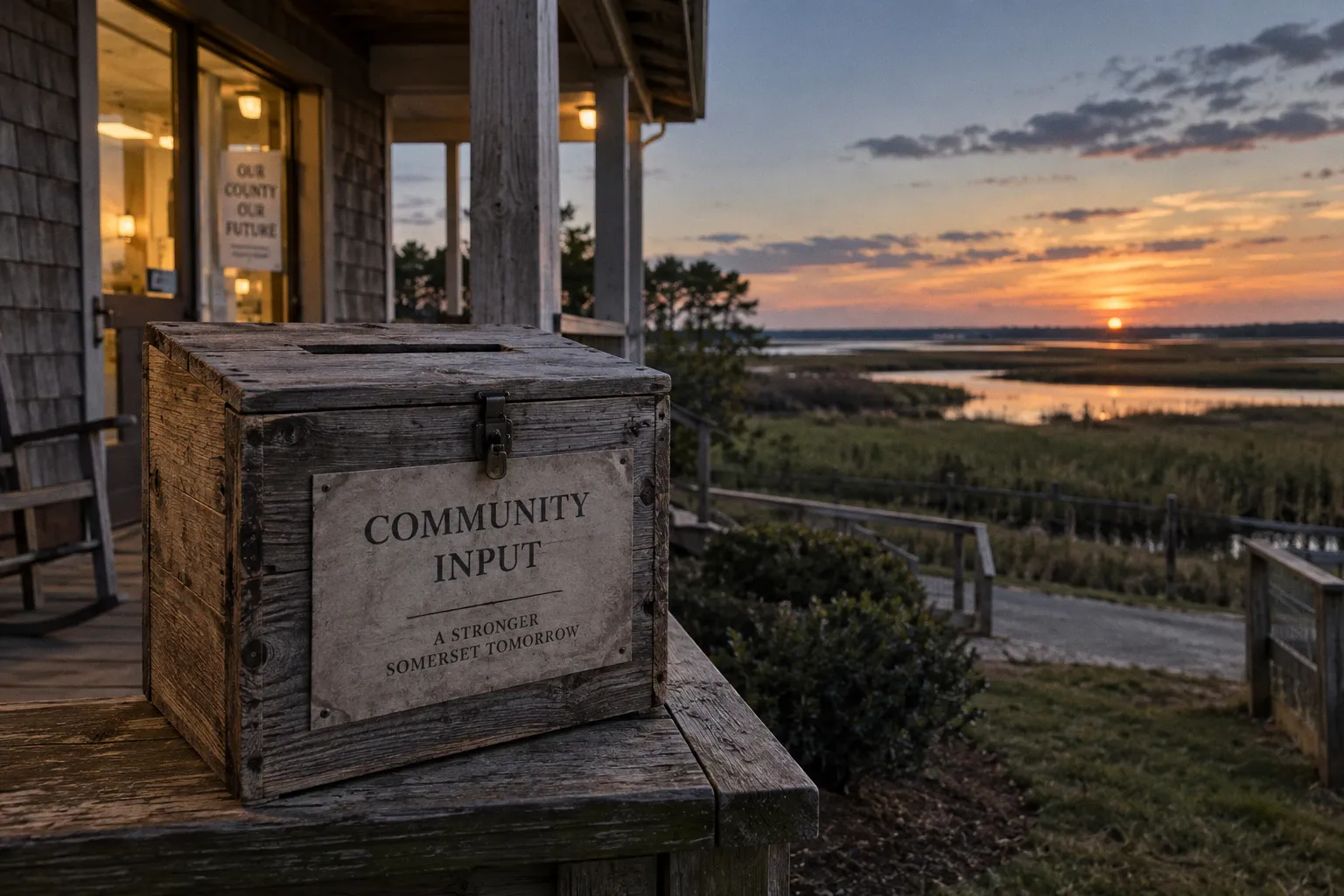
It may refer to land-use designations, infrastructure capacity, or a Comprehensive Plan review, while the question on your mind is much simpler: what does this mean for my block, my commute, my family, or the future of our community?
In Somerset County, public participation is one of the ways those practical concerns enter the planning process. Residents can respond through public comment periods, online surveys, written questionnaires, draft chapter reviews, public hearings, and meetings of the Somerset County Planning Commission. The process has several doors, and you do not have to be a planning professional to walk through one.
The Somerset County public comment period process is best understood as a series of opportunities rather than a single event. A survey can help identify community priorities early. A written comment can point out a problem in a draft. Public hearing testimony can place your concerns on the formal record. Each method serves a different purpose, and using the right one at the right stage makes your participation clearer and more useful.
The role of public input in shaping Somerset’s future
A Comprehensive Plan is a long-range policy document. It helps establish how a county thinks about land use, housing, transportation, natural resources, economic development, public facilities, and the community’s broader direction. It does not decide every individual project by itself, but it creates a framework that can guide later decisions about development and infrastructure.
That framework matters because planning choices accumulate. A decision about where growth should occur can affect roads, water and sewer service, school capacity, emergency response, farmland, wetlands, and the daily distance between homes and essential services. What may look like a technical change in a planning document can eventually influence what gets built and where.
Public participation gives residents a way to connect those policy choices with lived experience. You may know that a road becomes difficult to navigate during certain seasons, that a neighborhood lacks safe pedestrian access, or that a proposed pattern of growth would make an already long trip even harder. Those observations are not separate from planning. They are part of the evidence a community brings to the conversation.
Somerset County’s Comprehensive Plan engagement included both digital and physical methods. Residents could provide input through online channels, including plansomersetmd.org, while physical questionnaires were distributed at public locations such as libraries. That combination matters in a county where not every resident participates online in the same way, and where a public process is stronger when it reaches people in the places they already use.
The survey for the Comprehensive Plan received more than 360 responses, exceeding the consultants’ initial benchmark of 300. That number does not mean every question was settled or that one survey automatically determines policy. It does show that residents were willing to participate when the process gave them a clear way to do so.
The feedback also affected the language of the plan’s vision statement. Community input helped bring forward specific features and priorities, including tidal bays, farm fields, lush woodland, seafood, affordable housing, and technical and higher education. These details are a useful reminder that participation is not only about objecting to a proposal. It can also help describe what residents value and what they want the county to protect, strengthen, or make more accessible.
Public participation is not limited to saying no to a project; it is also how a community describes the future it wants to build.
How the Comprehensive Plan review cycle works
Maryland law requires local jurisdictions to review or update their Comprehensive Plans every 10 years. After a plan is adopted, the jurisdiction must also prepare a five-year Mid-Cycle Report. In practical terms, that creates a continuing rhythm of review rather than a once-in-a-generation planning conversation.
A comprehensive planning cycle generally includes several stages:
1. Research and community listening.
Planners and consultants gather information about population, housing, land use, infrastructure, environmental conditions, transportation, and other local priorities. Community surveys, workshops, questionnaires, and conversations can help identify the issues that deserve attention.
2. Drafting goals, policies, and recommendations.
The information is organized into chapters or topic areas. A draft may describe existing conditions, identify challenges, and propose a direction for future decisions.
3. Public review of the draft.
Residents may be invited to read draft chapters, respond to surveys, attend workshops, or submit written comments. This is often the best time to identify unclear language, missing local knowledge, or recommendations that could have unintended consequences.
4. Planning Commission consideration.
The Somerset County Planning Commission reviews planning materials and hears public input as part of its role in the county’s planning process. The commission has seven members, appointed to five-year terms by the Board of County Commissioners.
5. Revision and recommendation.
Draft materials may be revised in response to technical review and public feedback. A recommendation then moves through the appropriate county decision-making process.
6. Final action and later monitoring.
The Board of County Commissioners has the final authority over adoption of the county’s Comprehensive Plan. Later reviews, including the required five-year Mid-Cycle Report, provide an opportunity to examine what has changed and whether the plan still reflects community conditions.
This sequence can feel slow, especially when a resident is focused on a concern that needs attention now. But the longer timeline is part of what makes a Comprehensive Plan different from an immediate project decision. The document is intended to guide a 20-year planning horizon, while still being revisited as circumstances change.
The most useful question at each stage is not simply, “Can I comment?” It is, “What kind of comment will be most helpful right now?” Early in the process, broad priorities and local knowledge can shape the direction of the plan. During draft review, specific language and omissions are easier to address. At a public hearing, concise testimony can explain why a recommendation matters to residents and how it may affect the community.
Choosing the right way to submit feedback
There is no single correct format for community participation. Some residents prefer to write carefully considered comments. Others are more comfortable answering survey questions or speaking briefly at a meeting. The best method depends on the question being asked, the stage of the process, and the detail you need to provide.
| Participation method | Best use | What makes it effective |
|---|---|---|
| Community survey | Identifying broad priorities and patterns across many residents | Answer each question directly and explain the local reason behind your preference |
| Written comment on a draft | Pointing out unclear, incomplete, or problematic language | Refer to the topic or passage and suggest a practical improvement |
| Public workshop | Learning how a proposal works and raising questions early | Ask for clarification and connect technical issues to everyday impacts |
| Public hearing testimony | Putting a focused position on the formal public record | Speak clearly, stay within the time provided, and make one or two main points |
| Planning Commission meeting | Following the review process and understanding how members respond | Read the agenda materials in advance and listen for the next opportunity to participate |
Community surveys
Surveys are especially useful when the county is trying to understand priorities across a broad group of residents. The Somerset County Comprehensive Plan survey demonstrated that online participation can reach a substantial number of people, while physical questionnaires can help include residents who may be less comfortable with digital forms.
When completing a Somerset MD community survey, avoid treating every question as a referendum on a single project unless the survey specifically asks about that project. A planning survey may be asking about housing, transportation, conservation, economic opportunity, public services, or the overall character of the county. Your answers are more useful when they reflect the principle behind your choice.
For example, if you support more housing options, explain whether your concern is affordability, access to services, housing for older residents, workforce needs, or the location of new homes. If you favor protecting open land, describe whether the priority is farmland, woodland, water quality, scenery, or the preservation of a particular community pattern. The reason helps planners understand what a short answer cannot show.
Written comments
Written comments are valuable when you have a specific point that may be lost in a general survey. You might identify a missing transportation concern, explain how a proposed policy would affect a rural area, or suggest that the plan acknowledge a community asset more clearly.
A strong comment usually contains three parts:
- The point: State what you support, question, or believe should be changed.
- The local connection: Explain what this means for your block, neighborhood, workplace, farm, route, or community.
- The practical suggestion: If possible, describe a clearer policy direction, additional consideration, or question that should be answered.
You do not need to write like a lawyer or land-use consultant. A plain explanation of how a policy could affect daily life is often easier to understand than a page of formal language.
It also helps to separate a concern about the overall plan from a concern about one future application. A Comprehensive Plan establishes broad direction. A later zoning, subdivision, site-plan, or development decision may involve different standards and a different public process. Keeping those levels distinct helps your comment reach the decision-makers who can act on it.
Public hearings
Public hearing testimony is different from an informal conversation or a social media post. It is an opportunity to present your position in a structured public setting. You should expect the meeting to have an agenda and a process for recognizing speakers, receiving comments, or limiting the time available to each person.
The basic guidelines for public hearing testimony in Maryland are practical, even when the subject is complicated:
1. Read the notice and agenda carefully.
Confirm what proposal or document is being discussed and whether the hearing concerns a draft plan, amendment, recommendation, or another action.
2. Decide on one main message.
A short statement with a clear point is easier for the board or commission to understand than a long list of loosely connected complaints.
3. Use specific local examples.
Explain how the issue affects access, traffic, housing, farmland, water, public services, neighborhood character, or another concrete community concern.
4. Distinguish facts from predictions.
If you know a road floods, a route lacks a sidewalk, or a service is difficult to reach, say so plainly. If you are concerned that a policy could create a future problem, identify the condition that creates that concern rather than presenting the prediction as a certainty.
5. Offer a constructive next step.
You might ask for revised language, additional analysis, a clearer implementation policy, or continued public review. A request gives decision-makers something specific to consider.
6. Respect the format.
Listen to the chair’s instructions, stay within the time allowed, and avoid repeating the same point after someone else has made it. Your goal is to add useful information to the record.
A calm, focused statement is not less powerful than an angry one. In fact, it is often easier for a public body to use. The point of testimony is not to win an argument in the room; it is to make sure your concern is understood and preserved as part of the decision-making process.
Engaging with the Somerset County Planning Commission
Navigating the board or commission can feel intimidating when you have never attended a planning meeting before. The Somerset County Planning Commission holds regular public meetings in Room 111 of the Somerset County Office Complex at 11916 Somerset Avenue in Princess Anne, Maryland. Meeting information, agendas, and participation instructions should be checked before attending because the details of a particular session can vary.
The Planning Commission’s seven members serve five-year terms appointed by the Board of County Commissioners. Their role is not to replace public participation but to evaluate planning materials, hear concerns, and help move recommendations through the planning process.
You can make a meeting more productive by doing a little preparation:
- Read the available agenda or draft material before the meeting.
- Mark the pages or topics that raise questions for you.
- Write down the one or two points you most want to communicate.
- Note whether you are speaking about a countywide policy or a specific property or project.
- Listen to the discussion before speaking so you can address what has not yet been covered.
- Keep a record of any follow-up information the commission or staff says will be provided.
If you are unsure whether your issue belongs on the agenda, you can still attend to learn how the commission works and when public comment is accepted. Many residents find that one meeting makes the next one much easier: the names, procedures, and planning terms become familiar, and the room feels less like a closed system.
That familiarity is part of the community fabric. Local government is not only made up of formal votes. It also depends on residents who understand when decisions are being shaped, ask questions before a problem becomes entrenched, and stay involved long enough to see how an idea moves from draft language toward implementation.
How citizen testimony influences local policy outcomes
Public comments do not guarantee a particular zoning result, project denial, or policy change. Final approval for the Comprehensive Plan rests with the Board of County Commissioners, and decision-makers must consider the full record, applicable law, technical information, and the planning document as a whole.
That does not make participation symbolic. It means influence works through the record and the quality of the information residents contribute.
A comment can influence a planning process in several ways:
It can reveal information missing from the draft
Residents often notice conditions that do not appear in maps or countywide data. A draft may describe a transportation connection as available while residents know that the route is unsafe for walking, difficult during certain weather, or inaccessible to people without a car. Those details can prompt a closer look.
It can improve the language of a policy
Broad phrases such as support for housing or protection of natural resources may sound positive but leave too many questions unanswered. Public feedback can encourage clearer language about location, infrastructure, affordability, environmental protection, or the services needed to support growth.
It can show where a broad goal needs a local exception or safeguard
A countywide goal may work differently in Princess Anne, Crisfield, an agricultural area, or a rural neighborhood. Residents can help planners understand where a general policy needs more precise implementation.
It can identify shared priorities
One comment tells a story. Several comments that describe the same barrier can show a pattern. This is one reason surveys and public meetings work together: surveys can reveal the breadth of a concern, while testimony and written comments can explain its human and geographic context.
It can improve accountability after adoption
Participation should not end when a plan is adopted. The five-year Mid-Cycle Report provides a future opportunity to examine whether conditions, priorities, and implementation have changed. Residents who followed the original discussion are often well positioned to ask whether the plan’s promises are being carried forward.
The most useful public comment connects a policy sentence to a real place, a real need, and a practical consequence.
Common mistakes that make public comments less effective
Residents do not need to be perfect participants. Still, a few habits can make it harder for decision-makers to understand what you are asking for.
The first is commenting on the wrong stage of the process. If the county is reviewing a Comprehensive Plan chapter, a detailed argument about a future site-plan application may not fit the decision before the commission. Your concern may still matter, but you may need to connect it to the broader policy question.
The second is relying on general statements without an example. Saying that a proposal is bad for the community communicates emotion but not necessarily information. Explain which part of the community is affected, what condition is at issue, and what you want the county to consider.
The third is treating disagreement as proof of bad faith. Planning decisions are complicated because they balance housing, infrastructure, conservation, economic opportunity, property rights, and public services. You can strongly disagree with a recommendation while still addressing the people involved as neighbors and public servants. A respectful tone keeps the focus on the issue.
The fourth is assuming that silence means approval. A low number of comments may reflect limited notice, confusion about the process, work schedules, transportation barriers, or uncertainty about what to say. If you want a broader community response, share clear information with neighbors and make participation easier to understand.
The fifth is waiting until the final hearing to begin learning. By then, the main direction of a plan may already be established. Early workshops, surveys, and draft reviews give residents more room to ask questions and shape the language before positions harden.
A practical approach for your next opportunity
When you see a notice about a Somerset planning workshop, public hearing, survey, or draft review, begin with the basic facts: what body is meeting, what document or proposal is under review, what decision is expected, and how comments must be submitted.
Then connect the issue to your community. Consider:
- What changes for residents if this policy is adopted?
- Which groups may experience the effects most directly?
- What local knowledge is missing from the draft?
- Does the proposal match the county’s stated goals for housing, land, infrastructure, conservation, or economic opportunity?
- What would make the policy clearer or more workable?
- Is there a specific question that should be answered before the next step?
You can then choose the participation method that fits your point. Use a survey to express a broad priority. Submit written feedback when you need to explain a specific change. Attend a workshop when you need clarification. Speak at a public hearing when you want your position entered into the formal conversation.
The process may not produce an immediate answer, and public feedback will not guarantee a particular outcome. But participation gives the county a fuller picture of what its plans mean beyond the page. It helps connect the long-range vision to the roads, homes, shorelines, farms, businesses, schools, and neighborhoods that make Somerset County a lived place rather than an abstract map.
Our community’s future is shaped not only by the people who hold office or sit on a commission, but also by residents who take the time to read the draft, ask the careful question, and explain what a decision means on the ground. When you participate, you are not stepping into a process that belongs to someone else. You are helping define the community fabric that the plan is meant to serve.