Public hearing petitions: Somerset County submission steps
Paper does not fix a flooded road. But before Somerset County will hear a variance request, consider a zoning text amendment, or schedule a public hearing touching your property, you have to put the…
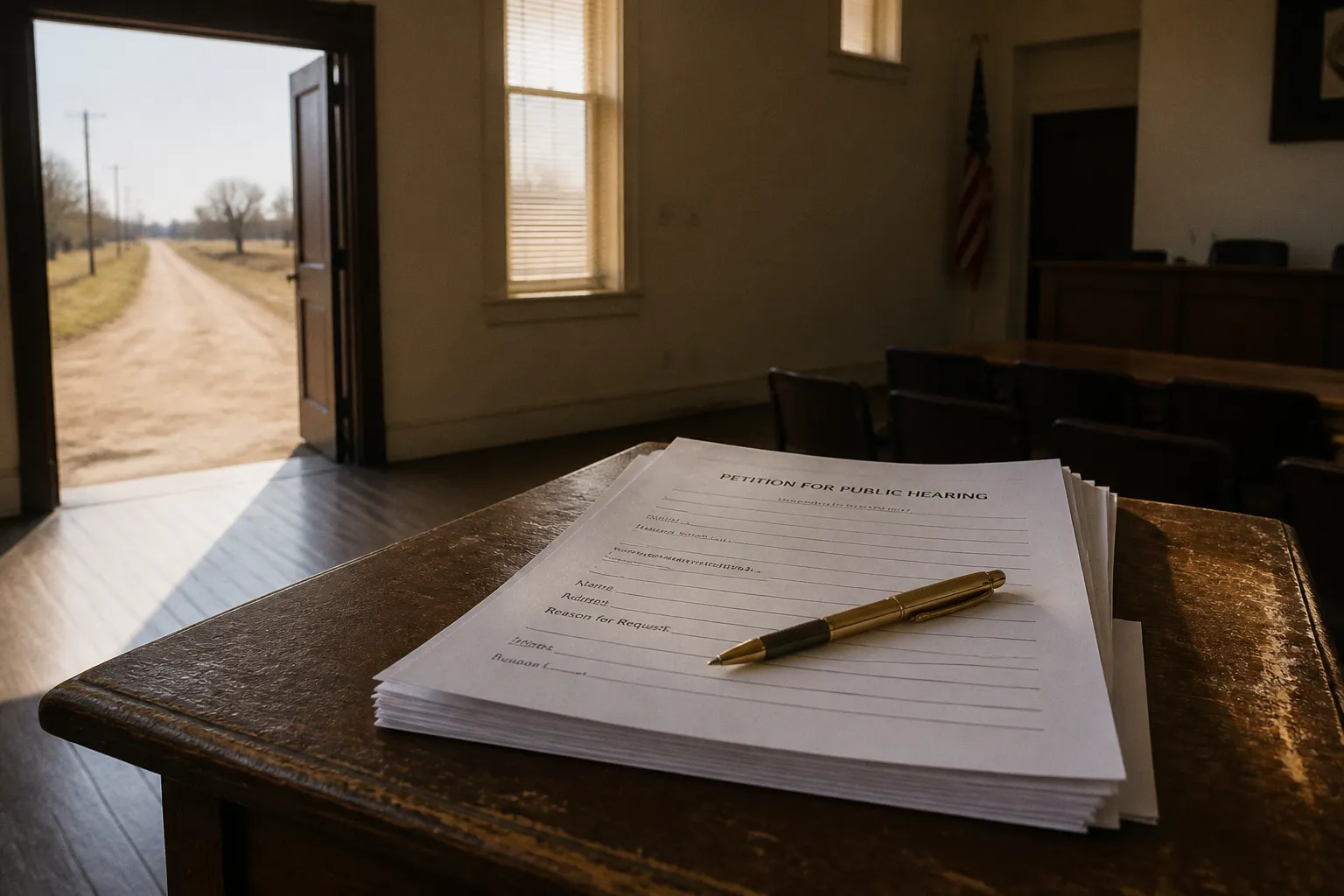
Paper does not fix a flooded road. But before Somerset County will hear a variance request, consider a zoning text amendment, or schedule a public hearing touching your property, you have to put the right request in front of the right body, through the right administrative channel. Skip a step and the request can stall before anyone reaches the merits.
That is the part many residents miss. A public hearing is not the beginning of the process. It is the visible middle of it. By the time your name appears on an agenda, the county should already know what you are asking for, which parcel is involved, what authority is being asked to act, and what supporting material belongs in the file.
Somerset County sits on the Eastern Shore with a thin administrative bench, aging infrastructure, and tight budgets. That is context, not an excuse. The Department of Technical & Community Services handles planning, zoning, and permitting for the county. The Planning Commission, the Board of Zoning Appeals, and the Board of County Commissioners each have different roles downstream of that office.
If you are trying to understand the Somerset County public hearing petition process, start with the forum. A zoning amendment and a variance are not two names for the same request. They are different tracks, heard by different bodies, supported by different kinds of arguments, and subject to different final decisions.
The Front Door: Department of Technical & Community Services for Land Use Requests
Most land-use requests begin with the Somerset County Department of Technical & Community Services. This is the administrative gateway for intake, document review, scheduling, public notice, and staff coordination. It is also the place to resolve the first and most consequential question: what kind of relief are you actually seeking?
A request may involve:
- A variance, which asks for relief from a dimensional or other zoning requirement as applied to a particular property.
- A special exception, where the zoning ordinance allows a use only after approval under specified conditions.
- A zoning text amendment, which proposes a change to the wording or structure of the zoning ordinance.
- A map amendment or rezoning, which proposes a change to the zoning classification of a parcel or area.
- A land-use or development matter referred for review through the county’s planning and permitting process.
Those categories should not be mixed casually. A property owner who needs relief from a setback is generally making a property-specific request. A resident seeking to change the way a zoning district treats a class of properties is raising a legislative zoning issue. The fact that both requests may result in a public hearing does not make them interchangeable.
Before filing, confirm the current administrative requirements with the department. A short call or visit can establish the applicable form, fee, filing method, supporting documents, and scheduling expectations. It can also clarify whether the request belongs before the Planning Commission, the Board of Zoning Appeals, the Board of County Commissioners, or more than one body at different stages.
Do not treat that conversation as the filing itself. Informal guidance may help you prepare, but a verbal request does not normally create a formal record or put a matter on an agenda. The request needs to be submitted in the form the county requires.
At a minimum, a written submission should identify:
- The applicant and, where relevant, the property owner.
- The parcel identification number and a usable property description.
- The specific relief or action requested.
- The factual basis for the request.
- Any site plan, sketch, map, photographs, or other material needed to understand the proposal.
- The applicant’s signature and the date of submission.
The exact package will depend on the matter. A variance request may require a site plan showing the existing and proposed conditions. A map amendment needs a clear description of the requested zoning change and the area affected. A text amendment needs proposed language or a sufficiently precise description of the language the petitioner wants changed. Staff can identify current requirements, but the applicant is responsible for making the request intelligible.
A petition that does not identify the property, the requested action, and the legal route is not ready for a hearing. It is still an idea.
A common intake mistake is appearing at a Planning Commission meeting and expecting to speak on a matter that has never been filed. Public comment at an advertised hearing is not a substitute for submitting a petition. If the request is not properly before the body, the meeting cannot turn an informal statement into a complete application.
Two Different Tracks: Planning Commission Amendments and Board of Zoning Appeals Variances
The cleanest way to avoid procedural confusion is to separate the two principal routes.
| Question | Zoning amendment route | Variance route |
|---|---|---|
| Basic request | Change the zoning ordinance text or zoning map | Obtain relief from a zoning requirement as applied to a property |
| Initial decision-maker | Planning Commission reviews and recommends; Board of County Commissioners acts on the amendment | Board of Zoning Appeals considers the variance request |
| Scope | Legislative or district-wide in effect, even when prompted by one property | Generally limited to the particular property and circumstances presented |
| Record to build | Planning rationale, consistency with the comprehensive plan, affected area, proposed language or map change | Site conditions, applicable standards, hardship or practical difficulty where relevant, and supporting plans |
| Final administrative action | Board of County Commissioners’ action on the amendment | Board of Zoning Appeals’ final decision on the variance |
| Judicial review | Directed at the final decision in the amendment track | Directed at the final decision in the variance track |
This table is not a substitute for the county’s current forms or legal advice. It is a warning against combining separate matters simply because they concern the same parcel.
The Planning Commission and Zoning Amendments
The Somerset County Planning Commission is the recommendation body for zoning amendments and a central forum for long-range planning. The draft materials identify seven members appointed by the Board of County Commissioners to five-year terms. The commission also reviews and updates the Somerset County Comprehensive Plan and advises on subdivisions, site plans, and other matters referred through the county’s land-use process.
For a zoning text amendment or map amendment, the Planning Commission is not acting as the Board of Zoning Appeals. Its role is to examine the planning and zoning question, receive the information and public comment required for the matter, and forward a recommendation to the Board of County Commissioners.
The Commission may consider questions such as:
- Whether the proposed change fits the county’s comprehensive planning framework.
- Whether the requested text or map change is internally coherent.
- What properties, districts, or future development patterns could be affected.
- Whether the record supports the change being proposed.
- Whether the amendment creates conflicts with existing zoning provisions or land-use policies.
A petition directed at this route should therefore do more than explain why one owner wants a different result. It should explain why the ordinance or zoning map should change, how the change would operate, and what consequences follow beyond the applicant’s individual circumstances.
The Planning Commission may hold a public hearing and accept written or oral comment according to the notice and procedures applicable to that matter. The hearing should be treated seriously, but its exact format is matter-specific. Some proceedings are legislative in character; others may involve more formal evidentiary procedures. Do not assume that every Planning Commission zoning-amendment hearing is a quasi-judicial proceeding or that every participant will be subject to the same procedures used in an adjudicatory appeal.
The practical point is simpler: submit your evidence in a form the Commission and the Board of County Commissioners can evaluate. A planning argument that exists only as an impromptu statement at the microphone is harder to test, answer, and preserve than one supported by a clear written proposal.
The Board of Zoning Appeals and Variances
A variance follows a separate path. The Board of Zoning Appeals, not the Planning Commission, considers whether the applicable zoning requirements may be adjusted for the property and circumstances presented.
That distinction matters because a variance is not a back-door zoning amendment. It does not generally rewrite the ordinance for everyone. It asks the appropriate decision-maker to apply the governing standards to a particular parcel.
A variance file should make the physical and legal problem easy to see:
- What requirement applies?
- What condition on the property creates the difficulty?
- What dimensions or use are proposed?
- What would happen without relief?
- How would the request affect neighboring properties and the surrounding district?
- What plans, photographs, surveys, or other documents support the description?
The Board of Zoning Appeals may use a more formal hearing structure than a legislative planning discussion, and the governing rules for notice, testimony, exhibits, and participation should be confirmed for the specific matter. Sworn testimony or cross-examination may be required or permitted in a particular proceeding, but they should not be presented as universal features of every public hearing in the county.
The applicant should not assume that a variance request can be cured by asking the Planning Commission to recommend around it. Nor should the applicant assume that approval of a variance would require the Planning Commission and the Board of County Commissioners to act first. These are separate administrative tracks.
Formalizing the Request: Administrative Procedures and Documentation
Once the correct route is identified, the petition needs to become a usable administrative file. That means more than attaching a signature page. The file should allow a staff reviewer, a hearing body, an affected neighbor, and—if necessary—a reviewing court to understand what was requested and why.
A practical submission package may include the following:
| Document | Purpose | Typical destination |
|---|---|---|
| Signed written request or application | Establishes the requested action and applicant | Department of Technical & Community Services |
| Parcel identification and property description | Identifies the land involved | Application and attachments |
| Statement of requested relief | Defines the variance, text amendment, map amendment, or other action | Application narrative |
| Site plan, sketch, survey, or map | Shows existing conditions and the proposal | Supporting exhibits |
| Photographs or related records | Documents physical conditions relevant to the request | Supporting exhibits |
| Adjacent-owner information, where required | Supports notice and administrative review | County staff |
| Filing fee, where applicable | Completes the administrative submission | Intake office |
The word “complete” does important work here. A petition can be sincere and still be incomplete. If the county cannot tell what action is being requested, cannot locate the parcel, or lacks the material needed to issue notice, the hearing may be delayed while the file is corrected.
Write the Relief as an Administrative Request
Avoid a narrative that makes the reader reconstruct the request. State the action directly, then explain it.
For a variance, identify the zoning requirement and the relief sought. For a text amendment, identify the provision to be changed and describe the proposed language or policy result. For a map amendment, identify the parcel or area, the current classification, and the classification being requested.
Specificity does not mean loading the application with legal conclusions. It means removing avoidable ambiguity. “I want to use my property” leaves the county with nothing precise to notice or decide. A description tied to the applicable requirement, parcel, and proposed condition gives the reviewing body something it can evaluate.
Verify Signature and Petition Requirements
The signature threshold for citizen-led zoning reform petitions is not specified in the materials available for this article, and there is no confirmed county figure to insert here. That is a reason to verify the current requirement directly with the Department of Technical & Community Services before collecting signatures, not a reason to guess.
Ask the department:
- Whether the request must use a county form.
- Who may sign or submit it.
- Whether signatures must be from property owners, residents, registered voters, or another defined group.
- How the county verifies signatures.
- What filing deadline applies before the matter can be scheduled.
- Whether the fee and supporting exhibits are due at the same time.
Keep a dated copy of everything submitted, including attachments and proof of delivery. If the county asks for corrections, preserve both the original submission and the corrected version. A clean administrative history is useful even when the matter never reaches court.
Public Notice, Agendas, and the Hearing Record
A hearing becomes meaningful only when the public receives the notice required for that type of proceeding and the decision-maker has a defined matter before it. Publication, mailing, posting, and agenda practices can vary by request. Confirm the applicable method rather than assuming that one notice rule covers every land-use matter.
The applicant should monitor:
- The date the request was accepted as complete.
- The expected agenda or hearing cycle.
- The publication or posting of notice.
- Any mailed notice to neighboring or affected property owners.
- Staff reports and attachments released before the hearing.
- Continuances, amended agendas, or requests for additional information.
Do not wait until the meeting begins to discover that the matter was postponed or that staff is recommending a different action. Administrative calendars move, especially when a file is incomplete or additional notice is required.
The hearing itself is not a performance contest. The decision-maker needs a record tied to the applicable standards. Submit relevant documents through the proper channel, answer the questions presented, and distinguish facts from conclusions. If the hearing rules allow public comment, use that time to address the request—not to assume that the body can decide an entirely different issue on the spot.
The exact hearing procedure depends on the matter. Some hearings may include sworn testimony, exhibits, or opportunities for questions; others may be structured as public comment on a legislative proposal. Staff may explain or test information, but “cross-examination by staff” is not a universal requirement. What is consistent is the value of a clear record: identify the document, state the point it proves, and connect the point to the decision the body has authority to make.
Pulling the File You Need First: Resolution No. 1182
Before filing, you may need the county’s own records: prior staff reports, engineering memoranda, earlier findings, recorded plats, correspondence, or decisions involving the parcel or nearby properties. Those records can reveal what the county has already considered and which factual issues are likely to control the next hearing.
Somerset County’s Public Information Act policy, amended by Resolution No. 1182 with an effective date of January 31, 2023, governs the process described in the draft materials. Public Information Act requests should be submitted in writing and directed to the County Administrator-Clerk or the Board of County Commissioners, as appropriate. The county’s response obligations and applicable deadlines are governed by the statute and the county’s procedures.
A useful request is narrow enough to process and broad enough to answer the question. Identify:
- The parcel number and address, if available.
- The type of records sought.
- The relevant subject matter or prior application.
- A date range, if you know it.
- Whether you are seeking final decisions, staff reports, maps, correspondence, or supporting materials.
Keep the submission date and follow up in writing if necessary. Do not assume that a record request automatically pauses a filing deadline or extends a hearing schedule. If a petition must be filed by a particular date, treat the records request and the land-use filing as separate tasks.
The administrative record begins before the hearing date. If a prior county finding affects your request, find it before you ask the county to make a new one.
Records are not useful merely because they are official. Read them for the issue they establish. A previous denial may identify a missing plan, a site-specific condition, a notice problem, or a standard the applicant failed to address. A prior approval may show how the county interpreted a provision, but it does not automatically guarantee the same result for a different parcel or set of facts.
Separate Final Decisions, Separate Court Routes
Judicial review begins with identifying the final decision in the track you actually pursued. There is no single sequence in which the Planning Commission, the Board of County Commissioners, and the Board of Zoning Appeals must all rule before a petitioner can seek review. Requiring all three bodies to act would incorrectly combine separate proceedings.
Zoning Amendment Decisions
For a zoning text amendment or map amendment, the Planning Commission generally reviews the proposal and sends a recommendation to the Board of County Commissioners. The Commissioners then take the action assigned to them under the applicable law and county procedures.
If the amendment is denied, approved with changes, or otherwise resolved by final action, the question of judicial review concerns that final decision and the procedures governing that amendment. The Planning Commission’s recommendation may be part of the record, but it is not the same thing as a final variance decision by the Board of Zoning Appeals.
Variance Decisions
For a variance, the Board of Zoning Appeals is the relevant decision-making body. If the Board issues a final denial, the petitioner must evaluate review rights based on that decision and the rules applicable to the variance proceeding. The Planning Commission and Board of County Commissioners do not need to issue separate decisions on the same variance before the matter can move toward judicial review.
Maryland judicial review of a final local administrative decision is generally sought in the Circuit Court for Somerset County, subject to the governing statute, rules, and deadlines. Confirm the filing period and the triggering event with qualified counsel. The clock may run from service, notice, or entry of the final decision under the applicable rules; do not calculate it from the day you happen to read the order.
The court’s review is not a new zoning hearing. Depending on the type of decision and the issues raised, the court may examine whether the agency acted within its authority, followed required procedures, applied the correct legal standards, and reached a decision supported by the administrative record. The court may not simply replace the agency’s judgment with the petitioner’s preferred result.
That is why the record matters from the beginning. Preserve the application, exhibits, staff reports, hearing notices, minutes, written comments, orders, and any written objections or responses. If a point matters, make sure it is presented through the procedure available in that proceeding. A court cannot review material that never became part of the record.
Common Mistakes That Burn the Calendar
The same avoidable errors appear across local land-use filings:
- Filing in the wrong forum. A variance belongs on the Board of Zoning Appeals track. A zoning text or map amendment follows the Planning Commission and Board of County Commissioners route. Do not assume the county will redirect a misfiled request.
- Using the wrong kind of argument. A property-specific hardship argument does not, by itself, explain why the county should rewrite a zoning provision. A broad policy objection does not, by itself, establish the basis for a variance.
- Leaving the relief vague. The county cannot schedule a useful hearing around an undefined request. Name the requirement, parcel, proposed change, or ordinance provision.
- Submitting an incomplete file. Missing plans, signatures, fees, or ownership information can delay intake and public notice.
- Assuming every hearing has the same rules. A legislative zoning discussion is not identical to a Board of Zoning Appeals proceeding. Confirm whether testimony is sworn, how exhibits are submitted, and how participants may respond.
- Treating public comment as the petition. Speaking at a meeting does not replace the written filing needed to place a matter before the appropriate body.
- Ignoring prior records. Earlier decisions, staff reports, and plats may contain the facts that determine whether your request is persuasive.
- Waiting for a final answer before preserving the file. Keep copies of submissions and decisions as the matter develops. If review becomes necessary, reconstruction is harder than preservation.
The Real Picture
Somerset County’s process is not mysterious, but it is unforgiving of category errors. The Department of Technical & Community Services is the administrative front door. The Planning Commission and Board of County Commissioners handle the zoning-amendment route. The Board of Zoning Appeals handles the variance route. A public hearing may appear in both tracks, but the hearing does not erase the difference between them.
Your job is to identify the action, file it through the proper office, provide a complete explanation and supporting record, and follow the matter through notice and final decision. If the answer is no, identify which body actually issued the final decision before considering judicial review.
That is the work. The hearing is only one part of it.