Planning commission broadcasts: how to watch Somerset meetings
The Somerset County Planning Commission does not broadcast its meetings. There is no YouTube channel, no public access feed, and no Zoom recording uploaded to the county website afterward.
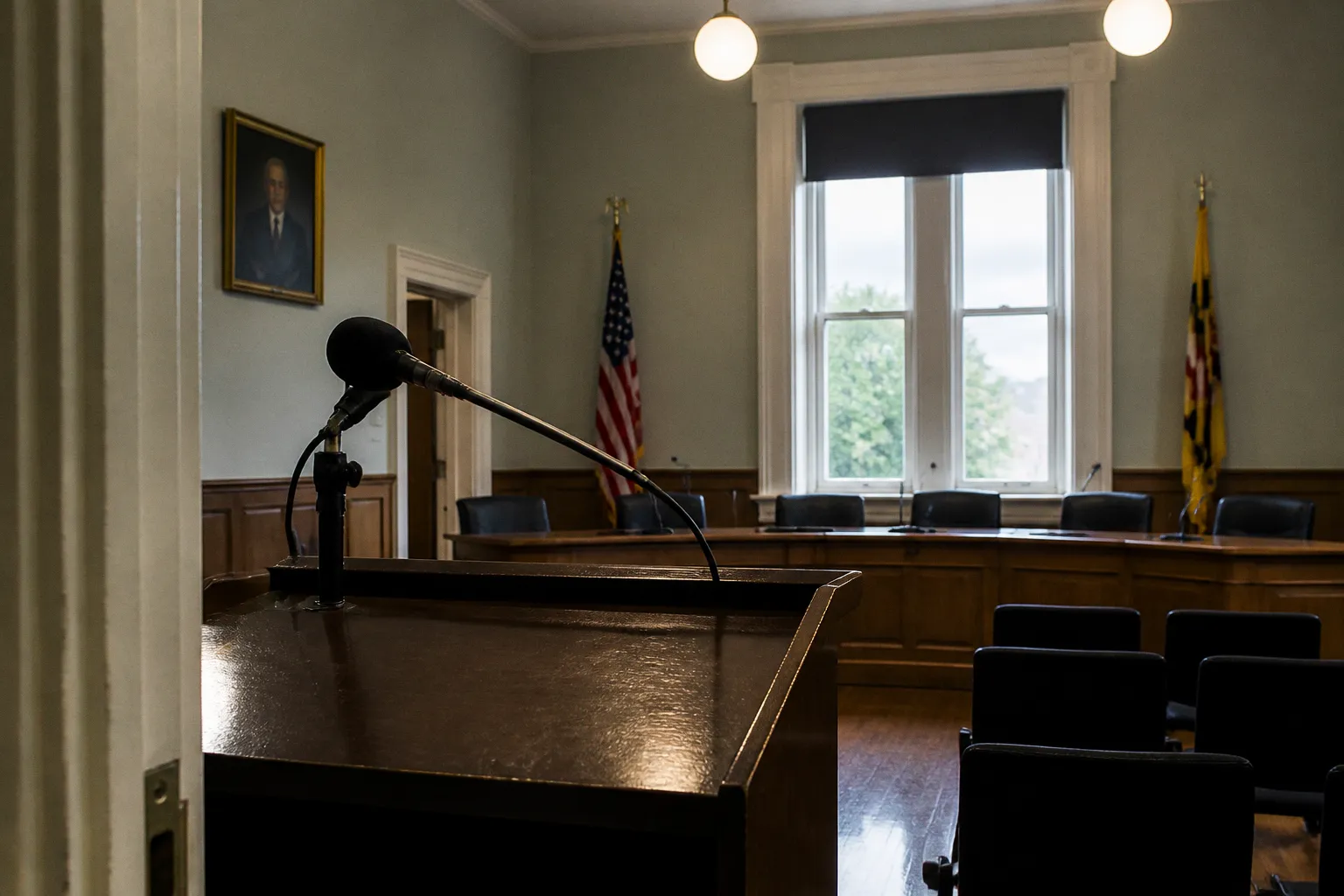
Seven appointed members sit in a first-floor meeting room, review subdivisions, consider recommendations on planning and zoning matters, and vote in front of whoever made the trip to Princess Anne.
If you are searching for a Somerset County planning commission meeting live stream, stop looking for a hidden link. The county’s system is built around in-person attendance, published agendas, and approved written minutes. Those minutes are the county’s public record of the meeting, but they are not a live feed and they are not a transcript. They may appear only after the meeting has ended and the commission has reviewed and approved them.
If you want to follow what is being done to the physical landscape of Somerset County — the lot lines, the drainage easements, the road frontages, the setbacks on your neighbor’s property — you show up at 11916 Somerset Avenue in Princess Anne, walk into Room 111, and sit through the proceedings in person. That is the practical reality. Pretending otherwise wastes your time.
Approved minutes are the county’s public record of the meeting. They are not a substitute for being in the room.
This is not a consumer-style guide to watching a polished replay. It is a map of the actual access points: where the meetings happen, what documents become available, how the decision-making clock works, and what a resident can do when attending in person is difficult.
The Reality of Digital Access in Somerset County
Let’s be direct about the digital footprint, because a lot of residents waste hours looking for something that does not exist.
- No live stream. Somerset County’s Planning Commission meetings are not broadcast online. There is no embedded video player on the county site, no livestream tab, and no regular public-access feed to check before a meeting.
- No video recording afterward. Even after a meeting concludes, an archive video is not posted as the standard public record. The written record is what becomes available through the county’s document process.
- No routine Zoom or hybrid option. The normal way to attend is in person. If a particular meeting has different arrangements, those should be confirmed with the county rather than assumed from another board’s practices.
That distinction matters because residents often search for meeting recordings when what they really need is one of three different things:
1. A way to observe the discussion. That means attending the meeting.
2. A way to understand the decision. That means reading the agenda packet, staff materials, and later the approved minutes.
3. A way to put an objection or position into the process. That means speaking during an appropriate public hearing or submitting written material through the channel the county identifies for that matter.
Those are not interchangeable. A recording would let you replay a commissioner’s wording, hear the sequence of questions, and watch how a presentation changed the discussion. Written minutes generally serve a different purpose. They summarize the official business, actions, and decisions rather than reproducing every sentence spoken in the room.
This is not unusual for rural Eastern Shore counties, where public bodies may have fewer digital production resources than larger jurisdictions. But “not unusual” does not make the access problem irrelevant. If your weekday schedule, mobility situation, childcare responsibilities, or distance from Princess Anne keeps you from showing up at the appointed hour, the lack of a replay changes how carefully you have to prepare.
What this means practically:
1. Your clearest opportunity to speak is the public hearing itself, not a comment form afterward.
2. Your opportunity to observe the full discussion is also the meeting itself. There is no routine replay to consult later.
3. If something is decided that you object to, your first exposure to the result may be the approved minutes or another county document posted after the vote.
4. If you need the reasoning behind a recommendation, look beyond the minutes to the staff report, application materials, maps, and exhibits.
5. If you are tracking a matter over time, save each agenda and packet as it appears. A later minutes page may not contain every attachment that was available before the meeting.
Don’t mistake the absence of a broadcast for the absence of public obligations. Maryland law requires a local planning commission to hold a public hearing before recommending adoption of, or an amendment to, a comprehensive plan under Md. Code, Land Use § 3-203. The commission takes testimony and acts through a public process. But for a resident trying to follow the details, that process is experienced in the room and reconstructed afterward from documents.
The practical search terms can also be misleading. “Somerset MD planning meeting recordings” suggests that a video archive should exist. “Watch Somerset County commissioner meetings online” refers to a different public body and should not be confused with Planning Commission access. The Planning Commission, the Board of County Commissioners, and other county boards may have different meeting practices, separate agendas, and separate document pages.
In-Person Attendance at the Somerset County Office Complex
Every Planning Commission meeting and public hearing happens in the same place: Room 111, the Commissioners Meeting Room, on the first floor of the Somerset County Office Complex, 11916 Somerset Avenue, Princess Anne, Maryland 21853.
You do not need a reservation to sit in the public area. You walk in, find a seat, and observe. When the chair opens a public hearing, you may approach the podium, state your name and address for the record, and deliver your comments within the allotted window — typically three minutes unless the chair extends it or announces a different arrangement.
The room itself is part of the process. It is where the staff presentation, applicant’s explanation, public comments, commissioner questions, and formal motion occur in sequence. If you are concerned about a proposed subdivision or a change that could affect drainage, access, traffic, or adjacent property, the sequence matters. A written packet can show the recommended conditions; only attendance lets you hear the questions that arise before the commission acts.
Logistics that matter
- Arrive early. Parking at the Office Complex is not usually the central problem, but the meeting room can fill up for controversial hearings. Ten minutes of buffer gives you time to locate Room 111, review the agenda, and find out whether the order of business has changed.
- Bring the relevant materials. Pull the staff report, application packet, site plan, and any draft ordinance from the county website before you come. Cell service in the building may be adequate, but relying on a large PDF loading at the exact moment a map is discussed is not a good plan.
- Bring paper or offline copies. A site plan with marked access points, drainage features, or neighboring parcels is easier to follow when you can refer to it without switching between a phone and the speakers at the front of the room.
- Sign in if a sign-in sheet is provided. This may not be the same thing as submitting a formal comment, but it helps you establish that you attended. Do not assume that signing in, by itself, places your position into the record.
- Know when public comment occurs. A general public-comment period is not necessarily the same as a public hearing on a specific application. If your concern is tied to a listed agenda item, wait for the chair to open the appropriate portion of the meeting.
- Dress for a public building. There is no need to perform seriousness through formal clothing. The useful standard is simple: arrive prepared, be clear, and treat the room as a working government space.
The agenda is posted on the county’s website in advance of each meeting. Read it closely. Look for the item number, application or case reference, the type of action requested, and any indication that a public hearing will be held. A title such as “subdivision review” may conceal the practical question that matters to you: a new entrance, a road connection, a waiver, a drainage issue, or a change in the number or arrangement of lots.
If your issue is on the agenda, prepare your statement around the decision the commission is actually being asked to make. A general objection to growth is less useful than a specific explanation of how the proposal interacts with an ordinance standard, an access point, an easement, or a documented condition on the site.
If your issue is not on the agenda, you will not automatically receive a formal hearing slot on that issue. You can still attend and observe, and you can ask whether a general public-comment portion is offered. You can also contact the appropriate county office about placing an item on a future agenda. The key is not to wait until the meeting begins to discover that the topic you came to discuss is not legally or procedurally before the commission.
Speaking at a hearing
A short public statement works best when it is organized before you enter the room. Identify yourself, identify the property or application, state your position, and connect the concern to a concrete planning issue. If you have documents, bring enough copies for the relevant staff or commission members if the county’s procedures permit distribution.
Avoid turning the hearing into a document dump. A stack of pages does not necessarily make an argument stronger. A single marked map or a concise written statement may help the commission understand what you are saying, particularly when the issue involves a road frontage, neighboring parcel, drainage route, or setback.
The chair controls the meeting and may set time limits, ask speakers to avoid repetition, or direct technical questions to staff. That is not a sign that public testimony is being ignored. It is how a hearing remains manageable. Make the point that belongs in the record, then leave room for the commission to ask questions.
Navigating Official Meeting Minutes and Public Records
Because there is no video archive, the minutes packet is one of your most important documents. Approved written minutes are the county’s public record of the meeting. They record the official business and actions taken, but ordinary minutes are summaries, not verbatim transcripts of everything said.
Where to find them: The Somerset County Government website hosts approved minutes under the Planning Commission section. Once a meeting is held, the draft minutes go through an approval process at a subsequent meeting. The approved version is generally posted after the commission has reviewed and approved it.
That timing creates an unavoidable gap between the meeting and the document that confirms what happened. It also means that a resident searching for “Somerset County public meeting archives” should not expect a single searchable video library. The archive is more likely to be a collection of agendas, packets, minutes, ordinances, reports, and related public documents organized by department or board.
| Stage | What happens | Your realistic timeline |
|---|---|---|
| Meeting held | The commission conducts its business, hears testimony when a hearing is scheduled, and takes action as appropriate | Day 0 |
| Draft prepared | Staff prepares written minutes for review and correction | After the meeting |
| Review and approval | Commissioners review the minutes and may approve them as written or with amendments at a later meeting | Often one or more meetings later |
| Posting | The approved minutes appear on the county website after approval | Shortly after the approval process |
The exact posting schedule can vary. Do not treat an absent minutes file as proof that no meeting occurred or that no action was taken. Check the next meeting’s agenda, the relevant Planning Commission page, and the county office responsible for the records.
What minutes can and cannot tell you
Minutes are useful for confirming the basic public history of a meeting:
- which matters were considered;
- whether a public hearing was held;
- whether a motion was made;
- whether the commission approved, denied, tabled, or otherwise acted on an item;
- what recommendation or next step followed;
- whether the minutes themselves were amended before approval.
They are less useful for reconstructing every exchange. They may not capture the full wording of a resident’s testimony, the exact sequence of informal questions, or every technical detail shown on a map. If the matter is important, read the minutes alongside the staff report and application materials rather than treating the minutes as a complete substitute for the meeting.
Practical steps:
1. Do not wait for the minutes to check on a vote. If a critical matter is on the agenda, attend the meeting or send someone you trust. The minutes may confirm the action later, but they will not give you the chance to respond before the commission votes.
2. Download the staff reports, not just the minutes. Staff reports include the technical analysis, site plan, engineering review, drainage information, and recommended conditions when those materials are provided. That is where the physical reality of a project usually becomes clearer.
3. Save the agenda packet. The packet can show what the commission was given before the meeting, while the minutes show what the body formally recorded afterward. The two documents answer different questions.
4. Cross-reference the zoning ordinance. When the minutes cite a section of the zoning ordinance, open the ordinance text and read the actual language. Minutes summarize; the ordinance supplies the governing standard.
5. Compare revisions. If an application returns to a later meeting, compare the new plan with the earlier version. Changes to access, lot lines, buffers, or conditions may be more significant than the short description on the agenda.
6. Save your own copy. PDFs get reorganized on government websites without notice. If a document matters to you, archive it locally with the meeting date and application number in the filename.
7. Ask for clarification instead of guessing. If the minutes refer to an exhibit, attachment, or condition that you cannot locate, contact the Planning Office and ask which document corresponds to that reference.
A county website is a working tool, not a museum. Documents move, links break, and an approved set of minutes from three years ago may no longer be where you first found it.
Building your own meeting file
For an active land-use matter, create a simple folder with the application number or property address. Keep the original agenda, revised agendas, staff reports, maps, written comments, hearing notice, minutes, and any follow-up correspondence together. Add the date each document was downloaded.
This is not bureaucratic overkill. Planning matters often return to a public body more than once. A proposal may be continued, revised, recommended with conditions, or sent to another decision-maker. If you rely on memory or a browser bookmark alone, it becomes difficult to determine which version was before the commission on a particular date.
A personal file also helps separate three things that are often blurred together:
- what the applicant proposed;
- what county staff recommended;
- what the Planning Commission actually voted to recommend or approve.
Those may be different at every stage.
Understanding the Commission’s Decision-Making Timeline
The Somerset County Zoning Ordinance gives the Planning Commission a hard deadline after every public hearing: 30 days. Within 30 days of closing the public hearing, the Commission must render its formal decision and recommendation. That recommendation then goes to the Board of County Commissioners, which has its own schedule and public process.
The important phrase is “after the hearing closes.” A hearing that is opened and continued is not necessarily the same as a hearing that has concluded. Track what the chair announces and what the minutes later record. If testimony remains open, the decision clock may not begin in the way a resident assumes.
A separate but equally important clock governs subdivisions. Under Maryland land-use practice reflected in Somerset’s procedures, an approved subdivision plat must be recorded in the county land records within two years of approval or it lapses. That provision matters because approval and construction are not the same event. A project can be approved without immediately changing the landscape, and the recording requirement creates a separate milestone to watch.
Key timing benchmarks
| Action | Statutory or ordinance window |
|---|---|
| Public hearing notice published in a newspaper of general circulation | At least once before the hearing date |
| Planning Commission decision after a public hearing | 30 days |
| Subdivision plat recorded in land records after approval | Two years |
| Comprehensive plan or amendment adoption recommendation | After at least one public hearing under § 3-203 |
Treat these benchmarks as dates to track, not as a substitute for reading the governing text. The application type, the body taking the action, and the exact procedural posture all matter. A Planning Commission recommendation is not necessarily the final county decision, and a public hearing on one component of a proposal does not automatically resolve every later approval.
If the Commission misses the 30-day deadline, that is a procedural issue you can raise — but do not assume that a missed date automatically voids the underlying matter or produces a particular legal result. Record the date the hearing closed, save the agenda and minutes, and ask the county or a qualified land-use attorney what consequence the missed deadline may have in that specific proceeding.
Set a reminder on the day the hearing closes. Then set another reminder shortly before the deadline. The point is not to manufacture a technical dispute. It is to avoid discovering months later that you lost track of the next vote, recommendation, or appeal-related date.
The handoff to the Board of County Commissioners
The Planning Commission and the Board of County Commissioners have different roles. The Planning Commission may review a plan, subdivision, or zoning-related proposal and issue a recommendation. The Board may then consider that recommendation through its own public process. A resident who attends the Planning Commission meeting but ignores the Board’s agenda may miss the point at which the final county action is considered.
For that reason, follow the matter by its application number, property location, and subject — not just by the date of the first hearing. When the Planning Commission refers an item onward, look for it in the Board of County Commissioners’ agendas and public notices. The absence of a Planning Commission recording does not mean the entire matter disappears; it means the resident has to follow the paper trail across the relevant public bodies.
Legal Requirements for Public Hearings and Notifications
The Planning Commission is not a discretionary body that can simply decide what to publish and when. Maryland law and the Somerset County Zoning Ordinance establish obligations for hearings, notices, and procedural steps. Those requirements are useful to residents, but they work best when treated precisely rather than as broad guarantees that every concern will produce a new hearing.
Public hearing requirement
Under Md. Code, Land Use § 3-203, a local planning commission must hold at least one public hearing before recommending adoption of a comprehensive plan or an amendment to it. If a comprehensive plan amendment is moving forward and no public hearing appears on the published agenda or notice, that is a procedural question worth raising promptly with the county and, where appropriate, the Board of County Commissioners.
A public hearing is not the same as an open-ended discussion whenever a resident requests one. The notice and agenda identify the matter before the commission. Your job is to connect your comments to that matter and to make clear whether you are addressing a plan amendment, a subdivision, a zoning recommendation, or another action.
Newspaper notice
Before a Planning Commission public hearing can occur, notice of the time and place must be published at least once in a local newspaper of general circulation. This is the formal notice residents should track. If you read the legal-notices section of your local paper and do not see a Planning Commission hearing advertised for a project you care about, ask the Planning Office before the hearing date whether notice was given and where the notice appeared.
Do not rely on a single source. Check the county’s meeting page, the agenda packet, posted notices, and the newspaper notice when available. Public information can be distributed across several pages, and a project may be described under an applicant’s name, a parcel address, an application number, or a short staff title that is not familiar to neighbors.
The commission’s composition
The Planning Commission has seven appointed members. It is not an elected body. Members are appointed by the Board of County Commissioners and serve under the county’s appointment structure. If you want to influence who sits on the Commission, the Board of County Commissioners meeting is where that conversation belongs — not the middle of a Planning Commission hearing on someone else’s application.
That does not mean the identity of individual commissioners is unimportant. Knowing the commission’s membership helps you understand the body you are addressing, but it should not replace a focused argument tied to the application and the applicable standards.
Practical engagement sequence
1. Watch the legal notices. Somerset’s local papers carry public hearing announcements. Mark the hearing date, time, location, and subject.
2. Read the agenda packet when it posts. Look for the application number, staff recommendation, maps, proposed conditions, and the exact action requested.
3. Prepare a written statement. Even if you plan to speak in person, a concise written statement helps you stay within the time limit and preserves the details you do not want to omit.
4. Attend or send a representative. If you cannot attend, designate someone you trust to attend and read your statement into the record if the hearing rules allow it. Confirm the arrangement in advance rather than assuming another person can speak for you.
5. Submit supporting material through the proper channel. Ask the Planning Office how written comments, maps, photographs, or technical information should be delivered and whether materials must arrive before the meeting.
6. Follow up in writing. A short email to the Planning Office after the hearing, identifying the application number and summarizing your concern, creates a parallel correspondence record. It does not replace testimony or alter the official minutes, but it can help resolve misunderstandings.
7. Track the 30-day clock. Note when the hearing closes and watch for the decision or recommendation. If the deadline approaches without a vote, ask the county for the status of the matter.
8. Follow the next decision-maker. If the Planning Commission sends a recommendation to the Board of County Commissioners, continue watching that board’s agenda and notice process.
What to Do When You Cannot Attend
The lack of Somerset planning virtual attendance makes preparation more important for residents who work evenings, live far from Princess Anne, or cannot travel easily. There is no guaranteed recording to catch up on later, so the first step is to determine what kind of participation is still possible.
Contact the Planning Office before the meeting and ask whether written comments may be submitted, whether materials can be distributed to the commission, and whether any special attendance arrangement exists for that particular meeting. Do not assume that a phone call, email, or message to an individual commissioner is equivalent to public testimony. It may be useful communication, but it is not necessarily part of the formal hearing record.
If you send written comments, make them easy to identify:
- include your name and contact information;
- identify the application number or property;
- state whether you support, oppose, or seek changes to the proposal;
- connect each concern to a specific planning, access, drainage, traffic, or land-use issue;
- attach only the materials that support the point;
- keep a copy of everything submitted.
You can also ask another resident to attend and take notes. Those notes are not an official record, but they may help you understand what happened while you wait for the approved minutes. If the issue is consequential, compare those notes with the later minutes and the staff materials. A discrepancy is a reason to ask for clarification, not an automatic conclusion that the county’s record is invalid.
The same approach applies when you are trying to watch Somerset County commissioner meetings online. The Board of County Commissioners is a separate body, and its digital or document practices may not match the Planning Commission’s. Confirm which board is handling the next stage of your matter before searching for a stream or archive.
The Bottom Line
Somerset County’s Planning Commission operates without a camera in the room. That is a real limitation, not a cosmetic one. It means the burden of physical presence falls on residents who care about what gets built, where, and under what conditions. It also means that the county’s public record is assembled through agendas, staff reports, notices, approved written minutes, and related filings rather than through a convenient replay.
If you engage the process, engage it on its terms. Show up at Room 111 when you can. Read the staff reports before you speak. Track the hearing date and the 30-day clock. Follow the matter if it moves to the Board of County Commissioners. Save your own copies of the documents, because the website is an active filing cabinet, not a permanent archive.
And treat every public hearing notice in the legal section of the paper like a load-bearing piece of information. For the physical landscape of Somerset County, the most consequential moment may not be a broadcast you can replay later. It may be a hearing notice you caught in time, a site plan you read closely, or a short statement you made before the commission took its vote.