Revitalization partners: how to select the right developer
Crisfield’s Low Income Housing Initiative illustrates the central problem in municipal revitalization: the city must select a development partner before the project can move from property clearance…
Crisfield’s Low Income Housing Initiative illustrates the central problem in municipal revitalization: the city must select a development partner before the project can move from property clearance to construction, but the lowest financial offer is not necessarily the most reliable public outcome. A $117,600 Maryland Department of Housing and Community Development Community Legacy grant was used to demolish six derelict homes acquired through Somerset County tax sales. The next phase requires a partner capable of delivering affordable housing under physical, financial, and community constraints.
That selection cannot be reduced to a purchase price or a general statement of interest. A credible process must establish what the municipality is transferring, what the developer is required to build, how performance will be measured, and which risks remain with the public entity. This is the operating framework for selecting Crisfield MD revitalization project partners through a structured Request for Proposals, or RFP.
Structuring the RFP: define the public objective before soliciting proposals
A municipal RFP is not a marketing document. It is the controlling description of the proposed transaction. If the document is incomplete, the city will receive proposals that cannot be compared on a consistent basis.
The first task is to separate the project into four categories:
- Property condition. Identify ownership, tax-sale history, demolition status, environmental constraints, utility availability, access conditions, and any known title or easement issues.
- Development obligation. State whether the selected partner must construct affordable housing, rehabilitate an existing structure, deliver commercial space, create a public venue, or combine several uses.
- Community objective. Define the intended result in measurable terms. “Revitalization” is insufficient by itself. The objective may be new housing units, preservation of a historic structure, commercial occupancy, job creation, flood resilience, or improved public access.
- Transaction structure. Specify whether the city is selling property, leasing it, contributing land, providing grant support, or entering into a development agreement with performance conditions.
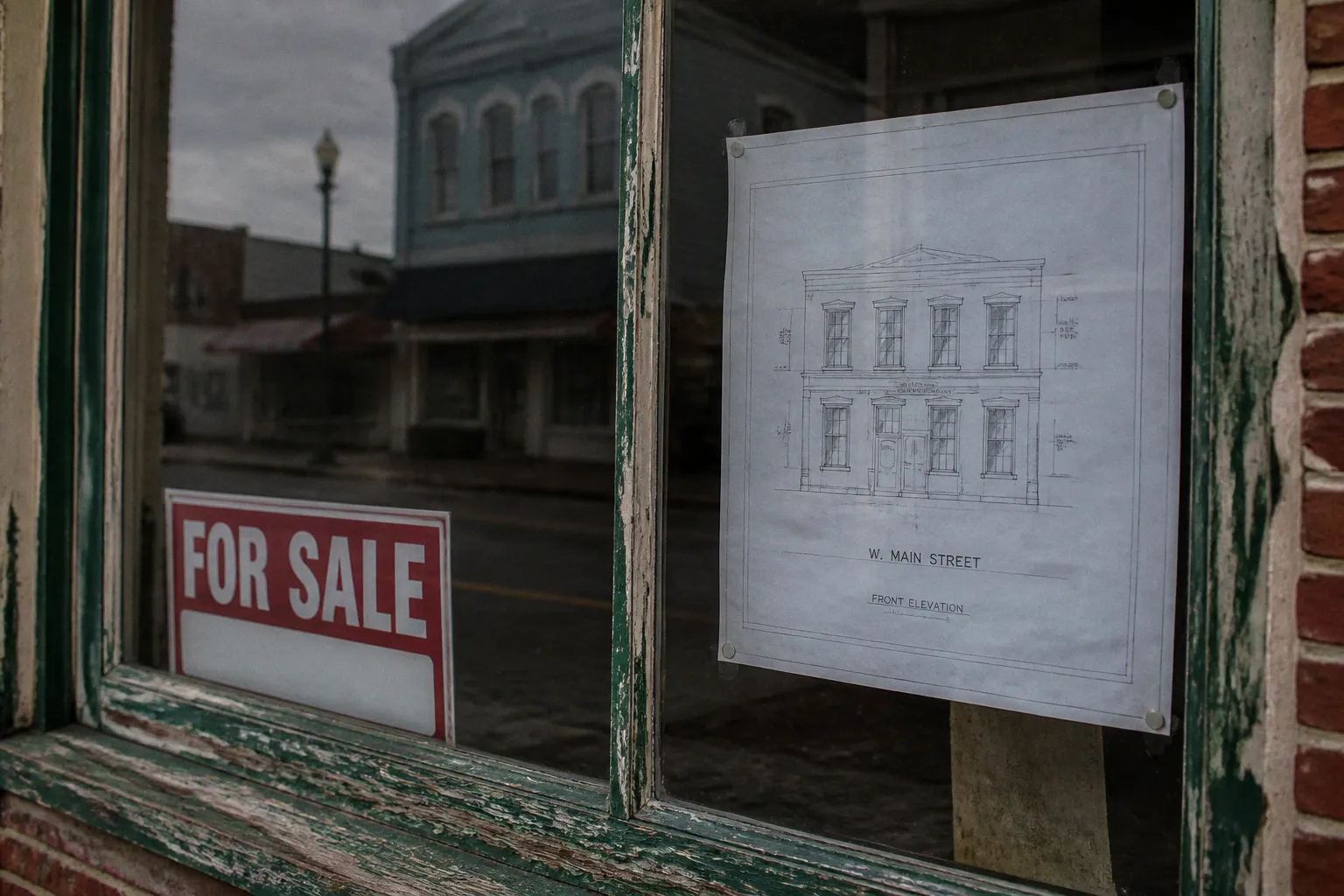
The RFP for the historic property at 328 W. Main Street demonstrates why this detail matters. The former Bank of Crisfield building was constructed in 1937. The property includes a 2,750-square-foot commercial building on approximately 0.073 acres, with roughly 3,200 square feet of land identified in the project materials. The city acquired the property in 2012 and later solicited proposals for its disposition and development.
A proposal for that site cannot be evaluated solely by the amount offered for the building. The relevant question is whether the proposed use is physically feasible, financially supported, compatible with the structure’s historic value, and capable of generating the stated public benefits.
The same principle applies to residential demolition and reconstruction. Clearing a derelict structure removes an immediate liability, but it does not establish a housing outcome. The RFP must define the post-demolition obligation. Otherwise, the city may complete the visible part of the project while leaving the central development objective unresolved.
Required components of a municipal revitalization RFP
A functional RFP should contain, at minimum, the following information:
1. A property schedule. List each parcel, address, lot information, current ownership, acquisition method, and known encumbrances.
2. A site condition report. Include demolition records, environmental information, utility conditions, flood exposure, access limitations, and available surveys.
3. A development program. State the number and type of units, commercial area, public amenities, or preservation work expected.
4. A funding map. Identify confirmed grants, required matching funds, anticipated subsidies, and funding sources that remain uncertain.
5. A regulatory framework. Describe applicable zoning classifications, permitted uses, dimensional standards, parking requirements, floodplain controls, historic-preservation obligations, and building-code requirements.
6. A schedule. Establish realistic milestones for due diligence, financing, design, permitting, construction, and completion.
7. A proposal format. Set page limits and submission requirements that permit meaningful comparison without excluding qualified smaller firms.
8. Evaluation criteria. Assign priorities and, where appropriate, relative weights to financial capacity, experience, feasibility, community benefit, and preservation performance.
9. Contract conditions. State the consequences of delay, nonperformance, unauthorized transfer, or failure to satisfy the approved development program.
A municipality should not require information it will not use. Excessive submission requirements increase administrative burden and can reduce participation without improving selection quality. A concise, disciplined RFP produces more useful responses than a long document containing unclear obligations.
The RFP should describe the public result in enforceable terms. “Revitalize the property” is an aspiration, not a development obligation.
Evaluating financial capacity and development experience
Financial capacity is not demonstrated by a proposal containing an attractive concept. It is demonstrated by evidence that the applicant can control costs, secure financing, manage construction, and sustain the completed asset.
The evaluation should distinguish between three separate financial questions:
- Can the applicant fund predevelopment work?
- Can the applicant assemble the capital stack required for construction?
- Can the applicant operate, maintain, or sell the completed project in accordance with the approved plan?
A developer may have experience in one category and not another. A firm that has completed market-rate commercial rehabilitation may not have the administrative systems required for income-restricted housing. A nonprofit housing organization may understand compliance obligations but require a private construction partner. A local contractor may know the market but lack the balance sheet necessary to carry a complex project.
The RFP should therefore require documentation proportionate to the project. Useful submissions may include:
- audited financial statements or equivalent financial records;
- evidence of available equity or committed capital;
- lender letters or financing indications;
- a preliminary development budget;
- sources-and-uses information;
- identification of public subsidies and application status;
- references for comparable completed projects;
- litigation, default, or bankruptcy disclosures where relevant;
- a description of the proposed ownership and management structure.
The city should not treat a letter of interest from a lender as equivalent to a financing commitment. Those documents represent different levels of certainty. The evaluation record should state which funds are committed, which are conditional, and which remain prospective.
Experience must be comparable, not merely extensive
A long list of projects does not automatically establish suitability. The relevant experience should match the physical and regulatory conditions of the proposed work.
For a Crisfield housing project, comparable experience may include:
- construction or rehabilitation in a flood-exposed coastal setting;
- affordable housing financed through public grants or tax-credit structures;
- infill construction on constrained urban lots;
- management of demolition and environmental remediation;
- coordination with municipal agencies and nonprofit recovery organizations;
- completion of projects subject to income, affordability, or reporting restrictions.
For the 328 W. Main Street property, the assessment should focus on historic-building rehabilitation, adaptive reuse, structural investigation, code compliance, and the ability to produce a viable commercial operation. A developer with substantial new-construction volume but no historic-rehabilitation record may be less suitable than a smaller firm with directly relevant experience.
The same distinction applies to the Crisfield Waterfront Depot. In June 2024, the city issued an RFP for the conceptual design of an outdoor multipurpose venue. The request required compliance with defined standards and limited proposals to 25 pages. A conceptual-design assignment should be evaluated on site planning, public access, operational requirements, resilience, and implementation feasibility. It should not be scored as though the respondent were already being selected for full construction.
Use a written scoring framework
A selection committee should use a documented framework rather than informal consensus. The committee may include planning or zoning board members, municipal staff, housing consultants, or other qualified reviewers. The composition should be disclosed in the procurement record, subject to applicable public-record and conflict-of-interest requirements.
A practical rating scale is:
| Rating | Meaning in the evaluation record | Typical interpretation |
|---|---|---|
| Unacceptable | The response fails a material requirement | Missing financial evidence, infeasible use, or noncompliance with the submission terms |
| Acceptable | The response satisfies the minimum requirement | Feasible concept with adequate but limited supporting detail |
| Advantageous | The response exceeds the minimum in a relevant area | Strong comparable experience, credible financing, or clear community benefit |
| Highly Advantageous | The response materially improves project certainty or public value | Exceptional feasibility, well-supported capital structure, and strong alignment with preservation or resilience objectives |
The city may assign separate weights to financial capacity, development experience, technical feasibility, community objectives, historic preservation, resilience, and schedule. The precise weighting should reflect the project. A historic property requires a different balance than a vacant residential lot.
The purchase price should be recorded, but it should not displace the other criteria. A high offer may be commercially attractive while producing little housing, minimal job creation, or inadequate preservation. Conversely, a lower offer may be justified if it delivers a fully funded public benefit that the higher offer cannot support.
Aligning projects with resilience and historic preservation
Crisfield’s development conditions are shaped by flood exposure, aging structures, limited land, and the cost of infrastructure. These constraints are not secondary design considerations. They affect site feasibility, construction methods, insurance, operating costs, and long-term public liability.
The city’s resilience work involves partners including The Nature Conservancy, George Mason University, the University of Maryland’s Environmental Finance Center, the Environmental Protection Agency, the Federal Emergency Management Agency, and SERCAP. Their roles differ, but the combined function is clear: improve the technical, financial, and institutional capacity required for flood mitigation and infrastructure planning.
A revitalization RFP should translate resilience into project requirements. The document should identify, where applicable:
- floodplain and elevation conditions;
- required flood-resistant construction measures;
- access and evacuation limitations;
- stormwater management obligations;
- utility vulnerability;
- emergency power or continuity requirements;
- long-term maintenance responsibilities;
- available resilience grants or technical assistance.
The city should avoid treating resilience as a general preference. If flood mitigation is a selection priority, the proposal must show how the applicant will address it, what it will cost, and who will maintain the resulting improvements.
The Eastern Shore Long Term Recovery Committee has partnered with the city on housing recovery and related resilience work. It is a nonprofit disaster-recovery organization, not a for-profit developer. That distinction must remain explicit in the project structure. A nonprofit recovery organization may assist with construction coordination, housing delivery, grant administration, or resident support while a separate developer, contractor, or ownership entity performs other functions.
The reported $100,000 Verizon Community Resilience Grant awarded to the committee in August 2026 supports its ongoing objective of elevating 100 homes out of the flood plain in Crisfield. That type of program is relevant to municipal partner selection because it demonstrates that flood resilience may require a network of organizations rather than one comprehensive developer contract.
Historic preservation requires enforceable scope
Historic preservation cannot be reduced to retaining a façade. A credible proposal must address the building’s structural condition, mechanical systems, accessibility, fire protection, interior configuration, and operating model.
The rehabilitation of the Crisfield Armory at 8 Main Street provides a defined example. A $250,000 DHCD Community Legacy grant supported HVAC upgrades and mold remediation, with the objective of transforming the property into a community and entertainment venue. The grant-funded work addresses specific building deficiencies. It does not, by itself, resolve every operational or preservation issue.
An RFP for a historic property should require:
- a condition assessment prepared by qualified professionals;
- a description of proposed structural and mechanical work;
- treatment of significant architectural features;
- code and accessibility compliance;
- a phased budget;
- a construction schedule;
- identification of grant restrictions;
- an operating plan after completion;
- maintenance and ownership responsibilities.
The city should also distinguish between rehabilitation and redevelopment. Rehabilitation retains and adapts an existing resource. Redevelopment may involve substantial alteration or replacement. Each approach carries different regulatory, financial, and community implications. The RFP must state which outcome is intended.
Navigating partnerships with state agencies and nonprofits
Local revitalization projects frequently depend on a layered funding structure. The municipality may control the property, DHCD may provide grant funding, a nonprofit may support recovery or housing delivery, and a private developer may manage construction or long-term ownership. Without a defined allocation of responsibility, the project becomes administratively fragile.
Maryland DHCD Community Legacy grants are central to several Crisfield initiatives. The $117,600 allocation for demolition and the $250,000 allocation for Armory rehabilitation show two different uses of the program: clearing unsafe or derelict structures and correcting deficiencies in a historic community asset. The state funding does not eliminate the need for local project controls. It increases that need because grant conditions, eligible costs, reporting, and deadlines must be integrated into the development agreement.
The city should create a responsibility matrix before selecting the partner. Each material task should have one accountable entity.
| Function | Municipality | Developer or contractor | Nonprofit or recovery partner | State or technical agency |
|---|---|---|---|---|
| Property control | Establishes title and transaction terms | Performs due diligence | May assist with site history or resident coordination | May review funding eligibility |
| Project design | Defines public requirements | Prepares design and cost documents | Provides community or recovery input where assigned | May provide technical guidance |
| Financing | Applies for or administers public funds | Provides equity, debt, or financing evidence | May administer grants or contribute program funds | Awards or oversees grants |
| Construction | Monitors contract performance | Manages construction and subcontractors | May coordinate housing delivery or support services | May impose grant or code requirements |
| Compliance reporting | Maintains municipal record | Supplies invoices, schedules, and certifications | Reports on assigned program activities | Reviews grant compliance |
| Long-term operation | Enforces development agreement | Operates or transfers asset if contracted | May provide resident or community services | May monitor affordability or grant restrictions |
This division should appear in the RFP or in the subsequent development agreement. Ambiguity at the proposal stage becomes a dispute during construction.
The city should also require disclosure of proposed subcontractors and affiliated entities where those relationships affect capacity or pricing. A thinly capitalized applicant may be relying on unnamed partners to perform essential work. That arrangement is not automatically defective, but it must be visible and contractually controlled.
Community alignment must be measurable
“Community alignment” is a valid criterion only when the city defines it. It may include:
- preservation of a locally significant building;
- creation or retention of jobs;
- affordable housing delivery;
- local contractor participation;
- public access to a completed facility;
- compatibility with a sustainable-community designation;
- flood-resilient design;
- neighborhood-scale commercial occupancy.
Crisfield’s inaugural Project Restore 2.0 grants, awarded in March 2025 to three downtown businesses from a $150,000 state block grant subgranted locally through the city, provide a commercial example. The program supports existing businesses and downtown revitalization. A separate property-disposition RFP should not assume that the same structure or criteria apply to a private commercial building, a public venue, and a residential infill site.
The correct approach is to define the public benefit for each asset and require the proposal to show how that benefit will be produced. Job creation projections, for example, should identify whether the jobs are temporary construction positions or permanent operating positions. A proposal that lists both without distinction creates an inflated impression of impact.
Avoiding common pitfalls in municipal developer selection
Municipalities often weaken a sound project through procurement design rather than through an impossible site. The recurring errors are procedural and avoidable.
Unrealistic timelines
A project involving title review, demolition, environmental conditions, grant funding, design, permitting, and construction cannot be evaluated on a schedule designed for a simple property sale. The RFP should provide enough time for site inspection, financing analysis, consultant coordination, and proposal preparation.
The selected partner should then submit a detailed schedule with dependencies. A financing deadline that precedes environmental due diligence is not a meaningful milestone. A construction start date without permits or executed funding agreements is not a reliable commitment.
Limited site information
Applicants cannot price risk that the city has concealed or failed to investigate. Available surveys, demolition records, environmental reports, utility information, flood data, photographs, title documents, and prior studies should be assembled into a data room or equivalent package.
Where information is unavailable, the RFP should say so. The city should not imply that the property is free of environmental, title, or structural issues merely because no report has identified them.
Excessive submission requirements
A 25-page maximum for the Waterfront Depot conceptual-design RFP illustrates a useful control. A page limit can force prioritization and reduce administrative burden. It should be paired with a clear list of required exhibits so that respondents spend pages on feasibility rather than repetition.
The city should request only information connected to the scoring criteria. If job creation, financial capacity, and historic treatment will be scored, those subjects should receive defined space in the proposal. Generic organizational profiles should not dominate the submission.
Subjective evaluation criteria
Terms such as “innovative,” “high quality,” or “strong community fit” are not adequate without a scoring definition. They create inconsistent evaluations and increase the risk that the selection record cannot explain why one proposal prevailed.
Each criterion should contain a testable description:
- Financial capacity: evidence of capital, financing, and cost control sufficient for the proposed scope.
- Comparable experience: completed projects with similar property, funding, regulatory, or resilience conditions.
- Feasibility: alignment among the site, program, budget, schedule, and approvals.
- Historic preservation: treatment of significant features and compliance with applicable preservation requirements.
- Community benefit: quantified housing, commercial, employment, access, or neighborhood outcomes.
- Resilience: specific measures addressing flood, stormwater, utility, and long-term maintenance conditions.
Treating the selection as final before contracting
An RFP award is not the same as project completion. Before transferring property or releasing funds, the city should convert the selected proposal into binding obligations. The development agreement should address:
- approved plans and permitted changes;
- financing deadlines;
- construction commencement and completion;
- performance security where appropriate;
- inspection and reporting rights;
- affordability or use restrictions;
- historic-preservation requirements;
- assignment and transfer controls;
- default remedies;
- reversion or termination rights;
- post-completion maintenance.
The agreement should also define what happens if the developer cannot obtain financing. A municipality should not leave a property encumbered indefinitely by an uncompleted proposal.
Applying the framework to Crisfield and Somerset County
The selection process for Crisfield revitalization projects should be calibrated to the asset rather than copied from a generic procurement template. A vacant lot, a tax-sale property, a historic bank building, the Armory, and the Waterfront Depot each require a different development program and risk allocation.
For a low-income housing initiative, the sequence should be:
1. Confirm parcel control and demolition status.
2. Identify flood, utility, access, and environmental constraints.
3. Define the required housing outcome.
4. Identify the available public funding and remaining capital requirement.
5. Solicit proposals from applicants with comparable affordable-housing and coastal-development experience.
6. Evaluate financial capacity, construction plan, resilience measures, and long-term ownership.
7. Negotiate enforceable delivery milestones.
8. Retain sufficient municipal control to address nonperformance.
For a historic commercial property, the sequence changes:
1. Document the structure’s historic and physical characteristics.
2. Establish the intended adaptive-reuse or preservation standard.
3. Require a condition-based rehabilitation budget.
4. Evaluate operating viability, not only construction funding.
5. Measure job creation and commercial occupancy separately.
6. Condition the transfer on preservation and completion obligations.
For a public venue such as the Waterfront Depot, the city must examine public access, event operations, maintenance, safety, utilities, resilience, and lifecycle costs. A visually attractive concept that cannot be operated within municipal capacity is not a successful development proposal.
This asset-specific approach is also relevant to Somerset County neighborhood revitalization beyond Crisfield. Maryland rural development grants and community block grant programs can provide capital, but the grant award does not substitute for local project management. A county or municipality must still define the land-use objective, confirm statutory compliance, and maintain a defensible procurement record.
A grant can fund demolition, rehabilitation, or resilience work. It cannot correct an undefined development program or an inadequate selection process.
The required standard for a defensible selection
A defensible municipal selection has three characteristics.
First, the city can explain why the project is needed and what public result it requires. The explanation is tied to the property, the neighborhood, and the applicable development objectives.
Second, the city can demonstrate that each respondent was evaluated against the same criteria. The scoring record distinguishes minimum qualifications from competitive advantages. It does not rely on unrecorded impressions.
Third, the city can convert the selected proposal into enforceable obligations. The public entity retains remedies if the developer misses financing, construction, preservation, affordability, or operating commitments.
Crisfield’s current revitalization portfolio shows why this standard is necessary. Derelict-home demolition, affordable housing, historic-building rehabilitation, commercial grants, flood mitigation, and waterfront design are related but not interchangeable tasks. They require different partners and different controls.
The city has not publicly established every final development partner for the housing construction phase, and the available record does not identify the buyer or redeveloper selected after the 328 W. Main Street RFP. The final design firm or developer for the Waterfront Depot conceptual-design project is likewise not established in the available facts. Those gaps should not be filled with assumption. They demonstrate the importance of publishing clear award decisions, evaluation summaries, and contract terms once a selection is complete.
The correct revitalization partner is therefore not the applicant with the most attractive promise or the highest purchase offer. It is the applicant whose experience, financial capacity, technical plan, resilience measures, and community obligations align with the property and can be enforced through the transaction documents. That is the controlling standard for Crisfield MD revitalization project partners and for broader Somerset County neighborhood revitalization.