Community Land Trusts: A Model for Affordable Housing
When a home is affordable only for the first buyer, a community can lose that affordability as soon as the property is resold.
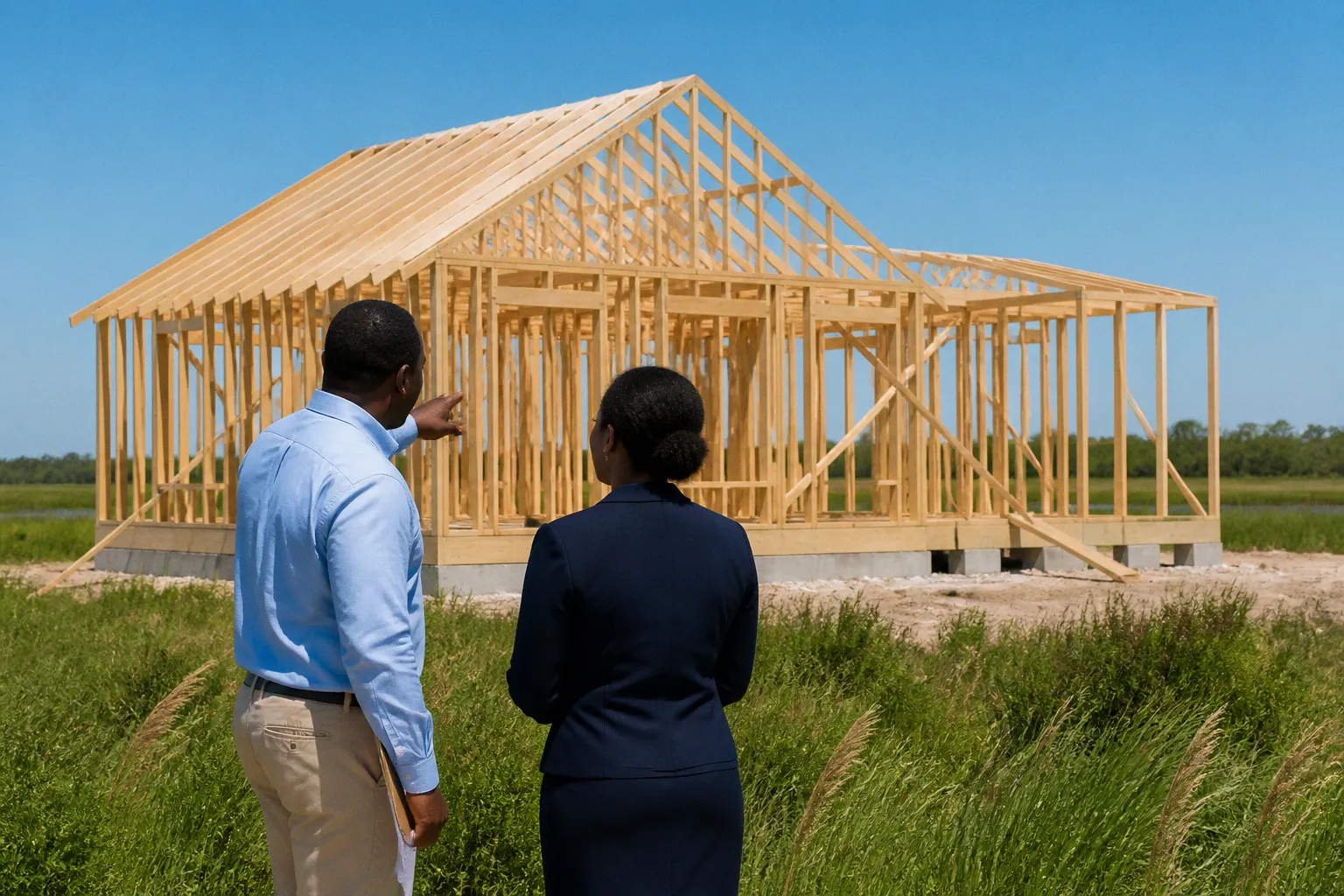
A community land trust offers a different arrangement: the trust keeps ownership of the land while a household owns the home built on it, creating a structure designed to keep housing within reach over time.
For Maryland communities, including Somerset County, this model is legally possible but not automatically available. The state has a framework for affordable housing land trusts, while local housing programs, nonprofit capacity, public funding, and the availability of suitable land determine whether the model can work on a particular block. That distinction matters when we talk about a potential Eastern Shore community land trust: the legal tool exists, but an active trust serving Somerset County should not be assumed without confirmation.
What a community land trust changes about homeownership
A community land trust, or CLT, is a nonprofit organization that acquires and holds land for community benefit. A household may purchase or occupy a home on that land, but the underlying parcel remains with the trust.
This separates two parts of a property that are usually bundled together:
- The land, held by the community land trust.
- The building, owned or occupied by the household under a long-term agreement with the trust.
The arrangement is intended to make the initial purchase more attainable and to preserve some affordability when the home changes hands. The homeowner generally receives the stability and responsibilities associated with owning a house, while the trust retains a long-term role in protecting the affordability of the land.
That is the central idea behind the CLT housing model explained in practical terms: public or charitable investment does not disappear into one transaction. Instead, the land remains connected to an affordability mission and can support more than one household over its useful life.
For you, this changes the question from “Can this household afford the full market price of this property?” to “What portion of the property must the household purchase, and how can the land remain affordable for the next buyer?”
A community land trust does not make land disappear from the cost of housing; it keeps land from becoming a one-time windfall that pushes every future buyer farther out of reach.
In a traditional sale, the homeowner may benefit from the entire increase in the property’s value. In a CLT arrangement, the resale rules usually allow the homeowner to build equity while limiting the price enough to preserve affordability. The exact formula depends on the trust’s governing documents and the agreement signed with the homeowner. Because those formulas can vary, we should not assume that every Maryland trust uses the same resale terms.
Maryland’s legal framework for affordable housing land trusts
Maryland established a statewide legal foundation for this approach through the Affordable Housing Land Trust Act. The governor signed the legislation on May 20, 2010, and it was codified in Maryland Annotated Code, Real Property § 14-501.
The law matters because a community land trust needs more than a mission statement. It needs a recognized organizational structure, clear property rights, and a way to maintain records as the trust operates. Affordable housing land trusts in Maryland must register their creation and submit operational updates to the Maryland State Department of Assessments and Taxation.
That registration requirement gives residents, lenders, public agencies, and prospective partners a way to understand whether an organization exists and how it is structured. It also reinforces a useful point for local conversations: a housing group using the language of community ownership is not necessarily the same thing as a formally established and registered affordable housing land trust.
What the state framework does—and does not—do
The Maryland Affordable Housing Land Trust Act makes the model legally available. It does not create a CLT in every county, provide land automatically, or guarantee a dedicated local funding stream.
Implementation still depends on practical work such as:
1. Forming or identifying a qualified organization.
A local nonprofit, housing organization, municipality, or partnership may need to take responsibility for the trust’s governance and long-term stewardship.
2. Finding land that can support the mission.
The trust needs property that is suitable for housing, legally transferable, and realistic to develop or rehabilitate. A vacant parcel with unresolved title issues, weak infrastructure, or prohibitive construction costs may not be a workable starting point.
3. Building a financing package.
Land acquisition, construction, rehabilitation, environmental review, utility connections, and supportive services may each require different sources of funding.
4. Writing durable resale and occupancy rules.
The trust must define who qualifies, how the property can be transferred, how equity is calculated, and what happens if the homeowner needs to sell, refinance, or make major repairs.
5. Maintaining stewardship after the sale.
A CLT is not simply a nonprofit that purchases land and steps away. It typically remains involved through homeowner support, monitoring, compliance, and assistance when a property changes hands.
This is where navigating the board, a municipal process, or a county housing conversation becomes more productive. Instead of asking only whether a CLT is a good idea, we can ask which organization would hold the land, which funding sources could support it, and what community need the first homes would address.
How the ownership structure works on a real block
The structure can sound abstract until we connect it to what this means for your block.
Suppose a nonprofit acquires a parcel and develops a modest home on it. The trust retains the land. A qualifying household purchases the house or receives a long-term right to occupy it under a ground lease. The household is responsible for ordinary homeownership obligations, while the trust maintains an interest in the land and the long-term affordability rules.
The household may still have a mortgage, property taxes, insurance, repair responsibilities, and the everyday work of maintaining a home. A CLT is not a rental program simply because the land and structure have different owners. It is a form of shared-equity homeownership in which the trust’s continued ownership of the land supports a public purpose.
The ground lease is especially important. It establishes the relationship between the trust and the homeowner and sets out what happens over the life of the agreement. Depending on the program, it may address:
- The household’s right to occupy and use the home.
- Requirements for maintaining the property.
- Rules for refinancing or taking on additional debt.
- Income or occupancy qualifications.
- The process for selling or transferring the home.
- The method used to preserve affordability at resale.
The resale provision is the part that most clearly separates a CLT from an ordinary market-rate home purchase. A homeowner may receive a defined share of the property’s appreciation, but not necessarily all of it. The remaining value is preserved for a future buyer or returned to the trust’s affordability mission.
This creates a tradeoff. The first household may give up some potential appreciation in exchange for a lower purchase price and greater access to homeownership. The community, in turn, gains a mechanism for keeping the home affordable beyond one transaction.
A practical comparison
| Housing approach | Who controls the land? | What happens to affordability? | Main benefit | Main challenge |
|---|---|---|---|---|
| Traditional market purchase | Homeowner | Usually follows market prices at resale | Full ownership flexibility and potential appreciation | Affordability can disappear after resale |
| Income-restricted rental | Landlord or housing provider | Preserved through program rules and eligibility | Lower-cost housing without a purchase requirement | Residents do not build ownership equity in the same way |
| Community land trust | CLT holds the land; household owns or occupies the home | Preserved through the ground lease and resale rules | Shared-equity ownership with long-term affordability | Requires ongoing stewardship and clear legal agreements |
| Publicly assisted homeownership | Often homeowner, with program restrictions | Protected for a defined period or under program terms | Can reduce the upfront cost of buying | Affordability rules may expire or require compliance |
The table is not a substitute for reviewing a specific program. A CLT’s actual terms can differ from one organization to another, and a county may combine the model with grants, loans, public housing resources, or rehabilitation programs.
Affordability in Somerset County is a numbers problem and a land problem
Housing discussions can become vague when we use “affordable” as a general description. For planning purposes, affordability is connected to household income, rent levels, financing costs, property condition, and the supply of homes that people can realistically access.
HUD Fair Market Rent figures for Somerset County include:
- $832 for a studio
- $837 for a one-bedroom unit
- $1,100 for a two-bedroom unit
- $1,458 for a three-bedroom unit
- $1,465 for a four-bedroom unit
These figures do not describe every household’s actual rent or every available home. They are reference points used in federal housing programs and affordability analysis. They help us see why a household can be priced out even when a home might appear modest by regional standards.
Income thresholds also matter. For a four-person household in Somerset County, the cited HUD program limits are:
- $26,500 at 30% of area median income, classified as extremely low income.
- $36,000 at 50% of area median income, classified as very low income.
- $57,600 at 80% of area median income, classified as low income.
A household near the 30% AMI level faces a very different housing market from a household near 80% AMI. The same monthly rent, mortgage payment, or repair bill can be manageable for one family and impossible for another.
That is why a community land trust may be most useful when it is designed around a clearly identified income range rather than described simply as “affordable housing.” A trust could serve households who earn too much to qualify for some deeply subsidized programs but too little to compete for market-rate homes, or it could focus more deeply on households with extremely limited incomes. The design choices need to match the local need and the funding available.
In Somerset County, the first CLT conversation should begin with the households we are trying to serve—not with the name of the model.
Land costs are only one part of the challenge. Rural and small-town housing projects may also face limited construction capacity, scattered sites, aging structures, infrastructure constraints, and a smaller pool of buyers or contractors. A CLT can address the ownership structure, but it cannot by itself solve every development cost or neighborhood condition.
What Maryland’s funding landscape can support
The Maryland Affordable Housing Trust, or MAHT, supports capital costs, supportive services, and capacity building for projects serving households earning less than 50% of the statewide or area median income. That range makes MAHT relevant to many deeply affordable housing efforts, but it would be inaccurate to describe the program as funding only community land trusts. It supports broader low-income housing initiatives across the state.
For a prospective CLT in Somerset County, capacity-building support may be just as important as construction money. A new organization may need help with:
- Organizational formation and governance.
- Property acquisition planning.
- Legal work for ground leases and resale restrictions.
- Homebuyer education and counseling.
- Property management and long-term stewardship.
- Grant administration and compliance.
- Community outreach in neighborhoods where homes may be developed.
The funding sequence also matters. A community group may be able to identify vacant or underused properties, but without an organization prepared to hold land and manage the agreements, the opportunity may not move forward. Conversely, a capable nonprofit may have a strong housing mission but no parcel that can be developed at a cost households can carry.
Maryland’s urban examples show what becomes possible when a CLT is paired with dedicated local resources. Baltimore City’s Affordable Housing Trust Fund Buyer’s Choice Program has documented assistance for eligible CLT homebuyers of up to $75,000 for households at or below 50% AMI and up to $120,000 for households at or below 30% AMI. Those figures illustrate the scale of support that may be needed when buyers have very low incomes and homes require substantial financial assistance.
They should not be treated as a Somerset County program or as an automatic template for the Eastern Shore. Baltimore has a different population base, funding structure, nonprofit ecosystem, and housing market. The useful lesson is more basic: a CLT becomes much stronger when the land-holding model is connected to a reliable source of acquisition, buyer, rehabilitation, or closing-cost assistance.
Why rural implementation requires a different strategy
Urban CLTs often work in places where a nonprofit can assemble multiple properties, public agencies have established housing funds, and demand for affordable homes is concentrated in a relatively small area. Rural counties may have a different pattern: properties are dispersed, development costs can be difficult to spread across many units, and a local organization may need to build partnerships almost from the beginning.
In Somerset County, the most realistic strategy may not start with a large, countywide land trust. It could begin with a small pilot tied to a specific neighborhood revitalization effort in Crisfield or Princess Anne, or with the rehabilitation of a limited number of homes where the community already has a clear need and a feasible property pipeline.
A rural CLT conversation should consider several questions:
- Are there publicly owned, tax-delinquent, vacant, or underused properties that could be assembled responsibly?
- Which homes need rehabilitation rather than new construction?
- Can water, sewer, roads, and other infrastructure support the proposed sites?
- Is there a nonprofit or public partner prepared to hold the land for decades?
- Which households are the intended buyers or residents?
- What assistance would make the monthly cost workable?
- How will the trust provide homeowner support after the initial purchase?
- Can the first project be small enough to manage but substantial enough to demonstrate value?
These questions are not bureaucratic hurdles for their own sake. They are how we protect the community fabric from projects that begin with good intentions and end without a steward, a funding plan, or a workable maintenance strategy.
Rehabilitation may be as important as new construction
A CLT does not have to mean building an entirely new subdivision. In a town with aging housing stock, preserving and improving existing homes may strengthen a neighborhood more effectively than creating isolated new units on the edge of town.
A rehabilitation-focused model might combine:
1. Acquisition of a vacant or distressed home.
2. Health and safety repairs.
3. Energy or systems upgrades where funding permits.
4. A resale restriction or ground lease that protects affordability.
5. Homebuyer counseling and a clear maintenance plan.
6. Continued monitoring by the trust.
The economics will depend on each property. A low purchase price does not guarantee an affordable final home if the structure needs extensive work. Likewise, a home in a strong location may offer more community value than a cheaper parcel far from jobs, schools, services, or transportation.
For what this means for your block, location is not a minor detail. A home can meet an income target on paper and still fail a family if getting to work requires an unreliable commute or if basic services are too far away.
Community land trusts and neighborhood revitalization
Affordable housing works best when it is connected to the broader life of a neighborhood. In Crisfield, Princess Anne, or another Somerset County community, a housing project may contribute more when it is considered alongside local business development, historic preservation, streetscape improvements, transit access, and the condition of nearby properties.
That does not mean every CLT must become an economic development agency. It means housing decisions have consequences beyond the lot line. Stabilized homeownership can support resident investment, reduce displacement pressure, and give a neighborhood a dependable base of residents. But those outcomes depend on the quality and location of the homes, the strength of the stewardship, and the relationship between the trust and the people who live nearby.
A community land trust can also be part of a larger neighborhood revitalization strategy where residents help define the goals. Community participation should happen before the development plan is fixed, not only at the point when a formal notice arrives. Residents may know which vacant homes are unsafe, which corners flood, which sidewalks are missing, and which commercial spaces could support daily life.
That local knowledge helps prevent a common mistake: selecting land because it is available rather than because it supports a healthy, connected neighborhood.
Historic properties need careful treatment
Historic preservation can be especially relevant in older Eastern Shore communities, where homes and commercial buildings may carry architectural and cultural value. A CLT could potentially support the preservation of a property while keeping its future use accessible, but historic status can introduce additional design, rehabilitation, and financing requirements.
The right approach is neither to preserve every building at any cost nor to treat older structures as obstacles. We should ask what the property contributes, what repairs are technically feasible, and whether its location can support the households the project is meant to serve.
This is another place where an experienced local partnership matters. Housing, preservation, code compliance, and financing all intersect, and the project needs someone able to navigate the board, coordinate professionals, and keep the community informed without burying residents in jargon.
A practical pathway for a Somerset County pilot
If local leaders, residents, or housing organizations want to explore a community land trust in Somerset County, the work can proceed in a deliberate sequence.
1. Define the housing problem precisely
Start with the households and properties involved. Is the priority first-time homeownership, preservation of existing homes, rental housing, workforce housing, or protection against displacement? A CLT may be appropriate for some of these needs and less appropriate for others.
The income figures and Fair Market Rents provide a starting point, but they do not replace local assessment. A project should examine household incomes, property conditions, available rents, commuting patterns, and the cost of repairs or new construction.
2. Build a local partnership
A CLT needs more than a temporary working group. Potential partners might include a nonprofit housing organization, a municipality, county staff, resident leaders, lenders, builders, housing counselors, and organizations familiar with Maryland rural development grants.
The goal is not to create a large committee that never decides anything. It is to assign clear responsibilities: who identifies properties, who manages funds, who communicates with residents, who handles legal documents, and who remains accountable after the first homes are occupied.
3. Confirm the legal and organizational structure
Before using the CLT label publicly, the organizing group should understand the Maryland statutory framework and the registration requirements with SDAT. It should also obtain qualified legal and financial advice on nonprofit formation, property ownership, leases, resale restrictions, lending, taxes, and insurance.
This is a point where precision protects trust. Somerset County should not be described as having an active local CLT unless a registered and operating entity can be confirmed. A proposed model, a nonprofit housing project, and an established community land trust are not interchangeable.
4. Identify a manageable property pipeline
A pilot needs more than one attractive address. The organizing group should evaluate ownership, title, zoning, environmental conditions, infrastructure, rehabilitation costs, and proximity to services.
A small number of related properties may be easier to steward than scattered homes across the county. On the other hand, a scattered-site strategy may make sense if the goal is to repair existing homes in established neighborhoods. The best choice depends on the local property inventory and the organization’s capacity.
5. Match the project to the funding
Funding should be assembled around the actual project rather than the other way around. Acquisition, construction, rehabilitation, buyer assistance, supportive services, and organizational capacity may require separate sources.
MAHT can be relevant to projects serving households below 50% of statewide or area median income, including capital costs, supportive services, and capacity building. Other public or philanthropic resources may have different eligibility rules. The organizing team should map those requirements early, because a funding source that supports construction may not pay for long-term stewardship or homeowner counseling.
6. Explain the tradeoffs before asking residents to commit
Residents should understand what they would gain and what they would give up. A CLT may lower the cost of entering homeownership and preserve affordability for the next household, but resale restrictions can limit the seller’s share of appreciation. The trust may offer support and stability, but it also imposes rules about occupancy, maintenance, refinancing, and transfer.
Plain-language education is not a side activity. It is the foundation of informed participation. People should have time to ask questions, review the agreements, and understand how the model affects their family’s finances.
7. Measure long-term performance
A successful pilot should be judged by more than the number of homes acquired. The community should be able to ask whether the homes remained affordable, whether residents were supported, whether properties were maintained, whether public investment continued to serve the intended households, and whether the project strengthened rather than isolated the neighborhood.
The answers can guide future expansion—or show that another housing tool would be better suited to a particular site.
The case for keeping the model on the table
Community land trusts are not a universal answer to Maryland’s housing challenges. They require land, financing, legal discipline, governance, and long-term stewardship. In a rural county, those requirements may be difficult to assemble, particularly when the local housing nonprofit network is small or when suitable properties are scattered.
But the model offers something that short-term subsidies often cannot: a way to keep the affordability mission attached to the land. That is a meaningful advantage when public funds are limited and housing costs continue to place pressure on households.
For Somerset County, the most responsible position is neither to promise a CLT that does not yet exist nor to dismiss the idea because urban examples receive more attention. The question is whether local partners can shape a version that fits the county’s towns, incomes, property conditions, and community priorities.
If we begin with real households, suitable properties, transparent agreements, and a steward prepared to stay involved, a Maryland affordable housing land trust could become one tool within a broader strategy for neighborhood revitalization. The first step is not adopting a label. It is building the local capacity that makes long-term affordability possible.