Crisfield revitalization planning errors and fixes
Crisfield's revitalization pipeline keeps choking on the same mistake: people mistake a council discussion for a state application.
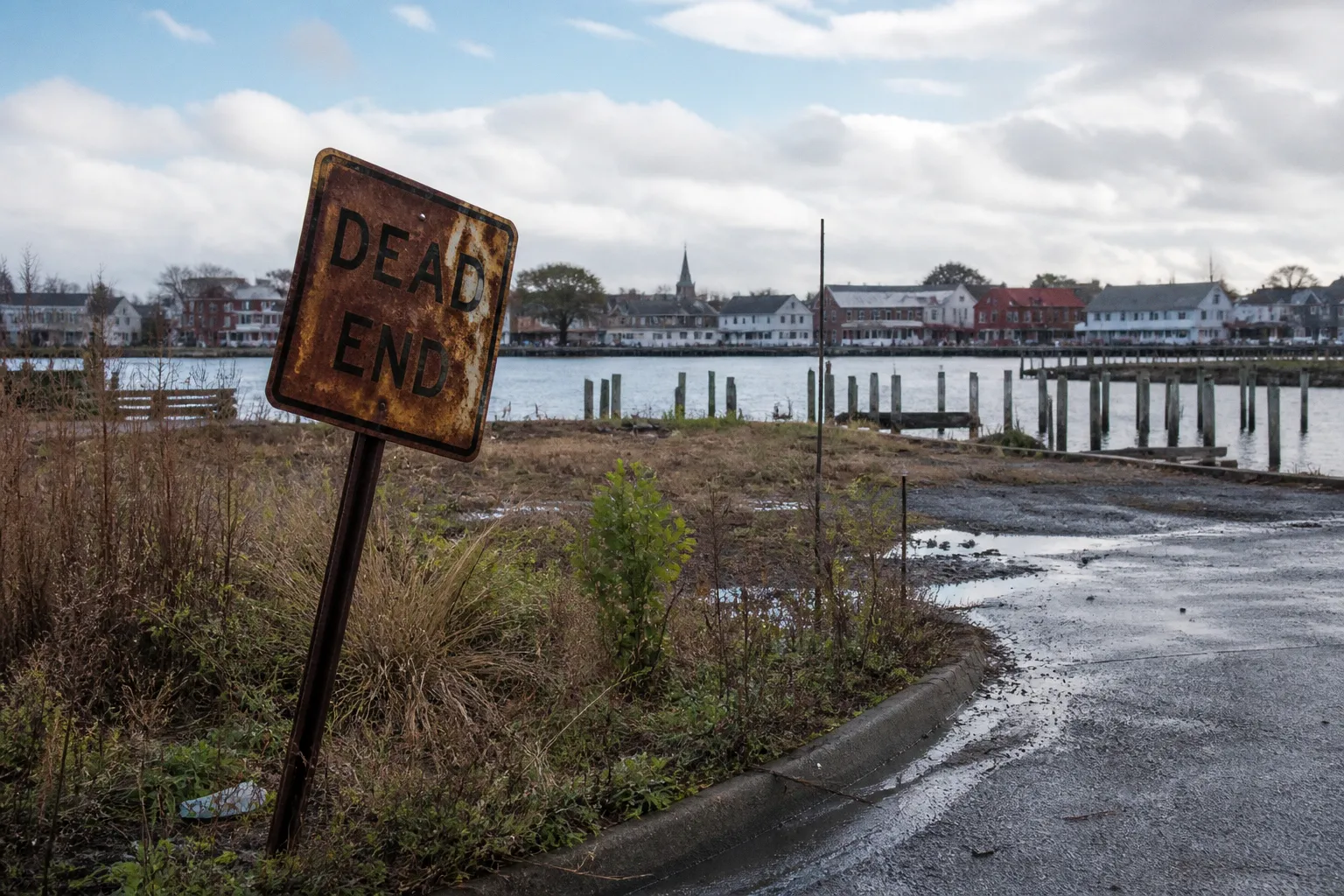
A town can spend six months debating a vacant storefront over coffee and zoning maps, but none of that counts at the Maryland Department of Housing and Community Development. What counts is what gets filed through the DHCD Project Portal before the deadline, with the right authorizations and matching funds attached. I have walked enough of these sites, read enough project ledgers, and sat through enough failed application cycles to know that the gap between local ambition and state procedure is where most of these projects die.
Crisfield has not been idle. The town pulled $150,000 through Project Restore 2.0 to bring three vacant commercial spaces back into use, and a separate $117,600 Community Legacy grant funded the demolition of six derelict properties conveyed by Somerset County. Those wins came alongside a sharper understanding of what the application process actually demands. The lessons embedded in those funded projects are worth studying closely, because the next cycle opens on a fixed clock and the same procedural traps are waiting for the next applicant.
Revitalization does not fail because a town lacks vision. It fails because nobody read the eligibility checklist before they spent the budget.
The Gap Between Local Ambition and State Requirements
Here is the dirty secret of small-town revitalization in Maryland: the state does not care what your planning commission voted on last Tuesday. The state cares about what you submitted through the correct portal, signed by the correct applicant, against the correct program guidelines. Treating local momentum as a substitute for formal application steps is the single most common reason Crisfield-style projects stall.
The mechanics of this gap show up in three places. First, property control. Before any demolition or rehabilitation grant gets reviewed, the applicant has to demonstrate legal control of the site. That means a recorded deed, a purchase contract, or a formal property conveyance from the county. Second, applicant authorization. The entity applying has to be the legal owner or have a binding agreement to act on the property. A council resolution saying "we want to fix this building" does not satisfy that requirement. Third, matching funds. State grants routinely require a local match, and that match has to be documented before submission, not promised after the award.
When any of these three elements is missing on the application date, the entire submission can be disqualified before scoring even begins. The state reviewers are not looking for good intentions. They are checking boxes against published eligibility criteria.
The FY2028 Cycle and the Clock That Does Not Move
The current state Revitalization Programs cycle opened on June 22, 2026, and award announcements are expected in 2027. That window is the runway every procedural fix has to land inside. The Project Restore application window closed on November 29, 2024, for the previous round, which means most of the prep work for the next opportunity has to be done months before the portal even opens.
The practical implication is straightforward: by the time the FY2028 cycle opened, Crisfield applicants should have already had their property titles cleared, their matching funds identified, and their authorizations documented. If any of those items was still being "worked on" in June 2026, the project was already behind schedule. The portal does not wait for municipal convenience. It opens on the published date and closes on the published date, and anything not submitted by that second deadline rolls into the next cycle with no credit for partial effort.
Navigating Maryland DHCD Grant Eligibility and Documentation
The state's two main revitalization funding streams for municipalities like Crisfield are Project Restore and Community Legacy, and each has its own eligibility architecture. Understanding which program fits which project is not optional; misrouting an application is a fast path to rejection.
Sustainable Community Area Designation Is the Gate
To access Community Legacy or Strategic Demolition funding, the project has to sit inside a state-designated Sustainable Community Area backed by an approved five-year Action Plan. This is a prerequisite, not a competitive scoring factor. If the project location falls outside the boundary, the application cannot proceed.
Crisfield's Sustainable Communities designation is the foundation everything else sits on, and the five-year Action Plan is the operating document that ties each project back to the state's strategic priorities. When projects get rejected for being "inconsistent with the Action Plan," it usually means the applicant wrote the proposal first and then tried to retrofit it to the plan. That is backwards. The plan should drive the project design, not the other way around. Every narrative section of the application should read like a natural extension of the Action Plan's stated goals, not like a standalone document that happens to mention the same zip code.
Program-Specific Requirements
Project Restore 2.0 funds the rehabilitation of vacant commercial properties, with assistance capped at $30,000 per business in most cases. Community Legacy, by contrast, focuses on residential demolition, site assembly, and broader community revitalization within Sustainable Community Areas. The $117,600 Crisfield received under Community Legacy went specifically to fund demolition of six derelict properties conveyed by Somerset County, intended to clear the sites for redevelopment into affordable housing. Project Restore funds the kind of work seen at Home Kitchen Restaurant, Inspiration Health Services, and Out of Time Game Center: turning empty commercial shells back into operating businesses.
| Program | Primary Use | Cap or Range | Site Requirement |
|---|---|---|---|
| Project Restore 2.0 | Commercial vacant space rehabilitation | Up to $30,000 per business | Within Sustainable Community Area |
| Community Legacy | Demolition, residential, community projects | Varies by project; $117,600 example shown | Within Sustainable Community Area + 5-year Action Plan alignment |
| Strategic Demolition | Targeted property clearance | Project-dependent | Sustainable Community Area |
Routing a residential demolition request through Project Restore, or a commercial rehab request through Community Legacy, is the kind of error that consumes an entire application cycle. The reviewers will return the submission rather than transfer it to the correct program. Getting this right at the concept stage — before a single dollar of grant-writing time is spent — eliminates an entire category of wasted effort.
Match the project to the program before you write the budget. The program dictates what gets funded, not the applicant's preferences.
Securing Site Control and Matching Funds for Project Success
Two of the most expensive mistakes in Crisfield's planning history involve site control and matching funds. Both are fixable. Both kill applications when ignored.
Property Title and Site Control
Site control means the applicant can legally act on the property. In Crisfield's case, the six derelict parcels targeted for demolition under the Low Income Housing Initiative came via formal conveyance from Somerset County. That conveyance had to be recorded, the title had to be clean, and the receiving entity had to have authority to demolish and redevelop.
The typical failure pattern looks like this: a property is identified as blighted, the council agrees it should be demolished, the applicant writes a grant proposal, and only then does somebody pull the title. At that point they discover there is a clouded chain of title, an unpaid tax lien, or an heir who has not signed off. Months of work vanish. The fix is straightforward: pull title on every target parcel before the application cycle opens. If the title is not clean, get it cleaned. Liens get paid, heirs get contacted, conveyances get recorded. None of this happens automatically because a grant application was submitted.
The cost of a title search is trivial compared to the cost of losing an entire funding cycle because somebody forgot to check who actually owns a derelict duplex on West Main Street. In Crisfield, where a significant share of blighted properties have passed through probate or tax sale, title irregularity is the norm, not the exception. Planning for it upfront is cheaper than discovering it mid-application.
Matching Fund Structures
State grants require local match. The amount varies by program, but the documentation has to be in place at submission. Promises of future matching funds, verbal commitments from local businesses, or "in-kind" estimates that have not been valued are not acceptable. The state wants a binding commitment letter or a documented line item in a municipal budget.
In small towns the matching fund problem usually shows up as underestimating the cash requirement. A project that needs $400,000 total but only has $40,000 in confirmed local funds is not a project that needs $360,000 in state money. It is a project that is not ready to submit. Either scale it down, stack multiple funding sources, or delay the application until the match is real.
The other trap is treating in-kind contributions as free money. A donated building, pro bono architectural hours, or volunteer labor all have value, but that value has to be documented using recognized rates and accepted valuation methods. An "in-kind" line item that reads "local businesses will help" is not documentation. It is a wish.
Integrating Coastal Resilience into Urban Redevelopment
Crisfield sits in a floodplain. This is not a metaphor or a climate projection. It is a load-bearing fact that has to be engineered around on every project, because ignoring it means the buildings come back underwater within a decade.
The Storm Surge Reality
The Southern Crisfield Flood Mitigation Strategy is built around a design storm surge of 3.5 to 5 feet NAVD88. The strategy specifically calls for elevating wastewater pump stations above the floodplain, because a pump station that floods is not a pump station; it is a hole in the ground. New construction and major rehabilitation in the southern portion of town should be designed with this surge elevation in mind, particularly for critical infrastructure and mechanical systems that cannot afford to fail during a flood event.
Projects that treat flood exposure as an afterthought risk catastrophic equipment loss and service interruption. State funding criteria have increasingly favored projects that demonstrate resilience integration from the design phase rather than treating it as a separate workstream patched on after the fact. An application that cannot show how its proposed improvements account for the documented flood risk is at a competitive disadvantage before scoring even begins.
What Integration Actually Looks Like
For commercial rehabilitation under Project Restore, integration means the rehab design accounts for flood exposure: elevated mechanical systems, flood-resistant materials at the lower level, utility connections placed above the design surge elevation. For residential demolition under Community Legacy, integration means the cleared site is graded and elevated to a buildable standard that does not put the next structure back in the same flood path.
The mistake to avoid is treating flood mitigation as someone else's problem. A streetscape improvement that ignores drainage capacity, or a commercial rehab that places the new electrical panel at existing grade, will fail inspection or fail during the next storm. Either outcome ends the project's useful life early.
Common Integration Errors
| Error | Consequence | Fix |
|---|---|---|
| Mechanical systems left at existing grade | Equipment destroyed in first major surge | Elevate above 3.5–5 ft NAVD88 |
| Drainage not recalculated for new impervious surface | Runoff overwhelms existing storm system | Model runoff post-construction |
| Site grading slopes back toward structure | Standing water, foundation damage | Regrade to positive drainage away from building |
| Pump station at floodplain elevation | Catastrophic failure during surge | Elevate station above design flood elevation |
The list is not theoretical. Every one of those errors has shown up in Eastern Shore project files. Each one is preventable if the engineering review happens before the application is submitted, not after the grant is awarded and construction is already underway.
Addressing LMI Survey Gaps to Unlock Infrastructure Funding
The CDBG funding stream is the workhorse for water and sewer upgrades in towns like Crisfield, but it carries a documentation requirement that consistently trips up applicants: the Low and Moderate Income community survey.
Why the LMI Survey Matters
CDBG funds are legally required to principally benefit low and moderate income persons. To prove that, the applicant has to survey the service area and document the income demographics. If the survey is incomplete, outdated, or methodologically flawed, the entire application can be delayed or disqualified. There is no workaround. The federal regulations do not allow CDBG funds to flow to projects that cannot demonstrate the LMI benefit threshold.
In Crisfield's case, the aging water and sewer infrastructure is precisely the kind of project CDBG is designed to fund, but the town has to prove that the residents served by that infrastructure meet the income criteria. That proof comes from the survey. Skipping it or shorting it is the fastest way to lose a multi-million dollar water upgrade.
What a Complete LMI Survey Requires
A complete survey covers every census tract or service area affected by the project, uses current income data, applies the HUD income limits for the area, and documents the methodology. Surveys done with partial coverage, outdated income figures, or non-standard data collection methods get returned for revision, which costs the applicant the entire cycle.
The fix is to budget for the LMI survey as a line item in the pre-application phase, well before the CDBG submission deadline. Hire a qualified consultant, run the survey against the actual service area, and document everything. This is not glamorous work. It is paperwork. But the water and sewer upgrades that small towns desperately need cannot happen without it.
Sequencing the Pre-Application Work
For any large infrastructure project, the sequencing matters. Pull title and verify site control. Run the LMI survey. Confirm the matching funds. Draft the application against the published scoring criteria. Submit through the correct portal before the deadline. Each step gates the next. Out-of-sequence work creates rework, and rework costs cycles.
The towns that consistently win infrastructure grants are not the ones with the best stories. They are the ones that finished the boring work before the portal opened. Title searches, environmental reviews, LMI surveys, match documentation — none of it is interesting at a town meeting, but all of it is what separates a funded application from a rejected one.
Where the Real Money Goes
Most of the planning errors I see in Crisfield do not come from lack of effort. They come from doing the work in the wrong order, or skipping the documentation that the state treats as non-negotiable. The grants are real. The funding cycles are predictable. The eligibility requirements are published. What kills projects is the assumption that local enthusiasm substitutes for procedural compliance.
The town has already proven the model works. The $150,000 Project Restore grant is rehabilitating three commercial spaces. The $117,600 Community Legacy grant funded demolition work on six derelict parcels. Those wins were not accidents. They resulted from addressing the procedural gaps that had stalled previous efforts — tightening up site control documentation, aligning projects with the correct funding programs, and getting the application materials right before submission.
For the next round, the playbook is the same. Get the titles clean. Document the matching funds. Run the LMI survey. Match the project to the correct program. Build flood resilience into the design from day one. Submit before the deadline, not after it. The state does not grade on effort. It grades on paperwork, and the paperwork has to be right.
Crisfield's waterfront is too valuable, and its infrastructure is too old, to keep losing cycles to procedural errors. The fix is not complicated. It is just unglamorous, and it has to happen before the renderings do.