Crisfield Facade Grant: Five Steps to Apply
Crisfield’s commercial blocks are deteriorating in plain sight. Paint is peeling from brick that has not been tuckpointed in decades. Storefront windows are fogged, cracked, or covered with plywood.
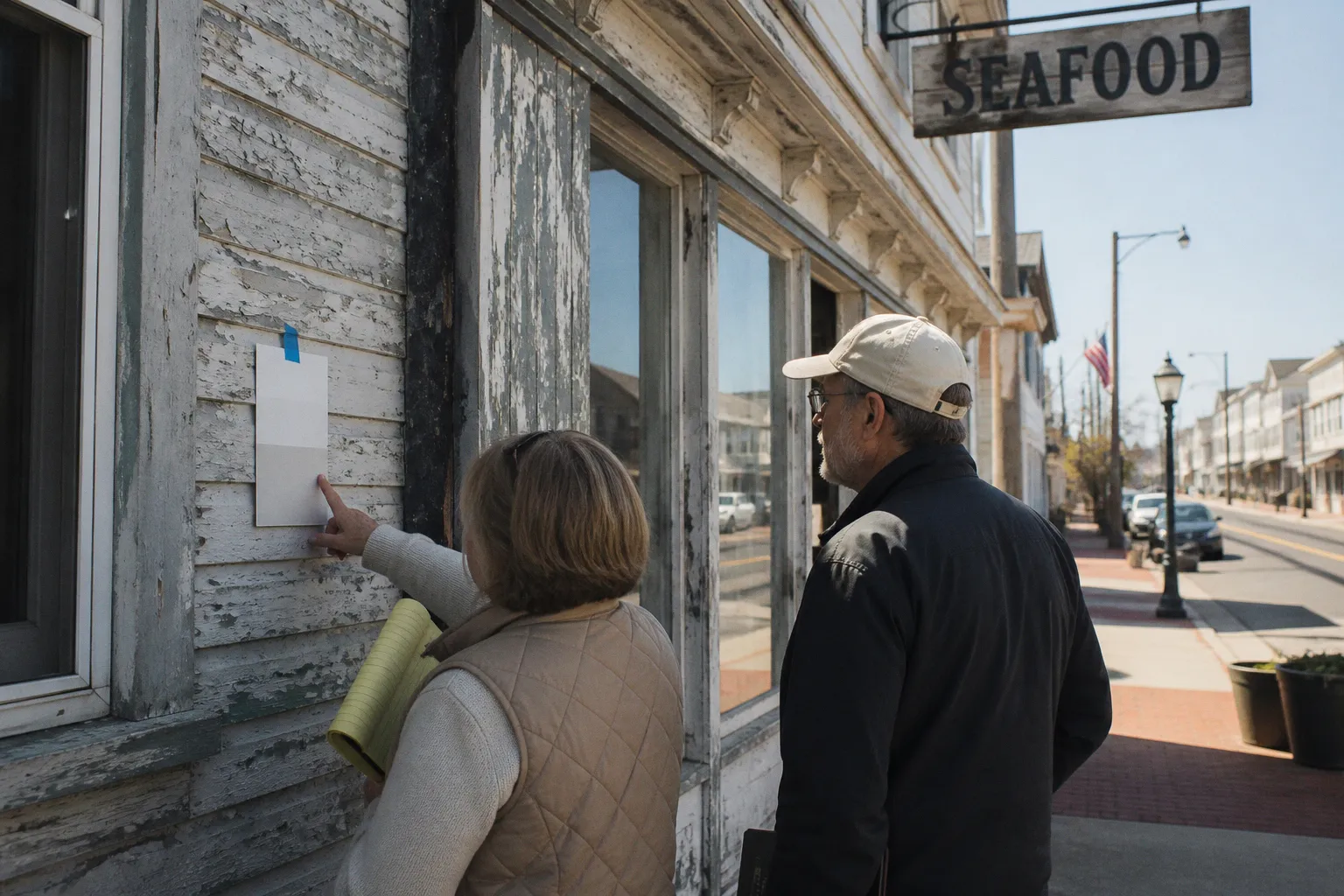
A failing façade does more than damage curb appeal: it makes a building harder to lease, weakens the commercial character of the block, and tells customers that investment has stopped at the front door.
The Maryland Façade Improvement Program and local revitalization funding can help reverse that decline. But the money does not flow to whoever submits the most enthusiastic application. It goes to applicants who clear a sequence of administrative and project-eligibility hurdles before a contractor starts work.
For a Crisfield facade improvement grant application, the order matters. Register first. Confirm the property boundary. Secure the owner’s consent. Define the exterior scope. Then assemble the match and wait for written approval.
Skip one step and the rest of the application can collapse with it.
Step One: Register on the DHCD Project Portal
The Maryland Department of Housing and Community Development runs state-level revitalization applications through the DHCD Project Portal. An active, approved portal account is the starting point for a state façade funding application. There is no paper submission that bypasses the system and no walk-in alternative that eliminates the portal review.
Registration itself is not complicated. The problem is that applicants often treat it as a quick formality, then discover that the information in the portal does not match the information in their supporting documents.
Expect roughly 72 hours from initial registration to portal approval. That is an average planning figure, not a guaranteed turnaround. An incomplete registration, a missing identification number, or an inconsistency in the business or property information can send the submission back for correction. Once that happens, the applicant has lost time and may have to wait through another review cycle.
The DHCD portal is a gate, not a shortcut. Plan around its rhythm or plan on resubmitting.
Have the basic information assembled before opening the account:
- The legal name of the business entity or applicant
- Federal tax identification information
- Contact information for the person responsible for the application
- The property address and parcel information
- The legal property owner’s name
- A clear description of the proposed exterior project
The important point is consistency. If the applicant is listed under one business name, the consent letter uses another, and the deed identifies a different owner or entity, the grant administrator has to stop and determine who is legally applying for the money. That is not a problem the reviewer can solve by inference.
Pull the deed and business records before entering the portal fields. Use the legal names as they appear in those documents rather than a shortened storefront name or a familiar trade name. If the property is owned by an LLC, partnership, trust, or individual who differs from the operating business, make that relationship clear from the beginning.
The portal account is also where the application timeline becomes real. A business owner may have spent weeks discussing windows, masonry, or signage with a contractor, but none of that work moves the application forward until the required account is active and approved. Contractors can help prepare estimates and scope descriptions, but they cannot replace the applicant’s responsibility for submitting accurate ownership and entity information.
Why the first registration matters
A portal account is not the same thing as project approval. It only establishes the applicant’s ability to enter the program’s application system. Treating registration as an award creates a dangerous timing mistake: an applicant may assume that because the project appears in the portal, construction can begin.
It cannot.
The registration stage should be used to organize the application, not to authorize work. Keep copies of the information submitted, including the entity name, contact details, and property data. If the application later requires a correction, those records make it easier to identify whether the error originated in the original registration or in a supporting document.
Step Two: Confirm That the Property Is Inside a Designated Sustainable Community
A strong project on an ineligible parcel is still ineligible. The Maryland Façade Improvement Program is tied to designated Sustainable Communities, so the property’s location must be verified before the applicant spends time developing a detailed scope or requesting contractor bids.
For Crisfield applicants, that means confirming that the commercial property falls within the designated area covering the historic downtown core and adjacent commercial corridors identified through the state’s Sustainable Communities framework. A building can be in Crisfield, serve a commercial purpose, and still fall outside the boundary used for state façade funding.
The practical move is to check the Sustainable Communities map for Somerset County through the Maryland Department of Planning. Do not rely on a general impression that a property is “downtown” or close to the eligible district. Boundary lines do not always follow the way residents describe a neighborhood. A parcel near the edge deserves particular attention.
If the online map is difficult to interpret, contact the City of Crisfield planning office and ask for confirmation of the parcel’s status. Have the street address and parcel number available. A precise question about a specific parcel is more useful than a general question about whether a neighborhood qualifies.
This verification should happen before:
- A contractor prepares a final project budget
- A tenant negotiates a consent letter with the property owner
- An applicant begins paying for design work
- A business schedules construction around an assumed award
- The owner treats a local program and a state program as interchangeable
The Sustainable Communities check is not merely a geographic detail. It determines which funding path is available and which rules govern the application. If the parcel is outside the designated boundary, the state façade route is closed for that property, regardless of how visible the deterioration may be.
That does not necessarily mean the building has no possible funding options. Crisfield may offer separate local business improvement or revitalization rounds, and those programs can have their own application forms, match requirements, eligible costs, and deadlines. But local-only funding is not a substitute for state eligibility. It is a different program.
Do not transfer assumptions from one program to another. A local round may treat signage differently from the Maryland Façade Improvement Program. It may have a different reimbursement process or require a different kind of owner authorization. Before changing the project plan, confirm which program is actually accepting applications and what it is designed to fund.
The boundary should shape the project plan
Once the parcel is confirmed as eligible, use that finding to anchor the rest of the application. Save the map result or written confirmation with the project records. If a reviewer later asks how the applicant established eligibility, the answer should be documented rather than reconstructed from memory.
This is especially important when the business occupies only part of a larger building, when several parcels make up a storefront, or when the building address used by customers differs from the legal parcel information. The grant is attached to a property and an approved project, not simply to a business name.
Step Three: Secure Property Owner Consent and Legal Documentation
A tenant-operated business may be the visible face of a storefront, but the façade belongs to the property owner. That distinction becomes decisive when grant funds are used for improvements to the building exterior.
Applicants should be prepared to show either that they are the legal owner of record or that the property owner has provided written authorization for the application and proposed work. Verbal permission is not enough. Neither is an informal message saying that the owner is “fine with the idea.” The application needs a document that identifies the parties, the property, and the project.
For a tenant, the owner-consent letter is the load-bearing document in the application package. It should identify:
- The property’s street address
- The parcel number, where required or available
- The legal name of the property owner
- The legal name of the tenant or business applicant
- The exterior improvements being proposed
- The specific grant or façade program involved
- The owner’s authorization for the tenant to apply
- The owner’s consent to the proposed work
- The signature and date of the property owner
The description of the work should be specific enough to connect the consent letter to the project scope. “Exterior improvements” is weaker than a description that names storefront window replacement, masonry repair, exterior lighting, or awning installation. If the project changes during review, update the owner authorization rather than assuming that a broad phrase covers every revision.
For an owner applying on the owner’s own behalf, the recorded deed establishes the basic legal standing. Even then, the ownership information in the application should match the supporting documents. Properties held through an entity can require additional care because the person signing the application may not be the same person named as the property owner. The application should make clear why the signer has authority to act for that entity.
A consent letter can be returned for correction if it is missing a signature, omits the project scope, names the wrong entity, or refers to a different program. These are avoidable delays, but they are common because applicants often treat the letter as a courtesy rather than as part of the legal foundation of the project.
Coordinate consent with the construction scope
Owner consent should be obtained after the proposed work is concrete enough to review, but before the application is submitted. The owner should know whether the work involves removing existing windows, altering masonry, installing lighting, changing an awning, or modifying signage. Those choices affect the building, the contractor’s methods, and sometimes the owner’s future maintenance obligations.
A tenant should also confirm who will handle:
- Contractor access to the property
- Temporary closure of the storefront
- Removal and storage of existing materials
- Permits or approvals that may be required
- Ongoing maintenance after the grant-funded work is completed
The grant application may not resolve every landlord-tenant issue. That is precisely why the owner’s written consent should not be reduced to a one-line approval. It establishes that the owner understands the project and authorizes the tenant to pursue funding for improvements to the property.
Step Four: Define Eligible Exterior Capital Improvements
The most important scope question is simple: what exactly will the grant pay for?
Eligible façade expenses are generally tied to street-facing exterior capital improvements. The work should improve the building’s visible exterior and represent a meaningful investment in the façade rather than ordinary upkeep. Typical eligible categories include storefront reconstruction, window and door upgrades, signage, exterior lighting, awnings, painting connected to a capital improvement, and masonry repair on the street-facing elevation.
The word “capital” does real work here. A project is not eligible simply because it takes place outdoors or makes the building look better. Routine maintenance and general building repairs can remain outside the program even when they are necessary.
The line is easiest to see through examples:
| Project Type | Likely Treatment Under the Façade Program |
|---|---|
| Replacement of deteriorated storefront windows | Eligible exterior capital work |
| Interior drywall, flooring, or display-area renovation | Ineligible interior work |
| Tuckpointing on a street-facing masonry wall | Eligible façade repair |
| Repainting an already sound painted surface | Generally routine maintenance |
| Replacement of deteriorated wood trim | Eligible capital improvement |
| New awning installation | Eligible exterior improvement |
| Roof replacement unrelated to the storefront elevation | Ineligible under a façade-only scope |
| Exterior lighting fixture upgrades | Eligible when tied to the façade |
| HVAC, plumbing, or general electrical service upgrades | Ineligible building-system work |
The table is a starting point, not a substitute for written program guidance or administrator review. A project that combines eligible and ineligible items should be separated clearly in the scope and budget. Do not place the entire project under a vague label such as “building renovation.” That makes it harder for the reviewer to determine which costs are being requested and easier for an otherwise eligible project to become confused with an ineligible one.
Capital improvement versus routine maintenance
Consider a storefront with deteriorated wood trim. Repainting sound trim may be routine maintenance. Removing rotted trim, replacing it with new material, and then applying a finish as part of that restoration is a capital improvement. The finish is connected to the eligible repair rather than being a stand-alone request to refresh an otherwise intact surface.
The same reasoning applies to masonry. Tuckpointing failing joints on the street-facing wall is different from applying a new color to sound masonry. Painting restored masonry can be part of the repair, while repainting an unchanged wall may be treated as maintenance.
The application should explain that connection. A reviewer should be able to see:
1. What condition exists now
2. What physical work will correct it
3. Which portion of the work is a capital improvement
4. How the proposed finish or fixture supports that improvement
5. Which costs are being excluded from the grant request
That level of detail does not require a long architectural report. It requires a scope that matches the building. “Improve appearance” is too broad. “Remove deteriorated storefront trim, replace with matching exterior material, and finish the restored trim” gives the reviewer something concrete to evaluate.
Keep the façade scope facing the public realm
The strongest application usually has a disciplined boundary. Work visible from the street belongs at the center of the narrative. Work behind the storefront glass, in a rear service area, or inside the building should be identified separately, even if it is part of the same construction contract.
This is where applicants often get into trouble with mixed bids. A contractor may price windows, interior framing, electrical upgrades, flooring, and painting in one package. The grant application should not simply attach the full bid and expect the administrator to sort it out. Request a line-item estimate that distinguishes eligible façade improvements from unrelated work.
A clean budget can show:
- Eligible storefront or façade work
- Ineligible interior or building-system work
- Applicant-funded extras
- Any contingency or allowance
- The total project cost
- The amount requested from the program
- The applicant’s matching contribution
Separating the costs at the beginning prevents a later dispute over whether the grant is being used to subsidize work outside the program.
Step Five: Manage the Match and Wait for Written Approval
Maryland façade programs operate on a matching-fund model. The baseline expectation described in the draft program framework is a 1:1 match: the grant reimburses half of eligible project costs, while the applicant provides the other half. The applicant’s share may come from business funds, a private loan, or a separate local award, including a possible stacked contribution from the City of Crisfield where the applicable program permits it.
Some Crisfield-specific rounds may offer enhanced matching terms for properties or applicants that meet additional criteria. Do not assume that a local match changes the state program’s rules. Confirm the terms of the specific funding round and identify whether the local contribution can be used alongside state funds.
The match is not just a number in the application. It is a cash-flow obligation that continues through construction and reimbursement.
A contractor’s bid can change. Materials can become more expensive. Hidden deterioration may appear after old trim or masonry is removed. If the total cost rises, the applicant may be responsible for covering the increase, particularly when the overrun affects the applicant’s matching share or falls outside the approved scope.
Get firm written bids before submitting the application. The contractor should understand the difference between the grant-funded work and any additional work the owner wants completed at the same time. A contractor who says, “We can sort out the details after approval,” is leaving the applicant to carry the risk.
Build the budget around reimbursement, not the award headline
A grant award is not necessarily an advance payment. The applicant may need to pay eligible project costs, document the work, submit the required invoices and proof of payment, and then receive reimbursement according to the program’s procedures.
That means the budget should answer practical questions before the application is filed:
- Who will pay the contractor initially?
- Is the applicant able to cover the matching share and any timing gap?
- What happens if reimbursement follows inspection or documentation review?
- Which costs are included in the approved scope?
- What happens if the contractor proposes a change order?
- Will a local grant be available at the same stage of the project?
The exact reimbursement schedule depends on the funding round and its written requirements. Applicants should not treat a general expectation about timing as a promise of immediate payment. Ask the grant administrator what documentation is required, whether progress payments are possible, and when the reimbursement clock begins.
No reimbursement letter, no reimbursement. Every dollar spent before written approval is a dollar you may not see back.
The pre-approval rule is not negotiable
The most expensive mistake is starting work early.
Construction, demolition, material purchases, or other project activity completed before formal approval and an official award or commitment letter may be ineligible for reimbursement. Good intentions do not change that rule. Neither does the fact that the work would have qualified if the applicant had waited.
If a contractor removes the storefront before the award is issued, that work can become the applicant’s responsibility. If a masonry crew begins grinding out joints before written authorization, the project may be exposed to the same problem. Even a small early action can complicate the administrator’s ability to verify existing conditions and confirm that public funds are being used for approved work.
The safe sequence is:
1. Submit the application with the required ownership, location, scope, and budget documentation.
2. Respond to review questions and make corrections.
3. Receive written project approval and the official award or commitment documentation.
4. Confirm any required pre-construction conditions.
5. Only then authorize the contractor to begin approved work.
Do not confuse a conversation with a city employee, a contractor’s expectation, or a portal submission confirmation with an award. Written approval is the line that matters.
The Application Calendar: What the Dates Actually Mean
The previous local Crisfield business grant window closed on November 29, 2024. The Maryland Façade Improvement Program Guidelines were updated in May 2025. The FY2028 State Revitalization Programs application window opened on June 22, 2026, and closed on August 6, 2026.
As of August 14, 2026, that FY2028 window has already closed. It should not be described as an upcoming opportunity or used as a current open-application deadline. Applicants who were preparing materials for that round should preserve their portal records, ownership documents, project scope, and contractor bids in case the administering agency requests follow-up information. Applicants who did not submit before August 6 should watch for the next announced funding round rather than assuming that the FY2028 portal remains available.
The closed window still matters for planning. It shows why the application process has to begin before a deadline appears on the calendar. A property owner who waits until the final days may still need to:
- Register and obtain portal approval
- Resolve a mismatch in entity or deed information
- Verify the Sustainable Communities boundary
- Obtain a signed consent letter
- Separate eligible and ineligible work
- Get a firm contractor bid
- Demonstrate the matching funds
- Review the project for pre-approval restrictions
None of those tasks becomes easier because the deadline is close.
For the next round, rely on the current program announcement and written guidance rather than carrying forward assumptions from FY2028. Match ratios, eligible categories, required documents, and submission dates can change between rounds. A prior application is useful as an organizational template, not as a permanent rulebook.
The Physical Reality Behind the Paperwork
Every one of these steps exists because the grant administrator has to answer a basic question: is public money being used for an eligible project at an eligible property, with the legal owner’s knowledge and the applicant’s ability to complete the work?
The portal registration confirms who is applying. The Sustainable Communities check confirms that the property is within the program’s intended geography. The owner-consent document prevents a tenant-led improvement from becoming a landlord dispute. The eligible-scope review distinguishes a façade investment from ordinary maintenance or unrelated renovation. The matching-fund requirement shows that the applicant has a financial stake in completing the project. The pre-approval rule prevents the program from reimbursing work that began before anyone had reviewed or authorized it.
That is not bureaucratic decoration. It is the operating structure of a public funding program.
A contractor may be focused on whether the masonry is sound enough to repair, whether a window can be ordered, or whether the storefront can remain open during construction. Those questions matter, but they do not replace the administrator’s questions. A beautiful awning does not cure an ownership mismatch. A signed contract does not create grant eligibility. A building that urgently needs a new roof may still have no eligible roof cost under a façade-only program.
The strongest application respects both realities: the physical condition of the building and the administrative conditions attached to the money.
Start with the portal and use the legal information, not the informal version. Confirm the parcel before paying for a detailed scope. Get the property owner’s consent in writing. Separate capital façade work from maintenance, interior renovation, and building systems. Build the match into the cash-flow plan. Then wait for the written approval before the first truck arrives.
Crisfield’s downtown blocks will not tuckpoint themselves, and a closed funding window will not reopen because a project is urgent. The next opportunity will reward applicants who have already done the unglamorous work: accurate documents, a defensible scope, a realistic budget, and patience at the point where public money requires permission before construction begins.