Boston Proposes Streamlined Zoning for Small-Scale Clean Energy Projects
Per the City of Boston, the Planning Department this month recommended approval of new zoning for Small Clean Energy Infrastructure, advancing the measure to the Boston Zoning Commission.
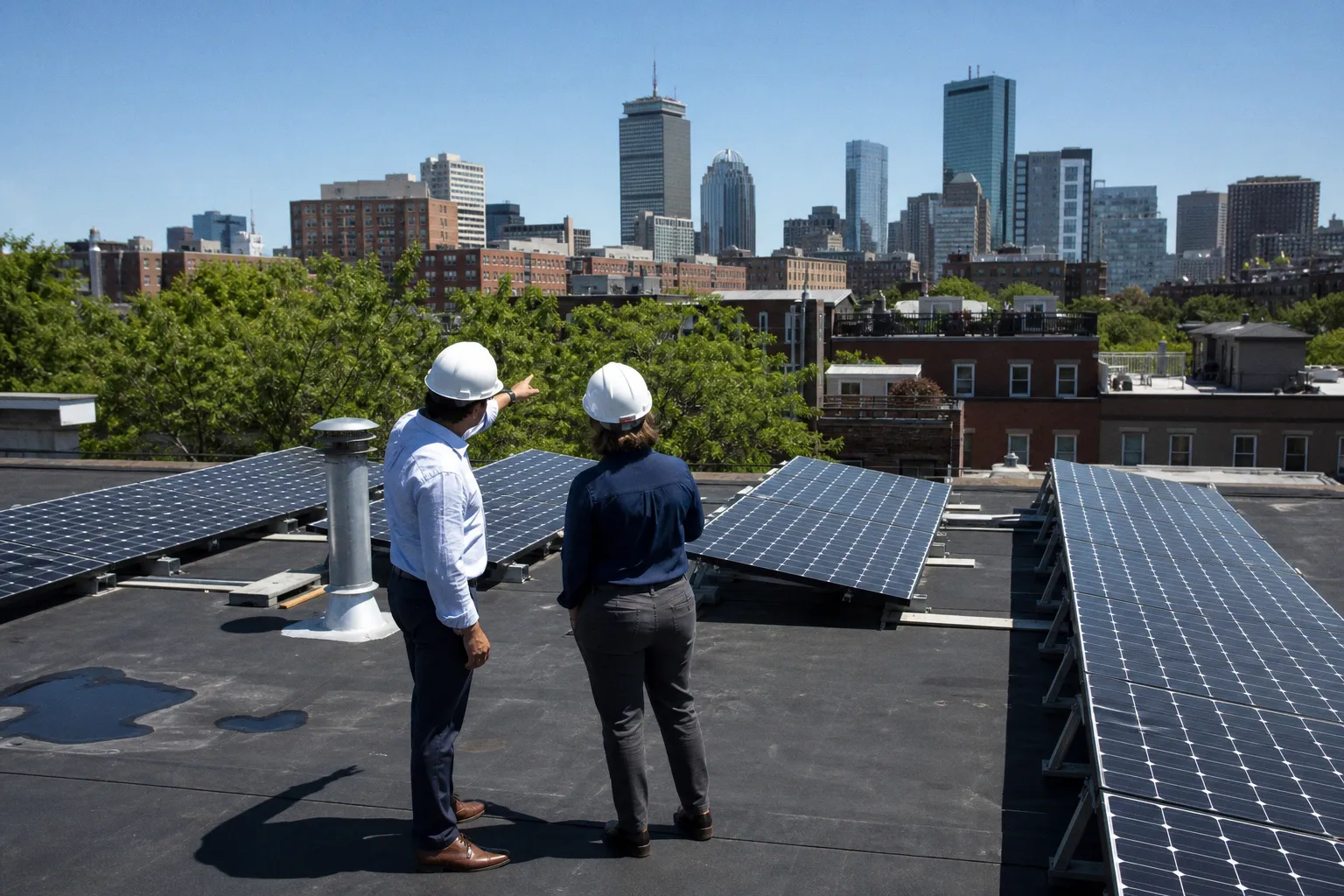
Planning Advances New Zoning for Small Clean Energy Infrastructure
The action establishes a Consolidated Local Permitting pathway authorized by Massachusetts statute, which requires every municipality in the state to provide an opt-in consolidated permitting process for qualifying infrastructure by October 1, 2026.
The statutory trigger and compliance window
The zoning responds to a direct state mandate. Under Massachusetts law, cities and towns must establish an opt-in consolidated permitting process for small clean energy infrastructure no later than October 1, 2026. Boston's draft text aligns with the energy resilience objectives of the city's 2030 Climate Action Plan and its stated goal of transitioning Boston's energy supply to fully electric over the coming decades. A consolidated process replaces the fragmented sequence of separate board, zoning, and inspections reviews that historically applied to solar arrays, wind installations, and storage facilities. Statutory compliance does not itself grant approval; final adoption rests with the Boston Zoning Commission.
What the draft text actually covers
The proposed zoning enumerates four infrastructure categories: solar panels, wind energy turbines, battery energy storage systems (BESS), and short energy transmission lines. For BESS specifically, the draft introduces codified dimensional and use regulations where prior zoning text carried no corresponding parameters. Each category falls under the Consolidated Local Permitting process, replacing the prior fragmented review sequence across categorical approvals.
Adjacent to the zoning action, the same Planning Department session recommended approval of four separate development projects totaling approximately 398,998 square feet, including 329 new housing units — 137 of them income-restricted — and supporting roughly 359 construction jobs. Those approvals advanced through the same Planning agenda but are independent of the clean-energy zoning text.
What Somerset County readers should verify
Neighboring Charles County's planning board this month opened a review of subdivision regulation changes, confirming that subdivision and infrastructure text remains in active motion across Southern Maryland. For Somerset County residents tracking local precedent, the Boston action is the most concrete comparable model currently on record. Three checkpoints apply when any local jurisdiction publishes parallel text:
- Setback and easement delineations. Confirm whether the draft specifies BESS setbacks from property lines, dwellings, and public rights-of-way, and whether transmission-line easements are explicitly mapped in the easement record.
- Permitting consolidation. Verify that the proposed process consolidates reviews under a single lead agency rather than stacking separate approvals from zoning, building, and inspections.
- Dimensional and use alignment. Check lot-coverage thresholds, height limits, and use-category assignments against the state climate plan targets the jurisdiction cites as authority.
Absent published Somerset County or Maryland statewide text on these categories, the Boston ordinance functions as a benchmark for the mechanical questions Maryland planners will face: how to define BESS setbacks, how to sequence consolidated permitting, and how to align local dimensional rules with state-level climate obligations. Under the Massachusetts framework, the Zoning Commission's vote — not Planning's recommendation — is the operative compliance event.